A & J Demière
A & J Demière is a family Champagne producer in Fleury-la-Rivière, on the right bank of the Vallée de la Marne. The family dates its winegrowing activity to 1936, when Fernand Demière bought the first vines. His son Jack joined the domaine in the 1950s and…
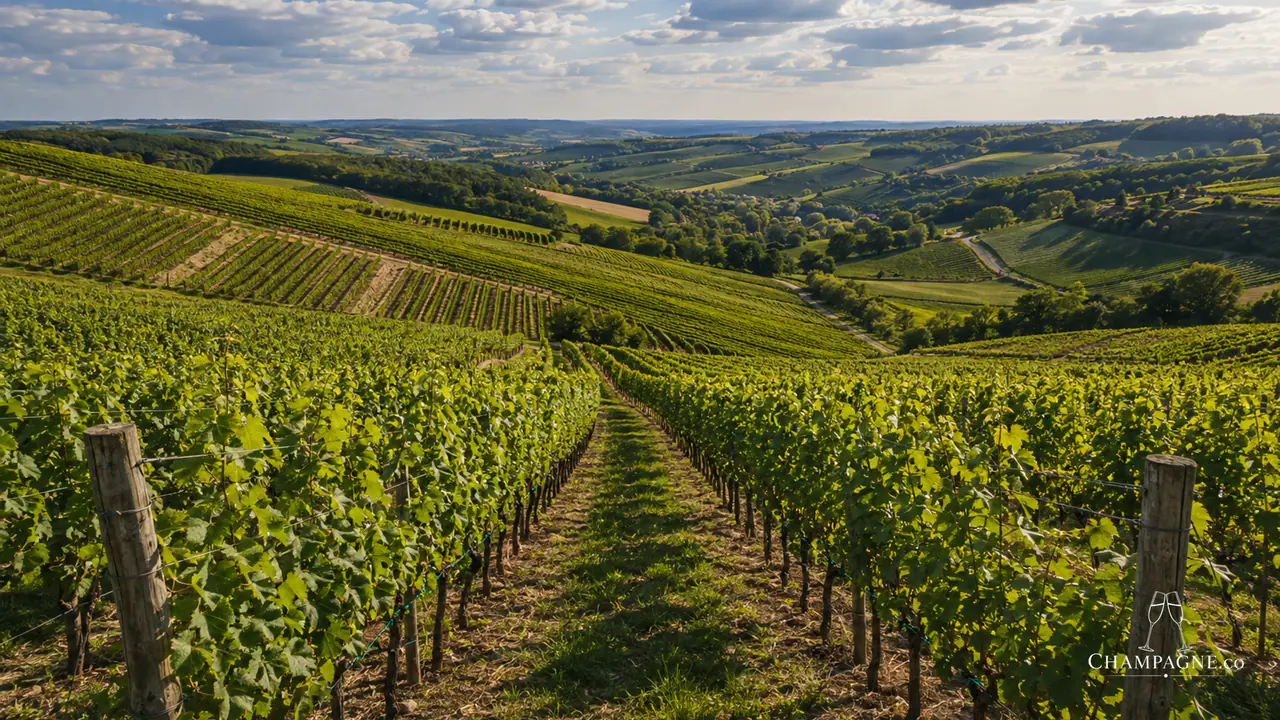
Editorial profile
A & J Demière is a family Champagne producer in Fleury-la-Rivière, on the right bank of the Vallée de la Marne. The family dates its winegrowing activity to 1936, when Fernand Demière bought the first vines. His son Jack joined the domaine in the 1950s and expanded the business, while Audrey and Jérôme, the third generation, took charge in the early 2000s and formed A & J Demière in 2003.
The producer works with Meunier, Pinot Noir and Chardonnay and has built a range that combines traditional multi-variety Champagne with Meunier-focused wines, long-running reserve programmes and vintage parcel bottlings. Current cellar material points to traditional pressing, the use of barrels, larger oak vessels and concrete ovoïdes, as well as maturation in the village's troglodyte cellars.
Why this producer matters
A & J Demière is particularly useful for understanding how a family grower can organise a range around several different expressions of Meunier without making every wine a single-variety cuvée. The house's Solera 23 programme dates back to a reserve begun in vat No. 23 in 1978, while the more recent Symbole wines move in a different direction by isolating particular sites and vintages.
That gives the range a clear progression: broader house blends sit alongside Meunier-led wines, vintage releases and parcel-specific bottlings. The producer's current catalogue therefore offers both an accessible view of the domaine and more narrowly defined wines for readers interested in site, vintage or cellar method.
House and vineyard identity
The domaine is based in Fleury-la-Rivière, a Vallée de la Marne village where Meunier has an important role alongside Pinot Noir and Chardonnay. The family history begins with Fernand Demière in 1936, continues through Jack Demière, and today centres on Audrey and Jérôme, with the next generation also involved in the business.
The producer describes its work as family-run and independent. Its current public material places particular emphasis on careful parcel work and on a combination of established cellar techniques and experimental vessels rather than on a single fixed recipe applied across the range.
Winemaking and cellar approach
A & J Demière uses traditional Champagne presses and works with several maturation vessels, including barrels, larger oak containers and concrete ovoïdes. The producer also highlights maturation in troglodyte cellars at Fleury-la-Rivière.
One of the house's most distinctive long-term cellar projects is Solera 23. The reserve began in vat No. 23 in 1978 and is refreshed with young Meunier wine in suitable years rather than being presented as a simple one-year blend. Elsewhere in the range, the producer uses more release-specific approaches. For example, the current Symbole 2018 La Côte du Diable page identifies a first-press selection, eight months in a 10-hectolitre oak vessel, tirage under cork and zero dosage for that named release.
These details are best read wine by wine: they illustrate the range of methods available to the domaine, but they are not permanent specifications for every A & J Demière Champagne.
Champagne.co analysis
The most revealing way to approach A & J Demière is to look at the contrast between continuity and experimentation. Solera 23 is built around a reserve started decades ago, while the Symbole project narrows the focus to a particular vintage and parcel. Between those two poles sit the broader house wines and vintage Lysandre releases.
That structure makes the producer more interesting than a simple "Meunier specialist" label would suggest. Meunier is central to some of its most distinctive wines, but the catalogue also uses Pinot Noir and Chardonnay and does not force every cuvée into the same stylistic template. The result is a range in which reserve age, grape choice, parcel origin and vessel can each become a different way of defining a wine.
Buying guidance
- For a first look at the producer: start with one of the broader Divin wines before moving into the more specialised releases.
- For the house's long-running reserve concept: Solera 23 is the key reference point and is distinct from a conventional single-base non-vintage blend.
- For Meunier: E'grég'Or and selected Blanc de Meuniers bottlings provide a direct route, while Solera 23 shows Meunier through a multi-year reserve approach.
- For vintage comparison: treat each Lysandre year separately rather than assuming the same blend or cellar specification across vintages.
- For parcel specificity: Symbole is the most targeted part of the range; check the exact named vintage and lieu-dit when buying because its technical details are release-specific.
Loading current Champagne range…
Spotted something wrong? Report a correction
Every report goes to a human review queue. Nothing on this page changes automatically.