A. Bergère
A. Bergère is a family Champagne grower rooted in Fèrebrianges in the Vallée du Petit Morin. The family traces its local winegrowing history to 1848, while Albert Bergère founded the A. Bergère Champagne marque in 1949. André Bergère expanded the vineyard…
Editorial profile
A. Bergère is a family Champagne grower rooted in Fèrebrianges in the Vallée du Petit Morin. The family traces its local winegrowing history to 1848, while Albert Bergère founded the A. Bergère Champagne marque in 1949. André Bergère expanded the vineyard base after taking over the domaine in 1986, and Adrien Bergère, a trained oenologist, assumed responsibility for winemaking in 2014.
The modern domaine combines a substantial estate-vineyard base with a deliberately parcel-focused cellar programme. Its holdings extend beyond the Vallée du Petit Morin into the Sézannais and the Côte des Blancs, giving the range access to several distinct Chardonnay terroirs as well as Pinot Noir and Meunier sites.
Why this producer matters
- The domaine currently states that it owns 45 hectares divided across 139 vineyard plots.
- About 35 hectares are in Fèrebrianges, Étoges and Congy in the Vallée du Petit Morin, with the remainder divided between the Sézannais and Côte des Blancs.
- The estate records a vineyard mix of approximately 70% Chardonnay, 20% Pinot Noir and 10% Meunier.
- Almost 12 hectares are described by the producer as organically farmed; that is kept distinct from any claim that the entire domaine is certified organic.
- Separate vinification of individual plots has been central to Adrien Bergère's cellar approach since 2014.
- The current range extends beyond blended house Champagne to single-parcel wines, Petit Meslier, Coteaux Champenois and Ratafia Champenois.
House and vineyard identity
A. Bergère remains a family-controlled domaine with its historical centre in Fèrebrianges. Current family material identifies Adrien and Annaëlle as the generation carrying the business forward, with Adrien responsible for winemaking. The producer also maintains a consumer-facing presence at 38–40 Avenue de Champagne in Épernay, an address independently listed by Comité Champagne.
The domaine's scale is significant for a grower producer but should not obscure its parcel-led direction.
Vineyards and terroir
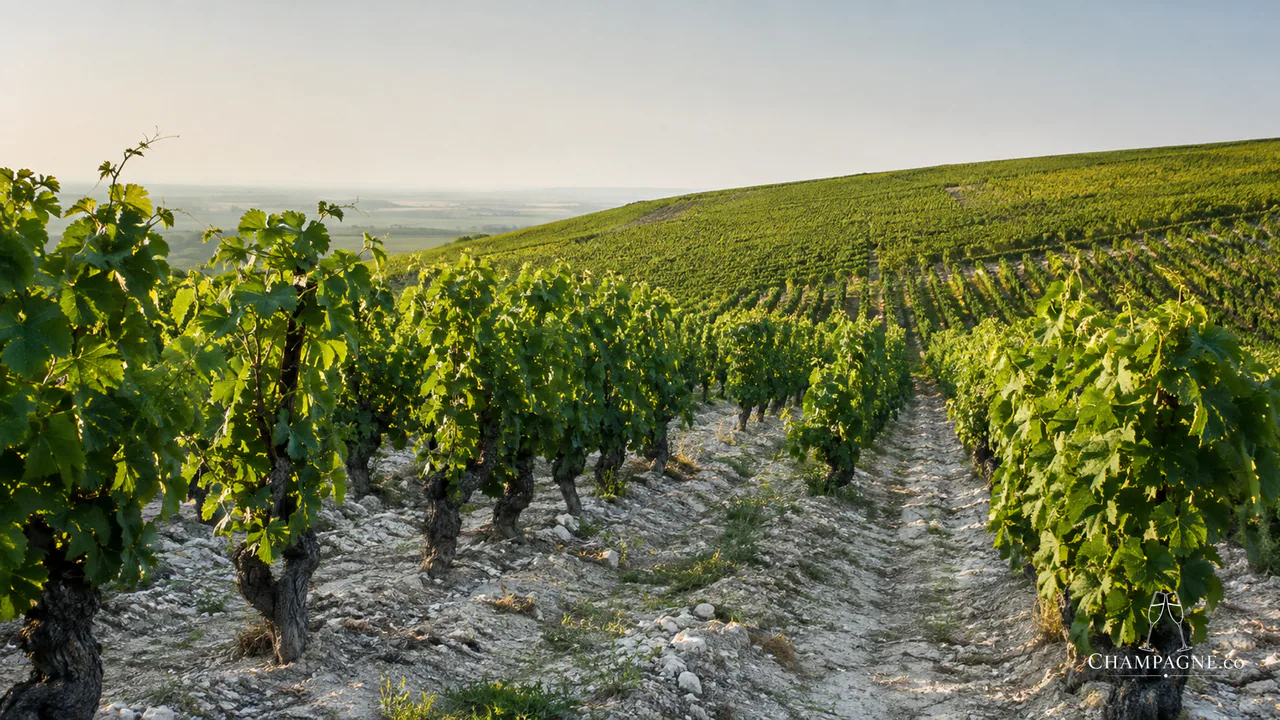
The producer's current vineyard information records 45 hectares in total. Roughly 35 hectares are located in Fèrebrianges, Étoges and Congy in the Vallée du Petit Morin. The remaining ten hectares are divided between Sézanne and Bethon in the Sézannais and Côte des Blancs villages including Avize, Le Mesnil-sur-Oger, Chouilly, Cramant and Oger.
Across 139 plots, the domaine records an overall planting mix of approximately 70% Chardonnay, 20% Pinot Noir and 10% Meunier. Its current vineyard page also states that almost 12 hectares are organically farmed. The wider estate is described through responsible and sustainable viticulture rather than as wholly organic.
Winemaking and cellar approach
Since Adrien Bergère joined the domaine in 2014, individual plots have been vinified separately before blending. The producer says fermentation may be spontaneous or assisted by yeasts selected from its vineyards, followed by malolactic fermentation. Depending on the wine, maturation can take place in stainless steel, barrels or larger foudres.
The house also states that its blending process is carried out without refrigeration, fining or filtration. Taken together, those choices make vineyard origin increasingly important to the way the range is organised, particularly in the parcel wines.
Champagne.co analysis
A. Bergère is best understood as an estate-led grower with enough vineyard scale to work across several Champagne sub-regions while still pursuing increasingly precise parcel expression. The domaine's 45 hectares and 139 plots give it breadth, but the more distinctive development is the separation of sites and varieties since Adrien Bergère took over winemaking in 2014.
For readers, that creates two useful entry points. The core wines show the broader Petit Morin identity of the estate, while bottles such as Les Peignottes, Les Vignes de Nuit, Les Clos and Petit Meslier make individual site or grape identity much more explicit. The result is a range that can be approached either as a substantial family grower domaine or as a source of increasingly specific terroir-led bottlings.
Buying guidance
- Start with the house style: Origine Brut provides the clearest introduction to the domaine's Petit Morin base.
- For parcel specificity: Les Peignottes, Les Vignes de Nuit and Les Clos are the most direct expressions of named sites and should remain distinct in the catalogue.
- For unusual grape interest: Petit Meslier is a separate 100% varietal bottling in the current range.
- For mature releases: Oenothèque bottles should be represented with exact vintage and release provenance.
- Beyond Champagne: Coteaux Champenois and Ratafia are part of the producer's wider output but should remain outside the Champagne AOC sparkling-wine count.
Loading current Champagne range…
Spotted something wrong? Report a correction
Every report goes to a human review queue. Nothing on this page changes automatically.