A. Limar
A. Limar is the young Champagne project of Alexis Limar, based in La Neuville-aux-Larris in the Vallée de la Marne. The current business was established at the end of 2023, when Limar took over family vineyard activity after training at the Viti Campus in…
Editorial profile
A. Limar is the young Champagne project of Alexis Limar, based in La Neuville-aux-Larris in the Vallée de la Marne. The current business was established at the end of 2023, when Limar took over family vineyard activity after training at the Viti Campus in Avize.
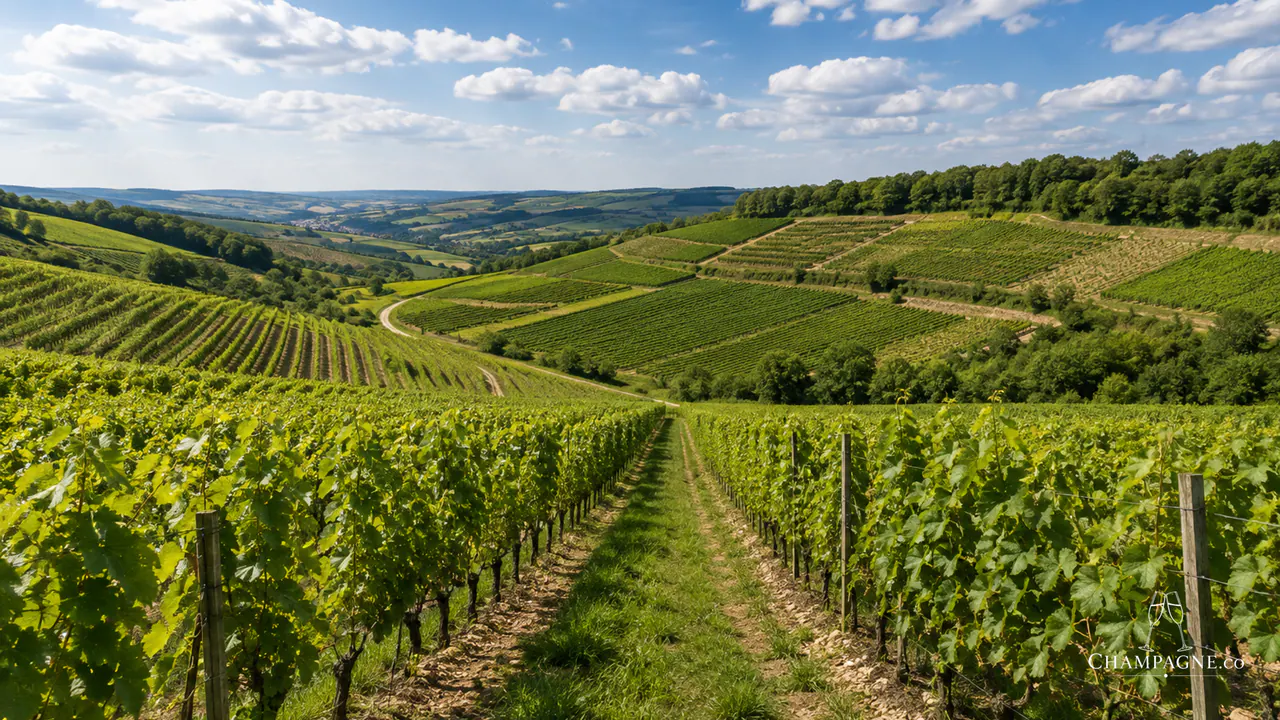
The domaine is small, with around three hectares reported across La Neuville-aux-Larris, Cuchery, Belval-sous-Châtillon and Mailly-Champagne. Pinot Noir, Meunier and Chardonnay are all represented. Because the project is recent and its own technical archive is still limited, the most useful way to present A. Limar is through the facts that can be consistently established rather than by treating every early-release specification as a permanent house rule.
Why this producer matters
A. Limar belongs to a new generation of very small growers whose first commercial identity is still taking shape. The interest lies partly in watching that evolution happen in real time: the domaine combines family vineyard continuity with a new producer name, a compact range and a growing emphasis on individual wines rather than a long inherited catalogue.
Its vineyard spread also matters. Most reported holdings are in the Vallée de la Marne, while Mailly-Champagne provides a foothold in the Montagne de Reims. That does not make the domaine as a whole Grand Cru; classification attaches to the relevant cru and wine context, not automatically to every bottle carrying the producer name.
Vineyard and cellar identity
The domaine works roughly three hectares and all three principal Champagne varieties. Current specialist documentation consistently places its vines in La Neuville-aux-Larris, Cuchery, Belval-sous-Châtillon and Mailly-Champagne.
Alexis Limar is reported to favour manual vineyard work and to avoid herbicides and pesticides. In the cellar, current documentation describes spontaneous fermentation, no fining or filtration, and a shift from stainless steel toward small Burgundy barrels for fermentation and ageing from the 2023 harvest onward. These practices help explain the direction of the project, but exact vessel, dosage and ageing details still need to be read release by release.
Champagne.co analysis
A. Limar is more interesting as an emerging producer than as a finished stylistic proposition. The small vineyard base, recent formal start and limited number of releases mean that its identity is still being defined bottle by bottle. That makes precision especially important: broad claims about a permanent "house style" would be premature.
The clearest thread so far is a preference for small-scale, low-intervention work and a range that increasingly foregrounds vineyard and cuvée identity. For readers interested in new grower Champagne, A. Limar is therefore a producer to follow through successive releases rather than one to reduce to a single headline wine or fixed cellar formula.
Buying guidance
- For the clearest introduction: Nos Terres Amoureuses is the most consistently documented entry point in the current range.
- For comparing the domaine's development: look at different releases side by side and check the exact vintage or base year rather than assuming the same recipe each time.
- For site-specific interest: Le Haut des Chapelleries is the most obviously parcel-signalled name in the current small catalogue.
- For technical detail: verify grape mix, dosage, vessel and disgorgement on the exact release because the domaine is young and its winemaking choices are still evolving.
Loading current Champagne range…
Spotted something wrong? Report a correction
Every report goes to a human review queue. Nothing on this page changes automatically.