A. Margaine
Champagne A. Margaine is a family grower in Villers-Marmery, a Premier Cru village on the Montagne de Reims where Chardonnay is unusually dominant. The current domaine is run by Arnaud and Mathilde Margaine, father and daughter. Club Trésors de Champagne…
Editorial profile
Champagne A. Margaine is a family grower in Villers-Marmery, a Premier Cru village on the Montagne de Reims where Chardonnay is unusually dominant. The current domaine is run by Arnaud and Mathilde Margaine, father and daughter. Club Trésors de Champagne dates the house to 1910, while the producer traces its family winegrowing roots further back into the 18th century.
The estate currently states that it farms 10 hectares across 48 parcels, planted approximately 90% Chardonnay and 10% Pinot Noir. That makes A. Margaine a useful counterpoint to the Pinot Noir-dominated image of the Montagne de Reims: its identity is built primarily around Chardonnay from Villers-Marmery.
Why this producer matters
A. Margaine's significance comes from the combination of place and range structure. Villers-Marmery is a Chardonnay enclave on the eastern Montagne de Reims, and the estate works that identity through blended wines, Blanc de Blancs, lower-dosage cuvées, a perpetual-reserve wine and vintage releases.
The current vineyard scale is also material. The producer's own site now reports 10 hectares and 48 parcels, larger than the older seven-hectare snapshot still carried by Club Trésors de Champagne. For current editorial purposes, the producer's live vineyard figure is the better representation of the estate today.
Vineyards and terroir
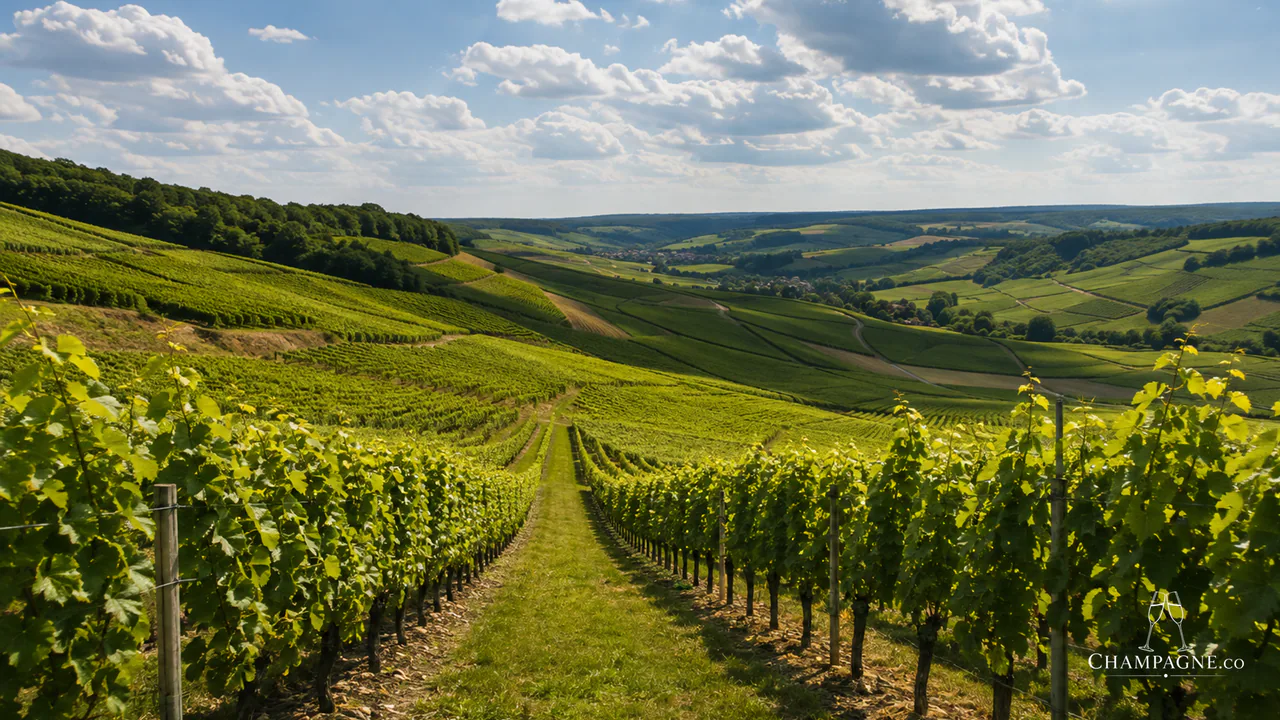
The domaine's current vineyard page lists 10 hectares, 48 parcels, 90% Chardonnay and 10% Pinot Noir. Its parcels are concentrated in Villers-Marmery, whose south and south-east exposures and chalk-based soils help explain why Chardonnay has such a strong local presence despite the village's Montagne de Reims location.
The producer describes a parcel-by-parcel approach in both vineyard and cellar. That matters because A. Margaine's wines are not all made to one fixed technical formula: malolactic fermentation, use of oak, reserve-wine composition and dosage differ between cuvées and releases.
Winemaking and cellar approach
Current producer material shows a deliberately flexible cellar rather than a single house recipe. Malolactic fermentation is often blocked or only partly completed, depending on the wine. Ageing may take place in tank or wood, and the proportion of oak varies by cuvée.
For example, the current Le Brut page identifies a 2021 base with 70% reserve wine and 70% of the blend without malolactic fermentation. L'Extra-Brut is listed as 100% Chardonnay from a 2021 base, with 30% oak and no malolactic fermentation. La Cuvée M uses a perpetual reserve and is currently described as stainless-steel vinified with partial malolactic fermentation. These are release-specific facts and should not be generalized across the whole domaine.
Champagne.co analysis
A. Margaine is best understood through Villers-Marmery rather than through a generic Montagne de Reims label. Chardonnay is the estate's dominant grape, and the range uses different cellar decisions to show that material in several forms: the core Brut, a lower-dosage Blanc de Blancs, the perpetual-reserve Cuvée M and vintage wines.
That makes the range particularly useful for readers who want to compare how reserve age, dosage and malolactic choices can alter the presentation of Chardonnay from the same village.
Buying guidance
- For the clearest introduction: Le Brut gives the broadest view of the domaine's Chardonnay-led Villers-Marmery identity.
- For a drier Blanc de Blancs: L'Extra-Brut is the obvious comparison point, with the current release at 3 g/L dosage.
- For reserve complexity: La Cuvée M is the key wine because its identity is built around the producer's perpetual-reserve programme.
- For rosé: distinguish Le Rosé, an assemblage rosé, from Le Rosé de Saignée, a vintage maceration wine.
- For vintage prestige: Millésimé and Spécial Club should be bought with the exact vintage and release information in view rather than as fixed non-vintage styles.
Loading current Champagne range…
Spotted something wrong? Report a correction
Every report goes to a human review queue. Nothing on this page changes automatically.