Alexandre Chaillon
Alexandre Chaillon is a new-generation grower based in Aÿ-Champagne whose vineyards lie mainly on the Coteaux Sud d’Épernay, especially around Brugny, Pierry and Vaudancourt. An engineer by training, he returned in 2017 to work his mother's Vollereaux…
Editorial profile
Alexandre Chaillon is a new-generation grower based in Aÿ-Champagne whose vineyards lie mainly on the Coteaux Sud d’Épernay, especially around Brugny, Pierry and Vaudancourt. An engineer by training, he returned in 2017 to work his mother's Vollereaux family vineyards and has since developed a small, parcel-conscious Champagne range under his own name.
Chaillon's farming transition is unusually well documented. In a 2021 Association des Champagnes Biologiques record, he states that he began converting his 11-hectare domaine to organic farming in 2017, staggering the conversion of different parcels across three years. The same association described him in 2024 as a vigneron bio and noted his engagement in organic certification since 2017.
Why this producer matters
Chaillon's project is young enough that the wines are still defining the domaine's identity, but the direction is clear: site, vessel and low dosage matter more than a single fixed house recipe. The range moves from Vitrail, a broader multi-site blend, toward wines associated with particular sectors around Brugny and Pierry.
Current specialist documentation reports plantings of roughly 59% Chardonnay, 23% Pinot Noir and 18% Meunier. In the cellar, 228- and 300-litre barrels and sandstone eggs are used for fermentation and ageing. These figures and methods help describe the domaine today, while exact blend, dosage and vessel remain release-specific.
Vineyards and farming
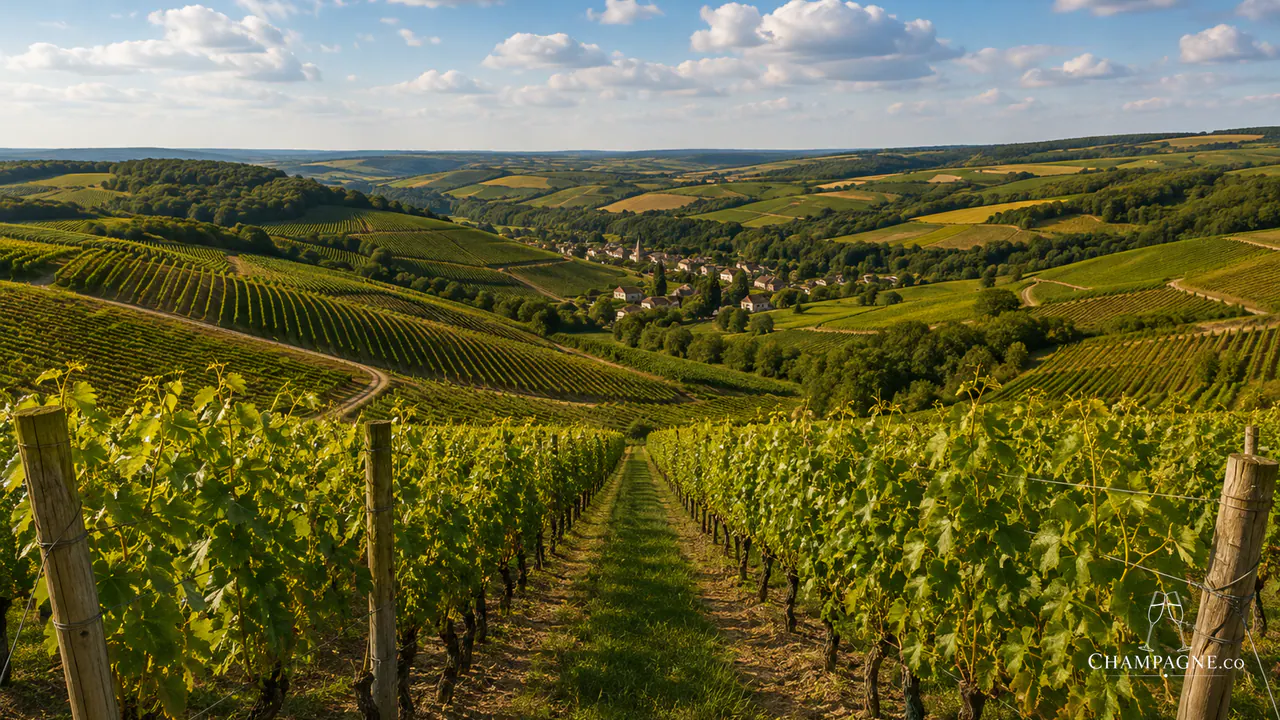
The vineyard base is concentrated south of Épernay, with parcels around Brugny, Pierry and Vaudancourt on a mix of limestone, marl and clay. Chaillon's own 2021 account records the start of a phased organic conversion in 2017, with the whole domaine expected to produce organic grapes by 2022. By 2024 the Association des Champagnes Biologiques was referring to him as an organic grower.
A current Wine Scholar Guild profile gives a later 2020 conversion date, but that conflicts with Chaillon's earlier first-person account published by the specialist organic association. The 2017 chronology is therefore the more directly evidenced starting point.
Winemaking and cellar approach
Current specialist material describes fermentation and ageing in 228- and 300-litre barrels and sandstone eggs. The wines are generally released at low dosage, with individual cuvées often linked to particular sites or combinations of sites.
Because the domaine's commercial history is short, technical details should be read bottle by bottle.
Champagne.co analysis
Chaillon is best understood as a young Coteaux Sud d’Épernay grower moving from a broad introductory blend toward increasingly site-conscious wines. Vitrail provides the range's widest frame; the Breux wines bring Brugny into focus; and Lamier des Renards provides a clearer Pierry reference.
The project's youth is part of its appeal but also a reason for editorial restraint. There is not yet a decades-long record from which to infer a permanent house style. The more reliable way to follow the domaine is through successive releases and the relationship between site, grape mix, vessel and dosage.
Buying guidance
- For a first bottle: Vitrail is the clearest introduction.
- For Brugny: compare Duo de Breux, Chardons de Breux and Stellaire de Breux.
- For Pierry: Lamier des Renards gives the most direct site cue in the current range.
- For newer releases: Diplodocus and later Stellaire bottlings are worth checking by exact vintage/release rather than by cuvée name alone.
- For technical comparison: verify blend, dosage and disgorgement on the exact bottle because the domaine is still evolving quickly.
Loading current Champagne range…
Spotted something wrong? Report a correction
Every report goes to a human review queue. Nothing on this page changes automatically.