Alexandre Lamblot
Champagne A. Lamblot is a family grower based in Janvry, led by Alexandre Lamblot. The current domaine is certified organic across 4 hectares, with the Association des Champagnes Biologiques recording the start of certification in August 2018 and the first…
Editorial profile
Champagne A. Lamblot is a family grower based in Janvry, led by Alexandre Lamblot. The current domaine is certified organic across 4 hectares, with the Association des Champagnes Biologiques recording the start of certification in August 2018 and the first certified-organic grapes in 2021. Lamblot's own current history says he returned to the family estate in 2009 and began working with organic methods in 2013 before entering formal certification.
The range is organised less like a conventional fixed house ladder than as two complementary groups: an Identity Collection, built around blends, grape varieties and a perpetual reserve, and a more place-driven set of wines tied to individual villages and parcels.
Why this producer matters
Lamblot's current range gives readers several different ways to understand the same small estate. Intuition Nature and Mouvance 21 work across several Champagne sectors, while Frénésie, Dissonance, Amplitude and Réserve Perpétuelle narrow the focus toward grape variety, village or reserve history. The place-driven wines go further by isolating specific parcels.
The certified farming position is also unusually clear: the specialist organic association records 100% of 4 hectares as certified organic, covering Meunier, Pinot Noir and Chardonnay. That gives a firmer contemporary baseline than older descriptions of the domaine as merely being in conversion.
Vineyards and farming
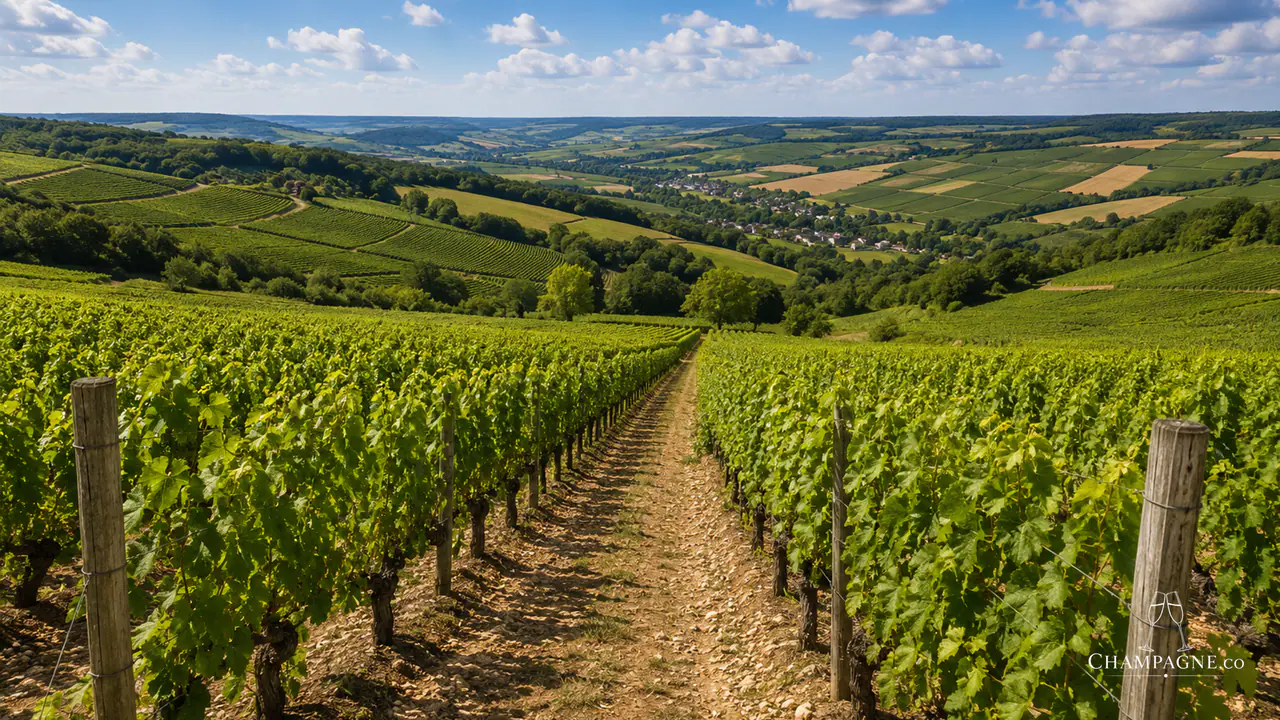
Lamblot works parcels around Janvry, Vrigny, Chenay and neighbouring sectors including the Massif de Saint-Thierry and Vallée de l'Ardre. The domaine's own current material describes reduced reliance on heavy machinery, late pruning, lunar-cycle practices and the use of preparations such as 500, 500P and 501 alongside plant-based treatments.
These practices sit alongside formal organic certification but should not be confused with a separate biodynamic certification. The current independently documented position is straightforward: the domaine is fully certified organic across four hectares.
Winemaking and cellar approach
The producer's present approach is low-intervention and varies by cuvée. Current pages describe natural cork, different ageing vessels, selective use of poignettage, and no sugar addition at disgorgement. Rather than imposing one cellar formula on the entire range, the wines use different combinations of vintage, reserve wine, grape variety and parcel origin.
That makes exact release information important. Mouvance 21, for example, combines the 2021 vintage with 50% perpetual reserve, while other wines such as Frénésie 2020 and Amplitude 2019 are tied to a particular year, grape and vineyard selection.
Champagne.co analysis
Lamblot's catalogue is best understood as a movement from broad identity to progressively narrower origin. Intuition Nature is the most flexible expression; Mouvance adds reserve history; Frénésie and Amplitude isolate individual varieties; Réserve Perpétuelle removes the pressure of a single vintage; and the place-driven wines shift the emphasis toward individual parcels.
That structure makes the producer particularly useful for readers who want to compare how one small grower uses blend, grape, reserve age and site as different organising ideas.
Buying guidance
- For the broadest introduction: Intuition Nature.
- For reserve depth: Mouvance 21 is the clearest current bridge between a named year and perpetual reserve.
- For Meunier: Frénésie is the direct varietal reference.
- For Chardonnay: Amplitude provides the dedicated single-variety route.
- For Pinot Noir and reserve history: Réserve Perpétuelle is the key wine.
- For parcel specificity: move into the place-driven collection and check the exact vintage, parcel and grape of the bottle offered.
Loading current Champagne range…
Spotted something wrong? Report a correction
Every report goes to a human review queue. Nothing on this page changes automatically.