Alexis Leconte (Champagne Alexis)
Alexis Leconte is the sixth-generation winemaker behind Champagne A. Leconte, the current identity of the family estate in Troissy-Bouquigny in the Vallée de la Marne. The producer's present site describes winegrowing roots going back to the 19th century…
Editorial profile
Alexis Leconte is the sixth-generation winemaker behind Champagne A. Leconte, the current identity of the family estate in Troissy-Bouquigny in the Vallée de la Marne. The producer's present site describes winegrowing roots going back to the 19th century and explicitly positions Totem as the bridge between the former Champagne Xavier Leconte name and A. Leconte.
Current importer material places the estate at roughly 10 hectares across about 40 plots in Troissy, Dormans, Mareuil-le-Port, Vandières and Aÿ. The producer's own current technical pages state organic certification since the 2023 harvest, full soil cultivation since 2015 and the introduction of biodynamic practices in 2016.
Why this producer matters
A. Leconte's range shows a family estate moving from a broad inherited blend toward wines defined more directly by grape, parcel and geological origin. Totem retains the historical mixed-variety identity, while La Terre Mère, Aria and Ageius isolate Meunier, Chardonnay and Pinot Noir in increasingly specific contexts.
The estate also works across more than one Champagne landscape. Its base remains the western Vallée de la Marne around Troissy, but Ageius draws on Aÿ Grand Cru, giving Pinot Noir from the Grande Vallée de la Marne a distinct place in the current range.
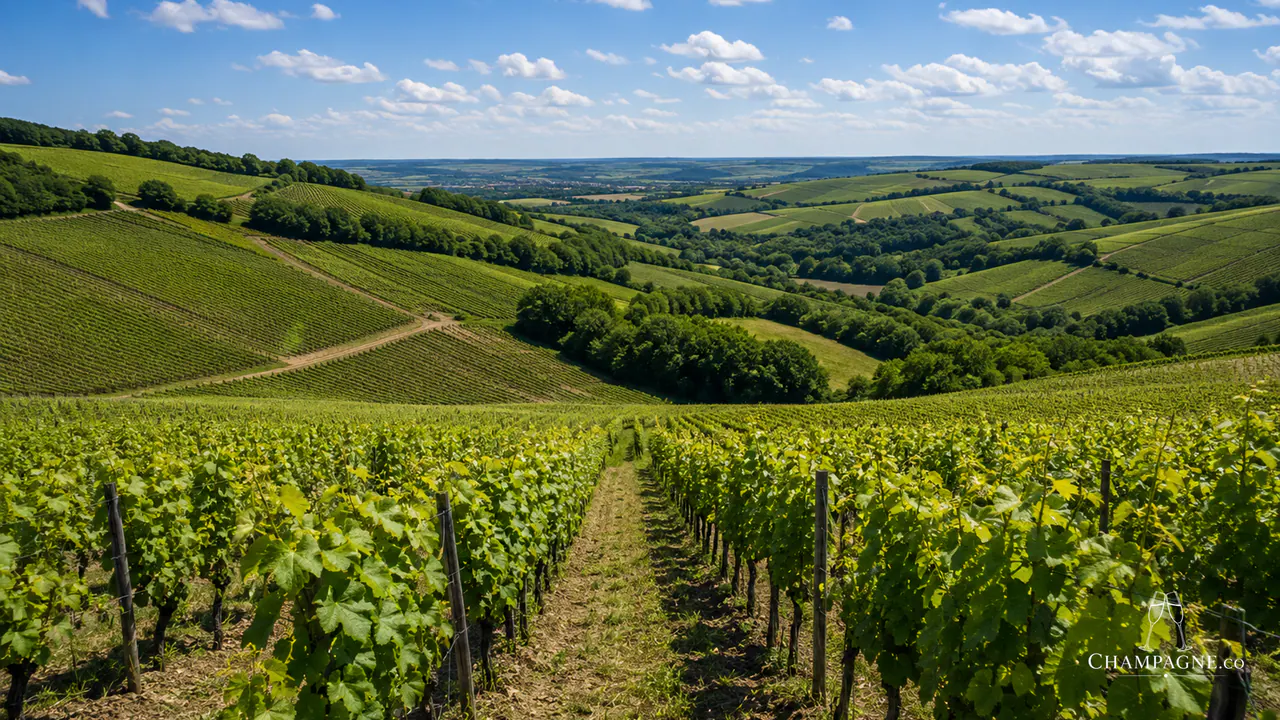
Vineyards and farming
The current vineyard scale is reported at about ten hectares divided among approximately forty plots. The producer's technical pages state that all soils have been fully cultivated since 2015, that biodynamic practices were introduced in 2016 and that the vineyards have been certified organic since the 2023 harvest.
The producer also states that synthetic herbicides and other synthetic vineyard products are avoided in favour of preparations including fermented extracts and plant decoctions. These farming practices are part of the domaine's current approach; they do not by themselves require a separate biodynamic-certification claim.
Winemaking and cellar approach
The cellar method varies materially from wine to wine. Totem uses stainless steel and oak with indigenous yeasts. La Terre Mère is made in foudres, 400-litre Burgundy barrels and sandstone jars, with indigenous fermentation and no malolactic fermentation or bâtonnage. Aria is fermented in cask, while Ageius uses 400-litre barrels and similarly avoids malolactic fermentation and bâtonnage for the current documented release.
This variability is central to the producer's current identity: vessel, grape, parcel and ageing are chosen by cuvée rather than applied as a single estate recipe.
Champagne.co analysis
The strongest way to read A. Leconte is as a progression from family continuity to varietal and parcel resolution. Totem preserves the mixed-grape heritage of the estate, La Terre Mère makes Meunier the centre of attention, Aria introduces a dedicated Chardonnay expression and Ageius takes Pinot Noir into Aÿ Grand Cru.
That sequence gives the range more coherence than a simple list of cuvées. It also explains why release-specific technical detail matters: the wines are deliberately differentiated by grape, site and vessel, so one bottling's blend, dosage or élevage should never be assumed to apply to another.
Buying guidance
- For the clearest introduction: Totem is the natural starting point and the best link to the estate's historical identity.
- For Meunier: La Terre Mère is the dedicated current expression.
- For Chardonnay: Aria provides the direct single-variety comparison.
- For Pinot Noir and Aÿ: Ageius is the most specific route.
- For still wine: Troissy Blanc and Troissy Rouge should be approached as Coteaux Champenois rather than as sparkling Champagne.
- For older or limited cuvées: verify the exact release because the current range has evolved significantly under the A. Leconte identity.
Loading current Champagne range…
Spotted something wrong? Report a correction
Every report goes to a human review queue. Nothing on this page changes automatically.