André Robert
Domaine André Robert is a family-run independent grower based in Le Mesnil-sur-Oger Grand Cru. The estate's current material states that every Champagne is made from its own grapes, drawn from 65 estate-owned plots across seven villages. Those vineyards…
Editorial profile
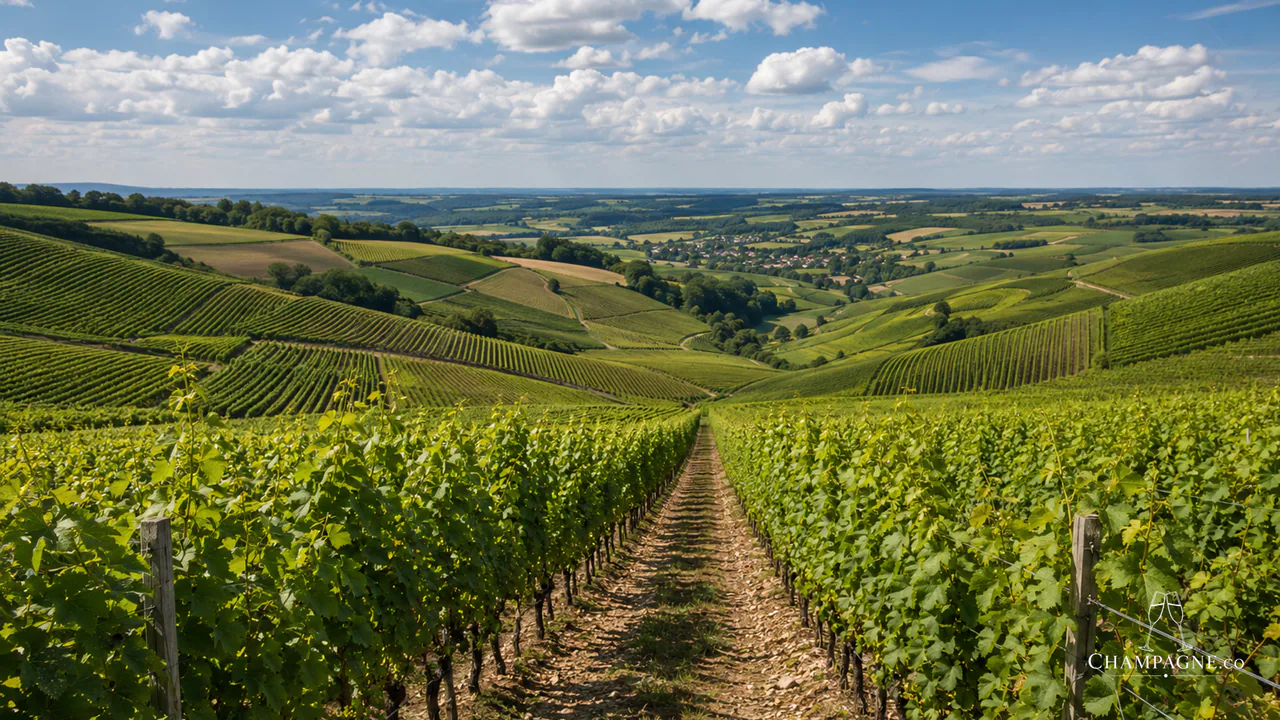
Domaine André Robert is a family-run independent grower based in Le Mesnil-sur-Oger Grand Cru. The estate's current material states that every Champagne is made from its own grapes, drawn from 65 estate-owned plots across seven villages. Those vineyards total approximately 14.5 hectares, with 40 plots in Le Mesnil-sur-Oger itself.
Claire Robert and Jean-Baptiste Denizart have managed the entire operation together since 2019. The family history runs back through Bertrand Robert to André Robert, who bought the house and its nineteenth-century chalk cellars in 1960 and began marketing Champagne under the family name in 1962.
Le Mesnil-sur-Oger is the anchor, but the domaine is broader than one Grand Cru village. Current vineyard records extend across the Côte des Blancs, the Vallée de la Marne and the Coteaux Vitryats. Chardonnay is central, while Pinot Noir and Meunier appear in the Marne Valley holdings and give the range a deliberate non-Chardonnay counterpoint.
Why this producer matters
- A true estate-grown model: the producer states that all Champagnes are made from grapes grown on its own parcels.
- Approximately 14.5 ha across 65 plots in seven villages.
- 40 plots in Le Mesnil-sur-Oger, making the Grand Cru village the estate's clear centre of gravity.
- Current management by Claire Robert and Jean-Baptiste Denizart since 2019.
- A range organised primarily by origin, moving from broad Chardonnay terroirs to Le Mesnil, Montigny-sous-Châtillon and specific vintage or parcel expressions.
- Chardonnay dominates the estate identity without excluding Pinot Noir and Meunier from the wider vineyard mosaic.
Vineyards and terroir
Most of the estate lies in the Côte des Blancs, with Le Mesnil-sur-Oger at its centre. The current vineyard map also includes holdings in villages such as Cuis, Vertus and Étréchy, plus parcels in the Vallée de la Marne and the Coteaux Vitryats.
The Marne Valley parcels introduce Pinot Noir and Meunier, while the Coteaux Vitryats add another Chardonnay origin on tuffeau soils. That geographic spread matters because it explains the current range: Les Horizons blends Chardonnay from several origins, Les Jardins du Mesnil narrows the focus to Le Mesnil-sur-Oger, and Les Vignes de Montigny moves deliberately away from Chardonnay into Meunier and Pinot Noir.
Winemaking and cellar approach
André Robert currently describes a parcel-conscious cellar programme built around micro-vinifications, careful separation of vineyard origins and a mix of stainless steel and wood. Oak is important, but not every wine follows exactly the same vessel programme.
The estate's current environmental approach includes HVE certification, reduced intervention in the vineyard, light tillage, natural ground cover and green manures. The useful link between vineyard and cellar is precision of origin: the winemaking is organised to keep different villages and parcels identifiable rather than folding every site into one house blend.
Champagne.co analysis
André Robert has an unusually clear editorial structure because the range mirrors the geography of the estate. Les Horizons shows the broadest Chardonnay view; Les Jardins du Mesnil tightens that lens onto the domaine's Grand Cru home village; Les Vignes de Montigny demonstrates that the estate is not simply a Blanc de Blancs specialist; and Terre du Mesnil pushes toward a specific year and a more narrowly defined Mesnil origin.
The scale of the vineyard makes that structure credible. Sixty-five estate-owned plots provide enough diversity for the producer to build wines around origin without relying on a large négociant-style sourcing network. The result is a domaine where the reader can move from regional breadth to village focus, then to particular vintage or parcel expressions while staying within one family-owned vineyard base.
Buying guidance
- First bottle: Les Horizons is the broadest and easiest introduction to the estate's Chardonnay identity.
- For Le Mesnil-sur-Oger: Les Jardins du Mesnil is the central Grand Cru reference.
- For zero dosage: choose the current Brut Nature version of Les Jardins du Mesnil.
- For Pinot Noir and Meunier: Les Vignes de Montigny gives the clearest contrast with the Chardonnay-led wines.
- For a more specific Mesnil release: Terre du Mesnil is the natural step up, with the exact vintage clearly identified.
- For mature or limited bottles: Collection d’auteur and Les Coullemets du Midi should be considered by exact vintage and release rather than as permanent non-vintage labels.
Loading current Champagne range…
Spotted something wrong? Report a correction
Every report goes to a human review queue. Nothing on this page changes automatically.