Aspasie / Ariston Fils
Champagne Aspasie is the consumer-facing name of the Ariston family's Champagne business in Brouillet, in the Vallée de l'Ardre west of Reims. The producer traces its family wine-growing history to a notarised deed dated 13 January 1794 and today presents…
Editorial profile
Champagne Aspasie is the consumer-facing name of the Ariston family's Champagne business in Brouillet, in the Vallée de l'Ardre west of Reims. The producer traces its family wine-growing history to a notarised deed dated 13 January 1794 and today presents Paul-Vincent Ariston and his wife Caroline as the generation continuing that story.
The estate farms 12 hectares around Brouillet. Its current producer material and the Association des Champagnes Biologiques both state that the vineyard is now 100% certified organic, following conversion from 2019 and the first certified-organic harvest in 2022. The house also records HVE and Viticulture Durable en Champagne certification.
Aspasie is particularly notable for retaining four rare Champagne varieties alongside Chardonnay, Pinot Noir and Meunier: Arbane, Petit Meslier, Pinot Blanc and Pinot Gris. Those seven cultivated varieties give the estate a broader genetic palette than most Champagne producers, although the rare-grape cuvée Cépages d'Antan currently uses only three of the four historic varieties.
Why this producer matters
- A Brouillet family estate whose documented wine-growing history reaches back to 1794.
- 12 ha of vineyard, with the current ACB record showing 100% certified-organic surface.
- Organic conversion began in 2019 and the first certified harvest was 2022.
- The house also holds HVE and Viticulture Durable en Champagne credentials according to its current material.
- The vineyard includes all three principal Champagne grapes plus Arbane, Petit Meslier, Pinot Blanc and Pinot Gris.
Brouillet, vineyards and farming
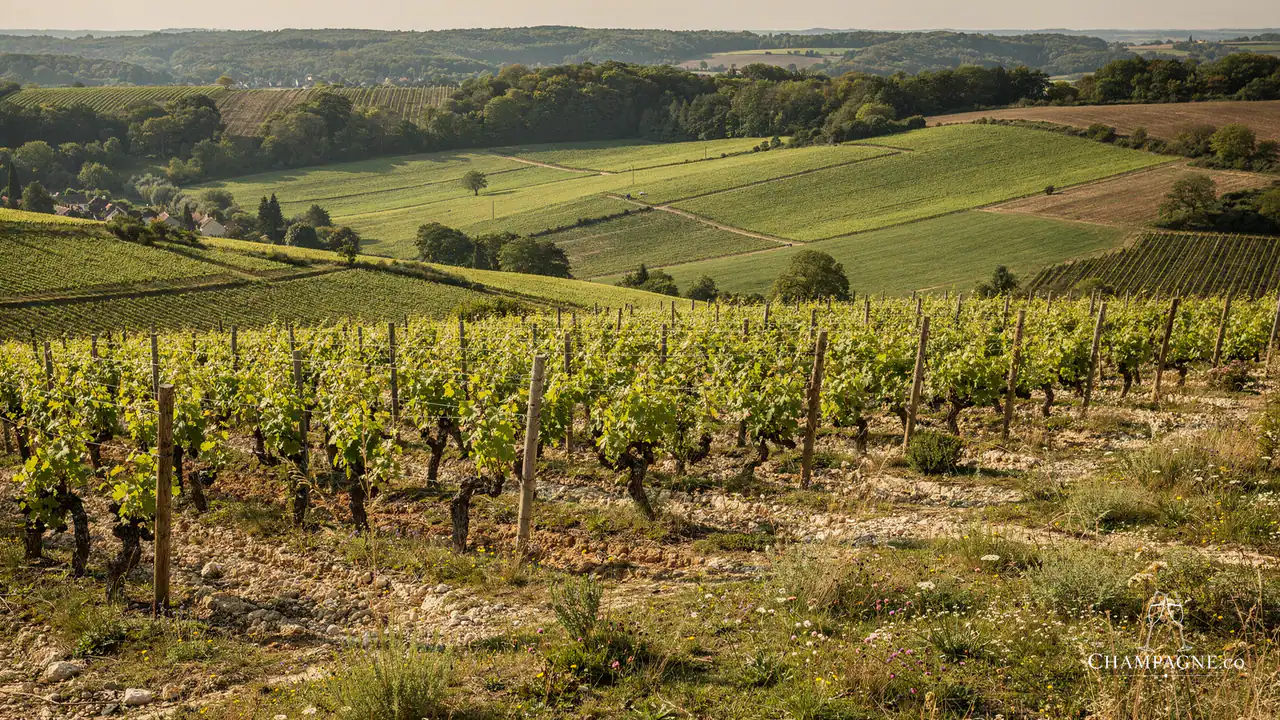
Aspasie's 12 hectares are centred on Brouillet in the Vallée de l'Ardre. The producer describes much of the estate as older-vine material and presses its own grapes on a family Coquard press. The current ACB record confirms that Chardonnay, Pinot Noir, Meunier, Arbane, Petit Meslier, Pinot Blanc and Pinot Gris all form part of the certified vineyard.
The move to organic farming is recent enough to matter when reading mature Champagne releases. The vineyard entered conversion in 2019 and achieved its first certified harvest in 2022, but Champagne's ageing cycle means a bottle released today may incorporate wine from before that certified harvest. Vineyard certification and bottle-level organic status therefore need to be understood separately.
Champagne.co analysis
Aspasie has two genuinely distinctive strands that fit together better than a simple “organic grower” label suggests. The first is the now fully certified vineyard base; the second is the continued cultivation of four rare Champagne grapes alongside the classic trio. Together they make the domaine a useful example of how environmental transition and preservation of older varieties can coexist in a family estate.
The range makes that diversity accessible without becoming unwieldy. Brut Réserve gives the conventional three-grape baseline, Brut de Fût changes the cellar frame, and Cépages d'Antan shifts the focus dramatically toward historic varieties. The latter is particularly informative because it also demonstrates the need for precision: cultivating four rare grapes does not mean all four appear in every rare-variety wine.
Buying guidance
- First bottle: Brut Réserve is the clearest introduction to the house's three-grape style.
- For Chardonnay: Brut Blanc de Blancs provides the direct varietal route.
- For oak influence: Brut de Fût is the dedicated current cuvée.
- For rare grapes: Cépages d'Antan is the defining specialist bottle, currently built from Arbane, Petit Meslier and Pinot Blanc.
- For vintage Champagne: the French shop currently lists 2014; verify the exact vintage rather than relying on older multilingual pages.
- For organic buying: check the exact bottle if organic labelling matters, because the vineyard's 2022 certification does not retroactively change older base wines ageing in the cellar.
Loading current Champagne range…
Spotted something wrong? Report a correction
Every report goes to a human review queue. Nothing on this page changes automatically.