Bertrand-Delespierre
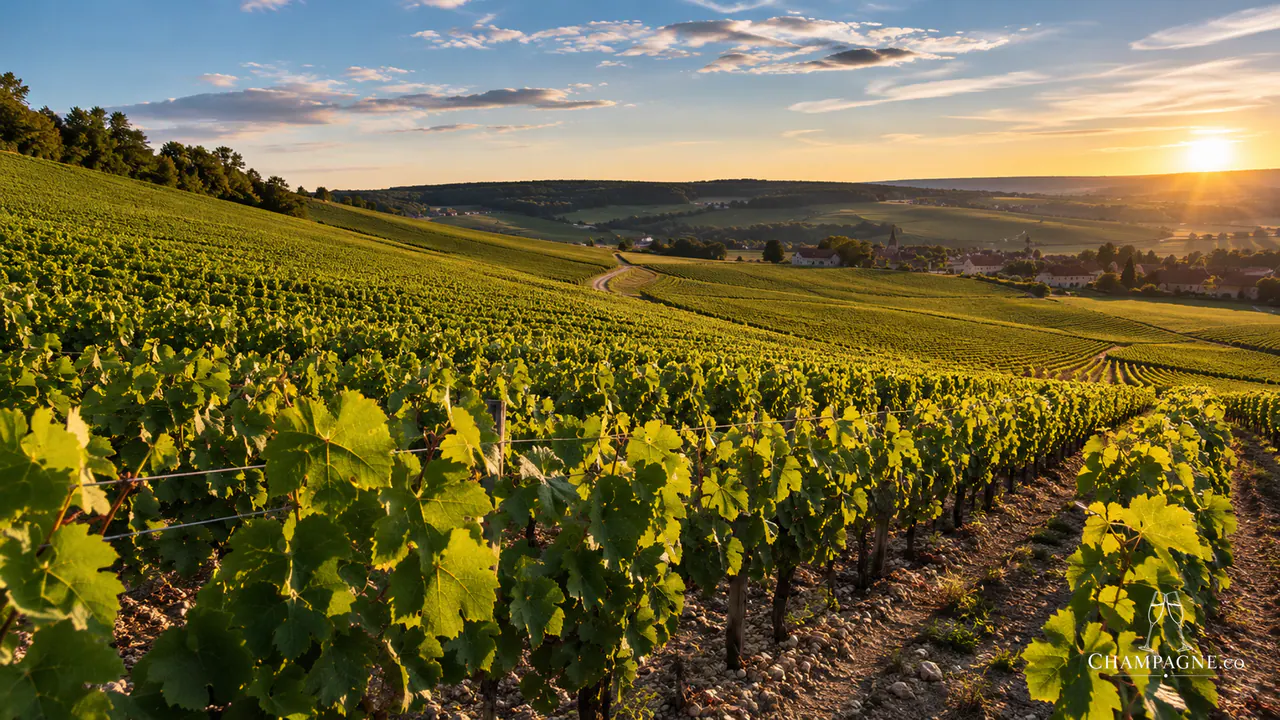
Bertrand-Delespierre is a family grower based in Chamery on the Montagne de Reims. The current generation is represented by siblings Clémence and Adrien Bertrand, working a Premier Cru vineyard spread across Chamery, Écueil, Villedommange and Montbré.
Editorial profile
Bertrand-Delespierre is a family grower based in Chamery on the Montagne de Reims. The current generation is represented by siblings Clémence and Adrien Bertrand, working a Premier Cru vineyard spread across Chamery, Écueil, Villedommange and Montbré.
Current grower-association records put the holding at roughly ten hectares. One current listing gives 9.5 hectares and another 10.05 hectares, so the useful public fact is the scale rather than a spurious decimal precision. The regional association also records an approximately even planting of Chardonnay, Pinot Noir and Meunier.
Why this producer matters
Bertrand-Delespierre brings together several strands of contemporary grower Champagne in a compact estate: a four-village Montagne de Reims footprint, all three principal Champagne varieties, Champagne and Coteaux Champenois production, and a current generation that presents its farming and cellar work in deliberately low-intervention terms.
That makes village and parcel identity particularly useful when reading the range.
Vineyards and terroir
The estate's Premier Cru vines are distributed among Chamery, Écueil, Villedommange and Montbré. Current Vignerons Indépendants material records Chardonnay, Pinot Noir and Meunier in near-equal proportions across the holding.
The multi-village footprint gives the family access to different sectors of the Montagne de Reims while retaining a clearly defined geographic centre in Chamery. Exact parcel, vine-age and varietal information belongs with the relevant wine when current release documentation identifies it.
Winemaking and cellar approach
Recent producer material describes spontaneous grassing, mechanical soil cultivation and a low-intervention direction.
The same discipline applies to vessel, lees ageing, dosage and disgorgement. These can be highly informative for Bertrand-Delespierre, but only when attached to the exact release for which the producer supplies them.
Champagne.co analysis
Bertrand-Delespierre is best understood through the relationship between a compact family vineyard and an increasingly specific range. The roughly even presence of the three principal varieties gives the producer options that a single-variety or single-village estate would not have, while the four Premier Cru villages provide distinct geographic reference points within the Montagne de Reims.
The result is a producer for which labels and release information matter. Broad estate facts explain the framework; the individual cuvée tells the reader which village, varieties and cellar choices are actually in the bottle.
Buying guidance
Start with the exact wine and release rather than relying on an old technical sheet. Enfant de la Montagne is the natural place to understand the estate at broader scale; named vintage or more tightly delimited cuvées are more useful when the aim is to explore a particular village, variety or release-specific cellar choice.
When comparing bottles, keep dosage, blend, lees ageing, malolactic-fermentation status and vessel tied to the named release. The estate's range evolves, and release-bounded information is more dependable than treating a historical specification as permanent.
Loading current Champagne range…
Spotted something wrong? Report a correction
Every report goes to a human review queue. Nothing on this page changes automatically.