Bonnaire
Champagne Bonnaire is a fourth-generation family grower based in Cramant, one of the Grand Cru villages of the Côte des Blancs. The domaine has been established there since 1932 and is now run by brothers Jean-Étienne and Jean-Emmanuel Bonnaire, who…
Editorial profile
Champagne Bonnaire is a fourth-generation family grower based in Cramant, one of the Grand Cru villages of the Côte des Blancs. The domaine has been established there since 1932 and is now run by brothers Jean-Étienne and Jean-Emmanuel Bonnaire, who succeeded the generation led by their father Jean-Louis.
Current Vignerons Indépendants records place the estate at 22 hectares, planted approximately 80% Chardonnay, 10% Pinot Noir and 10% Meunier. Comité Champagne currently identifies Bonnaire as both Haute Valeur Environnementale and Vigneron Indépendant. The estate's home base and strongest stylistic reference remain Cramant and Chardonnay, but the range also draws on vineyards in other parts of the Côte des Blancs, the Montagne de Reims and the Vallée de la Marne.
Why this producer matters
Bonnaire is a useful example of a Côte des Blancs grower whose scale is substantial enough to support more than one interpretation of Chardonnay. The range moves from a broad three-variety reserve blend to Grand Cru Blanc de Blancs, long-aged Chardonnay, named-vintage wines and parcel-led releases.
The estate also maintains a clear distinction between sparkling Champagne and still Coteaux Champenois. That matters for readers because Cramant Nature belongs to the producer's wider wine portfolio but is not a Champagne cuvée.
Vineyards and terroir
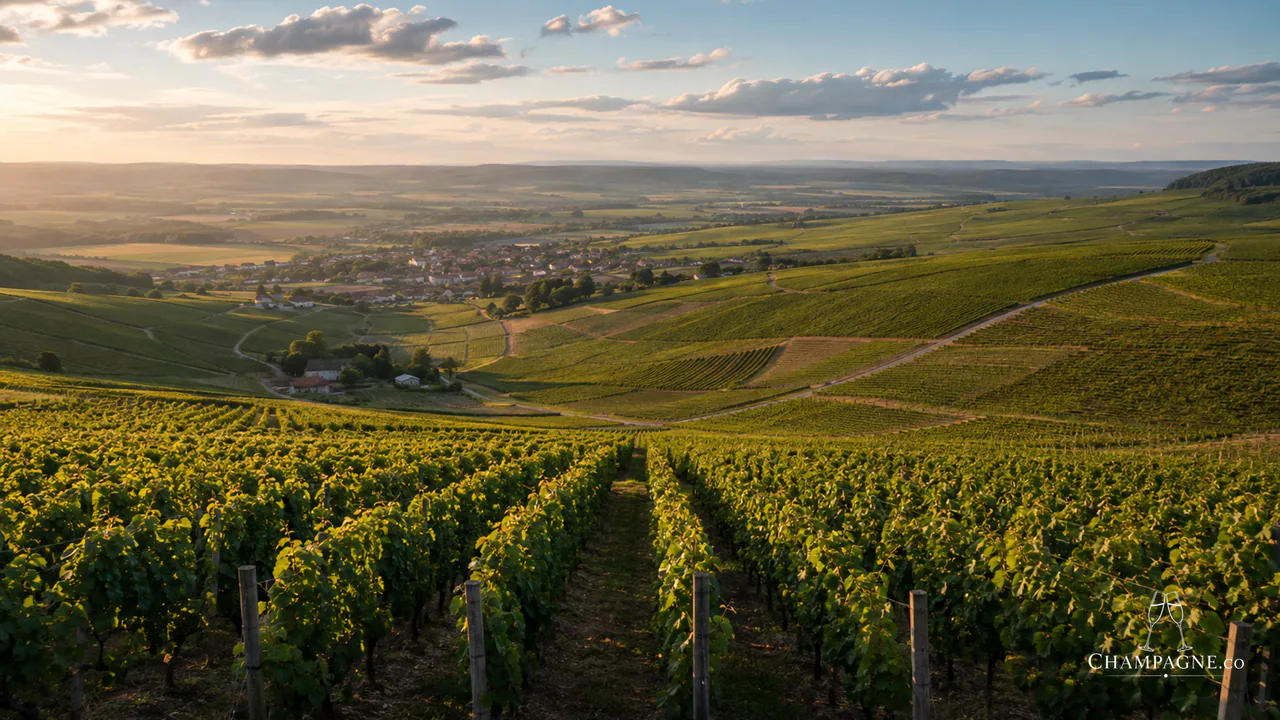
Cramant is the centre of the domaine, but the current range shows a broader vineyard footprint. Terroirs uses Chardonnay from Cramant, Chouilly and Oiry, all Grand Cru. Les Versants brings together fruit from Cramant, Cuis, Bergères-les-Vertus, Bouzy and Fossoy, illustrating how the estate's holdings extend beyond a single village.
The overall vineyard mix remains strongly Chardonnay-led, consistent with the Côte des Blancs base. Pinot Noir and Meunier are used in the broader blends and give the house a wider structural palette than a pure Blanc de Blancs specialist.
Cellar and winemaking approach
The technical pages show a deliberately varied cellar programme rather than one fixed recipe. Stainless steel is important across the range, while oak appears in selected wines. Les Versants is raised on fine lees in stainless steel and oak; Terroirs is handled in stainless steel; Ver Sacrum uses stainless steel, malolactic fermentation and tirage under cork before extended lees ageing.
Dosage is generally restrained in the currently documented wines. Les Versants and Terroirs are both listed at 4 g/L, while Ver Sacrum is 2.5 g/L. These figures are treated as current cuvée specifications rather than permanent house-wide rules.
Champagne.co analysis
Bonnaire's range is best understood as a study in how a Chardonnay-dominant grower can create different levels of geographic and cellar specificity without abandoning a broader house blend. Les Versants provides the multi-variety, multi-region entry point. Terroirs brings the focus back to Grand Cru Chardonnay. Ver Sacrum changes the ageing and tirage regime, while the named vintage and parcel wines push further toward individual places and years.
That progression makes Cramant more than a postal address. It is the estate's anchor, but the portfolio deliberately shows how the Bonnaire family works across several Champagne landscapes. The strongest distinction is therefore not simply 'Blanc de Blancs grower' but the contrast between a broad estate blend and increasingly precise Chardonnay expressions.
Buying guidance
Les Versants Réserve is the natural starting point for understanding the estate as a whole because it includes all three principal Champagne varieties and fruit from several sectors. For a clearer Côte des Blancs reference, Terroirs Grand Cru Blanc de Blancs is the most direct route.
Readers interested in longer ageing and a more specialised cellar approach should look to Ver Sacrum. Cramant Vintage, Le Bateau, Les Terres des Buissons and Les Harengs should always be bought and compared by exact vintage because the current catalogue includes specific dated releases rather than permanent generic versions. Cramant Nature is for readers exploring the estate's still Chardonnay and should be kept outside the Champagne category.
Loading current Champagne range…
Spotted something wrong? Report a correction
Every report goes to a human review queue. Nothing on this page changes automatically.