Brimoncourt
Champagne Brimoncourt is a contemporary house whose wines are made in Aÿ, in buildings and gardens that the producer describes as nearly two centuries old. Its urban headquarters is a separate 1875 hôtel particulier in Reims. The modern project is closely…
Editorial profile
Champagne Brimoncourt is a contemporary house whose wines are made in Aÿ, in buildings and gardens that the producer describes as nearly two centuries old. Its urban headquarters is a separate 1875 hôtel particulier in Reims. The modern project is closely identified with Alexandre Cornot, who rebuilt Brimoncourt as a new-generation Champagne house rather than presenting it as a continuously operating historic grande marque.
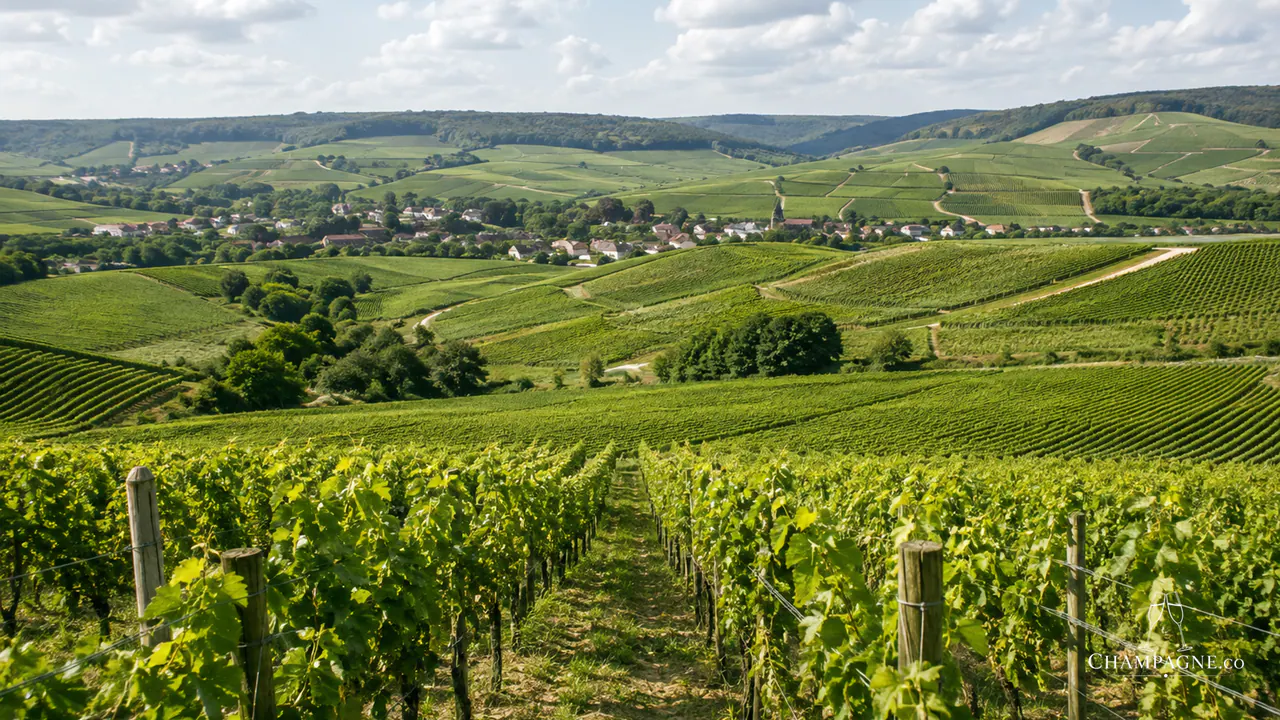
Brimoncourt does not define itself through a single owned-vineyard estate. Its current elaboration material instead describes a selective sourcing model built over time with growers: Chardonnay comes principally from the Sézannais and Côte des Blancs, while Pinot Noir and Meunier come from the Montagne de Reims and Vallée de la Marne. François Huré is identified by the house as chief oenologist.
Why this producer matters
Brimoncourt is useful because it shows a different model from the estate-driven growers and historic houses elsewhere in Champagne. The house's identity is built around sourcing, blending and a deliberately compact portfolio rather than a headline hectare figure or a long inherited vineyard base.
The range is also unusually easy to navigate. Brut Régence is Chardonnay-led; Brut Rosé broadens the blend to all three main varieties; Blanc de Blancs isolates Chardonnay; Extra-Brut flips the emphasis toward Pinot Noir; and Millésime 2009 provides the mature vintage reference.
Sourcing and vineyard relationships
The house says it developed its grower relationships gradually, with a focus on long-term qualitative sourcing rather than rapid volume growth. Its current vineyard-and-elaboration page encourages integrated viticulture through those supply relationships but does not claim one estate-wide organic or biodynamic certification.
Geographically, the sourcing pattern gives Chardonnay a strong eastern and southern chalk-country role through the Côte des Blancs and Sézannais, while Pinot Noir and Meunier are drawn from the Montagne de Reims and Vallée de la Marne. For the current Extra-Brut, the technical sheet narrows the origin further to six Grand Cru villages: Aÿ, Ambonnay, Bouzy, Oger, Le Mesnil-sur-Oger and Cramant.
Cellar and blending approach
Brimoncourt's current technical sheets show stainless-steel vinification as an important part of the cellar programme, with ageing length changing materially by cuvée. The house's central skill is therefore less about one signature vessel than about the construction and maturation of blends from different Champagne sectors.
That is particularly visible in Extra-Brut, which currently spends 72 months ageing in bottle and is dosed at 2 g/L. Millésime 2009 is presented after twelve years in the house's chalk cellars. Those figures belong to the named wines and should not be generalized across the range.
Champagne.co analysis
Brimoncourt's range works as a controlled shift in grape emphasis. Brut Régence establishes the house through Chardonnay, the Rosé introduces Meunier and a larger Pinot Noir component, Blanc de Blancs removes the black grapes entirely, and Extra-Brut reverses the hierarchy by becoming strongly Pinot Noir-led. Millésime 2009 then adds time as the defining variable.
That sequence makes the sourcing model important. Brimoncourt is not trying to express one contiguous estate; it is using different Champagne regions as components in a compact house portfolio. The useful comparison is therefore not 'which vineyard does Brimoncourt own?' but how the house changes grape balance, cru selection and ageing to create distinct positions within a five-wine core range.
Buying guidance
Brut Régence is the most logical introduction because it is the house signature and shows the Chardonnay-led side of Brimoncourt most directly. Brut Rosé is the broader three-variety comparison, while Blanc de Blancs is the pure Chardonnay option.
For a more Pinot Noir-led, lower-dosage expression with longer ageing, Extra-Brut is the clearest choice. Millésime 2009 is the route into the mature-vintage side of the house while that release remains current; because it is a dated wine, its release-specific information should stay attached to the 2009 bottling.
Loading current Champagne range…
Spotted something wrong? Report a correction
Every report goes to a human review queue. Nothing on this page changes automatically.