Brocard
The Champagne.co producer Brocard is Champagne Pierre Brocard, the family estate at Celles-sur-Ource in the Côte des Bar, now led by Thibaud Brocard. The family began making its own Champagne in 1932, and Thibaud took responsibility for the domaine in 2012…
Editorial profile
The Champagne.co producer Brocard is Champagne Pierre Brocard, the family estate at Celles-sur-Ource in the Côte des Bar, now led by Thibaud Brocard. The family began making its own Champagne in 1932, and Thibaud took responsibility for the domaine in 2012 under the guidance of his father, Pierre.
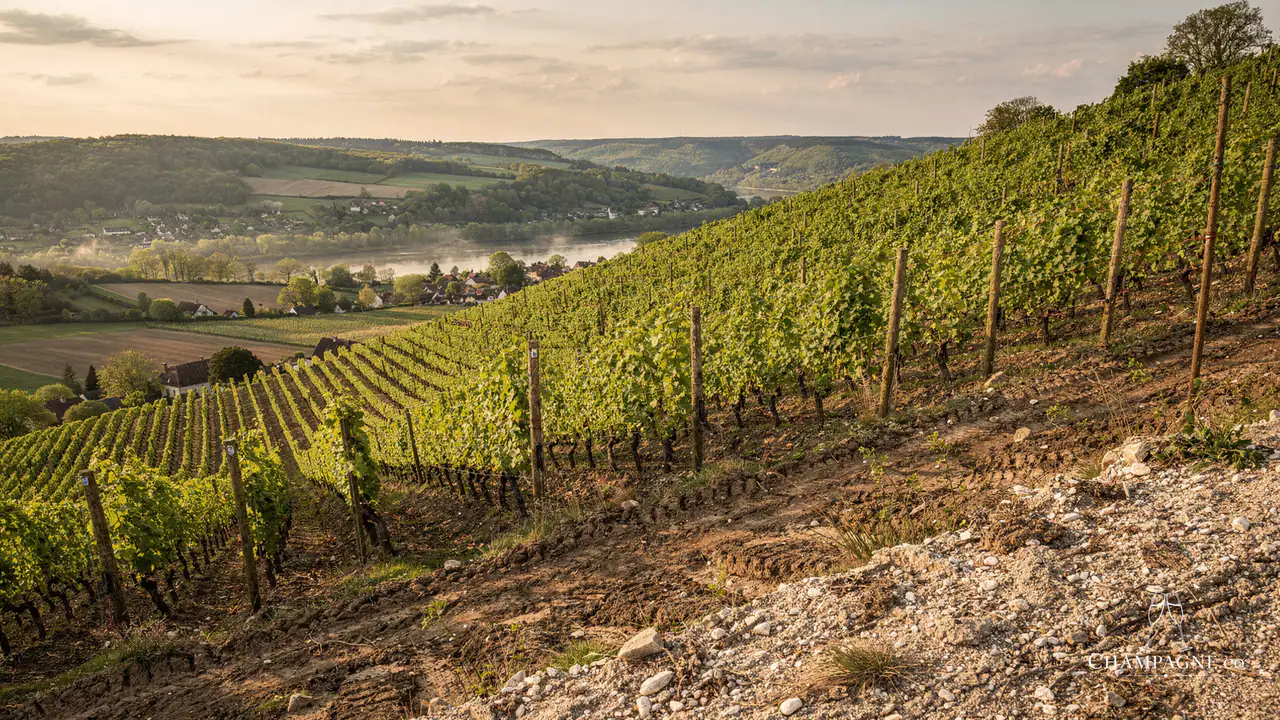
The estate's current identity is built around three contrasting hillside sectors near Celles-sur-Ource: a very clay-rich south-facing slope, a north-facing slope on Kimmeridgian marl, and another south-facing sector influenced by a Portlandian fault. That geology provides the framework for a range that moves between Pinot Noir, Chardonnay and the less-common Pinot Blanc.
Why this producer matters
Pierre Brocard offers a particularly clear Côte des Bar comparison because grape and site are often separated rather than hidden inside a broad house blend. Pinot Noir is the central variety, but Chardonnay and Pinot Blanc have dedicated current wines, making the domaine useful for readers who want to compare how different white and black grapes behave within the same producer's southern-Champagne context.
The estate is also explicit about what it does not claim. Thibaud Brocard describes responsible, highly reasoned vineyard management but says the domaine works under no organic or biodynamic label or charter.
Vineyards and terroir
The producer describes its vineyard through three hillside geologies rather than a single uniform soil type. Kimmeridgian marl, Portlandian limestone and clay-rich sectors all appear in the current estate narrative. This variation is important because the modern cuvées increasingly isolate individual sites or grape varieties instead of blending away those distinctions.
The technical material for Aube Saline and Contrée Noire, for example, identifies the Val-Frion parcel and a complex mix of hard Portlandian limestone, fossil-rich limestone, Kimmeridgian marl and brown clay. Dits-Lieux deliberately takes the opposite approach by bringing together multiple parcels and both Portlandian and Kimmeridgian ground.
Cellar and winemaking approach
The house uses a traditional vertical Coquard press and describes stainless steel as the principal vinification vessel. Nitrogen is used to reduce the need for sulphur additions. The producer places particular emphasis on vintage wines from a single grape and hillside, supported by prolonged lees ageing.
Current technical sheets show that not every wine follows an identical vessel programme. Dits-Lieux, for example, is currently raised predominantly in stainless steel with a small oak component, while Aube Saline and Contrée Noire are listed as 100% stainless steel. Exact vessel and ageing details therefore remain wine-specific.
Champagne.co analysis
Brocard's range is best read as a dialogue between blend and isolation. Dits-Lieux gives the broadest estate view by combining ten parcels and three grape varieties. The vintage wines then narrow the lens: Aube Saline isolates Chardonnay, Contrée Noire isolates Pinot Noir, Absimilis isolates Pinot Blanc, and Saignée de la Côte uses Pinot Noir through a different rosé method.
The three-hillside geology makes that structure more meaningful than a simple grape catalogue. Thibaud Brocard's current approach is to let vintage, grape and hillside become distinct variables while keeping the cellar relatively restrained.
Buying guidance
Dits-Lieux is the natural starting point because it combines Pinot Noir, Pinot Blanc and Chardonnay and draws from multiple parcels. For a direct single-variety comparison, Aube Saline 2018 provides Chardonnay and Contrée Noire 2018 provides Pinot Noir from the same named parcel context.
Absimilis 2019 is the most relevant bottle for readers specifically interested in Pinot Blanc, while Saignée de la Côte 2022 is the current Pinot Noir rosé route. L'Égarée 2020 offers the clearest equal Pinot Noir/Chardonnay comparison. The two Coteaux Champenois wines belong to the still-wine side of the estate and should remain separate from the Champagne cuvée count.
Loading current Champagne range…
Spotted something wrong? Report a correction
Every report goes to a human review queue. Nothing on this page changes automatically.