Bruno Paillard
Maison Bruno Paillard is an independent family Champagne house founded in Reims in 1981 by Bruno Paillard. Unlike houses built around inherited nineteenth-century cellars and vineyards, it was created from scratch in the modern era, initially using…
Editorial profile
Maison Bruno Paillard is an independent family Champagne house founded in Reims in 1981 by Bruno Paillard. Unlike houses built around inherited nineteenth-century cellars and vineyards, it was created from scratch in the modern era, initially using purchased grapes and rented cellar space before gradually building its own vineyard base and production infrastructure.
Alice Paillard joined her father in 2007, working first in the vineyard and cellar and then in export development. Current first-party material states that she took direction of the Maison in 2018, with Bruno Paillard remaining as president. The house remains family-owned and independent.
Why this producer matters
Bruno Paillard is distinctive because a large part of its present identity can be traced to deliberate technical choices made from the beginning of a relatively young Champagne house. Two are especially important: the creation of a perpetual reserve in 1985, and the decision to print the disgorgement date on every bottle from 1983.
The house has also built a meaningful estate vineyard without becoming self-sufficient. Its current vineyard covers 25 hectares, providing around half of the Maison's grape needs; the balance continues to come from long-standing grower partners. That combination gives Bruno Paillard both direct vineyard control and a broader sourcing palette across Champagne.
Vineyards and farming
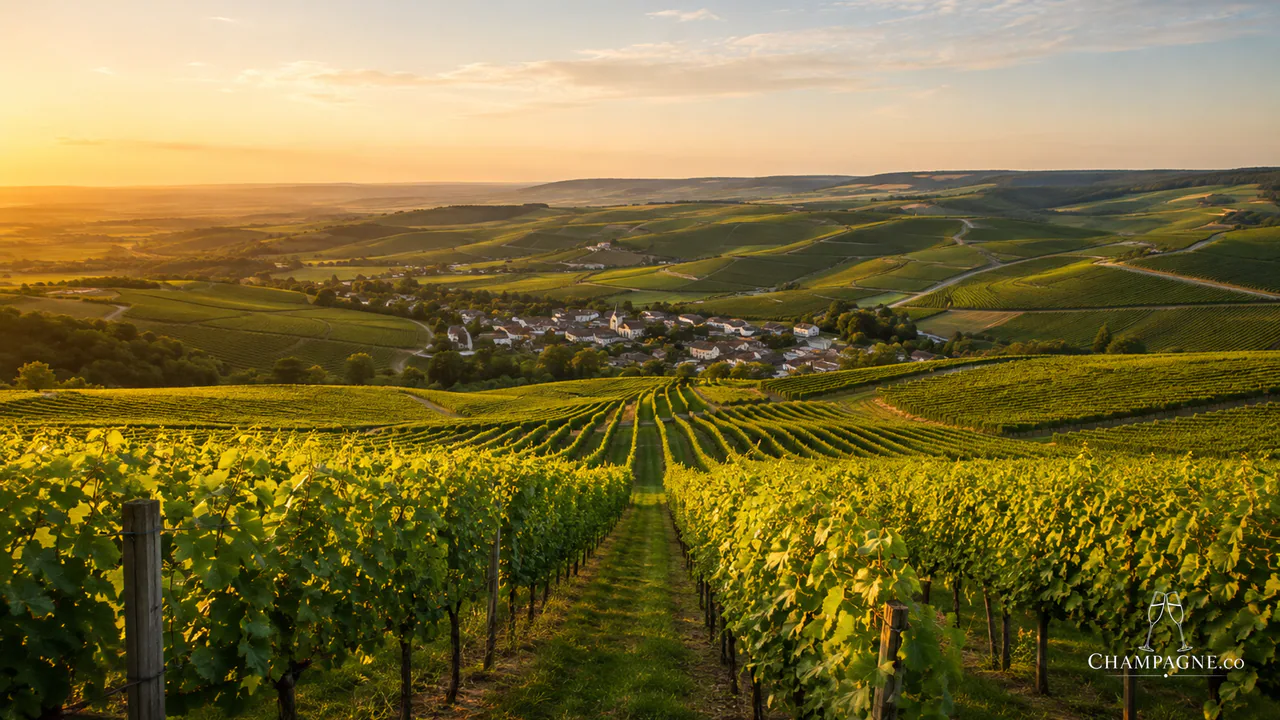
The current estate vineyard is divided into 89 plots across 19 crus, including six Grands Crus and five Premiers Crus, spanning the Montagne de Reims, the beginning of the Vallée de la Marne, the Côte des Blancs and Les Riceys. The house currently gives the planting mix as 50% Pinot Noir, 37% Chardonnay and 13% Meunier, with an average vine age of about 32 years.
The producer states that the estate vineyards are certified organic. Its current viticulture programme excludes weedkillers and pesticides, uses ploughing and partial grassing, and applies parcel-specific soil analysis and amendments.
Cellar and blending approach
At harvest, Bruno Paillard currently receives grapes from more than 40 selected crus. The house states that it uses only the first pressing. Individual origins are vinified separately in a large network of stainless-steel tanks and old barrels before blending.
Reserve wines are structurally important in the multi-vintage wines. Depending on the base year, they can make up roughly 25% to 50% or more of a blend. The perpetual reserve, created in 1985, is central to Première Cuvée and gives the house a way to carry material from successive harvests forward into later releases.
All current Bruno Paillard Champagnes are presented as Extra-Brut, with a maximum dosage of 6 g/L. The wines are also deliberately rested after disgorgement before release. The house's current English production and collection pages state that the disgorgement date has appeared on every bottle since 1983.
Champagne.co analysis
Bruno Paillard is best understood through time and versioning. Première Cuvée is not simply a fixed non-vintage blend: its perpetual reserve links many harvests, and the proportion of reserve wine changes according to the base year. Vintage wines take the opposite approach by focusing on one harvest, while the Old Disgorgements Collection adds a second time axis by comparing wines after different periods since disgorgement.
The estate vineyard adds another layer. Twenty-five hectares and 89 plots give the house meaningful direct control, but they supply only about half its needs, so Bruno Paillard remains both a vineyard owner and a selective sourcing house. That balance helps explain why blending across crus remains as important to the Maison as its own parcels.
Buying guidance
Première Cuvée Extra-Brut is the clearest starting point because it brings together the perpetual reserve, multi-cru sourcing and low-dosage house framework. Rosé Première Cuvée is the obvious rosé comparison, while Blanc de Blancs Grand Cru and Blanc de Noirs Grand Cru allow readers to explore the range through grape colour and origin.
Choose D:Z for the zero-dosage interpretation and Cuvée 72 for a longer-matured multi-vintage expression. The current Blanc de Blancs 2014 and Assemblage 2015 are the relevant vintage references and should always retain their exact years. N.P.U. 2009 is the prestige release for readers specifically interested in the house's most extended and oak-focused vintage programme. The Old Disgorgements Collection is most useful for comparing the effect of time after disgorgement rather than for treating all bottles as one identical release.
Loading current Champagne range…
Spotted something wrong? Report a correction
Every report goes to a human review queue. Nothing on this page changes automatically.