Canard-Duchêne
Canard-Duchêne is a historic Champagne house based in Ludes, on the Montagne de Reims. It was founded in 1868 by Victor Canard and Léonie Duchêne, who combined their names and their respective links to barrel-making and winegrowing. The house remains…
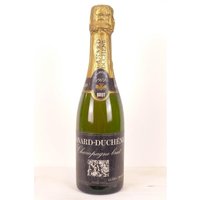
Representative Champagne from Canard-Duchêne
Editorial profile
Canard-Duchêne is a historic Champagne house based in Ludes, on the Montagne de Reims. It was founded in 1868 by Victor Canard and Léonie Duchêne, who combined their names and their respective links to barrel-making and winegrowing. The house remains rooted in Ludes today.
Current Union des Maisons de Champagne data places Canard-Duchêne within the Arvitis group and records a 25-hectare vineyard estate. That owned vineyard base is only one part of the supply picture: the house also says that its vineyard team works with more than 200 winegrowing families. The scale of the house therefore comes from a combination of estate land and long-term grower relationships rather than from 25 hectares alone.
The current cellar master is Cynthia Fossier, who joined the house as deputy cellar master in 2019 and succeeded Laurent Fédou in January 2025. Her appointment marks the latest stage in a house whose modern identity places particular emphasis on Pinot Noir, reserve wines and the Montagne de Reims.
Why this producer matters
Canard-Duchêne sits at an interesting point between historic Grande Maison scale and a recognisable village identity. Its home is not Reims or Épernay but Ludes, and the house still makes the Domaine de Ludes and its chalk cellars a central part of its story.
The sourcing model is equally important. A 25-hectare estate gives the house direct vineyard holdings, while partnerships with more than 200 growers provide the broader palette required for a substantial non-vintage and vintage range. That distinction helps explain how Canard-Duchêne can produce at Maison scale without pretending that every bottle comes from its own land.
The current range also shows several different ways of expressing the house: an organic Extra-Brut in P181, reserve-driven Iconic wines, a Pinot-led vintage programme and a broad Essentiel range. It is a much more varied proposition than a single flagship bottle.
House, vineyards and Ludes
Canard-Duchêne acquired the Domaine de Ludes in 1929, together with approximately six kilometres of chalk-carved cellars. The house records that the estate was heavily damaged during the two World Wars but that the chalk cellars survived and remain in use.
Pinot Noir has a particularly important role in the house's current identity, consistent with its Montagne de Reims setting. The 25-hectare estate sits alongside a much larger grower network, giving the cellar team access to multiple crus, varieties and harvest years for blending.
One particularly visible part of the vineyard programme is the organically farmed ZE 181 vineyard at Verneuil, a nine-hectare site that contributes to P181. The finished P181 cuvée is not simply a single-parcel wine, however: the current producer page also describes collaboration with partner growers.
Cellar and reserve-wine approach
Blending and reserve wines are central to Canard-Duchêne's current range. The Iconic programme uses substantial reserve-wine components, including perpetual reserves developed from earlier Pinot Noir selections. Léonie Iconic currently draws on a perpetual reserve begun in 2012, while Blanc de Noirs Iconic includes a dedicated Pinot Noir perpetual reserve dating from the same period.
The current range generally uses restrained dosage, but the exact level belongs to the individual wine. Ageing also varies materially: current product pages range from about three years in cellar for several non-vintage cuvées to six years for Millésime 2018.
Champagne.co analysis
Canard-Duchêne makes most sense when three elements are considered together: its Ludes base, its mixed estate-and-grower sourcing model and its increasingly explicit reserve-wine architecture. Those elements distinguish it from both a small grower Champagne and a house that relies almost entirely on anonymous large-scale sourcing.
P181 is a good example of that structure. Its organic identity is genuinely connected to the nine-hectare ZE 181 vineyard, but the wine also includes fruit from partner growers. That makes it a house blend with a strong organic-vineyard anchor rather than a simple single-parcel bottling.
The Iconic wines show another side of the house. Instead of relying on vintage alone, they build continuity through reserve wines and perpetual reserves, particularly around Pinot Noir. Millésime 2018 then provides the vintage counterpoint, with Pinot Noir again taking the majority share.
Cynthia Fossier's succession in 2025 is therefore more than a personnel footnote. It places a new cellar master in charge of a house already structured around long-term reserve systems, a broad grower network and a clear Montagne de Reims identity.
Buying guidance
- Best introduction to the current house style: Léonie Iconic is the most useful starting point for the reserve-driven core of the modern range.
- For organic Champagne: P181 is the direct route, with a current Extra-Brut profile and a documented connection to the organically certified ZE 181 vineyard.
- For Pinot Noir: Blanc de Noirs Iconic is the clearest dedicated expression, built entirely from Pinot Noir in the current release.
- For a vintage comparison: Millésime 2018 provides the current Pinot-majority vintage expression after six years of cellar ageing.
- For exploring the wider catalogue: Rosé, Blanc de Blancs, Brut and Demi-Sec sit around these reference wines and are best compared using the specifications of the current release.
Loading current Champagne range…
Spotted something wrong? Report a correction
Every report goes to a human review queue. Nothing on this page changes automatically.