Charles Dufour
Champagne Charles Dufour is a grower-producer based in Landreville in the Côte des Bar. The current Association des Champagnes Biologiques record gives a precise picture of the estate's certified vineyard: 4 hectares, 100% organically certified, planted…
Editorial profile
Champagne Charles Dufour is a grower-producer based in Landreville in the Côte des Bar. The current Association des Champagnes Biologiques record gives a precise picture of the estate's certified vineyard: 4 hectares, 100% organically certified, planted approximately 60% Pinot Noir, 30% Chardonnay and 10% Pinot Blanc.
The organic chronology is equally clear. Dufour entered the certification process in 2007, and the estate's first certified-organic grapes were harvested in 2010. That makes certified organic farming a documented part of the producer's identity rather than a secondary stylistic claim.
The best-known Champagne project is Bulles de Comptoir, an evolving series of numbered releases. Each edition has its own subtitle and release identity, allowing Dufour to change the relationship between current-harvest fruit and reserve wines rather than repeating one fixed non-vintage recipe year after year.
Why this producer matters
Charles Dufour is distinctive because a very small organic vineyard feeds a Champagne programme built around continuity without sameness. The estate's 60/30/10 mix of Pinot Noir, Chardonnay and Pinot Blanc gives the cellar a three-variety base, but Bulles de Comptoir changes from release to release instead of disguising those changes behind a permanent formula.
The reserve-wine architecture is particularly revealing in the current Bulles de Comptoir #13 — Cuisine du Dimanche. That release combines the 2022 harvest with a reserve system covering 2010–2021 and a further layer derived from older family wines dating from 1982–2009. The result connects a current harvest with two different generations of reserve material.
Pinot Blanc also matters here. At around 10% of the certified vineyard, it is a meaningful part of the estate rather than a token curiosity, and it appears in the documented Bulles de Comptoir blend alongside Pinot Noir and Chardonnay.
Vineyard and farming
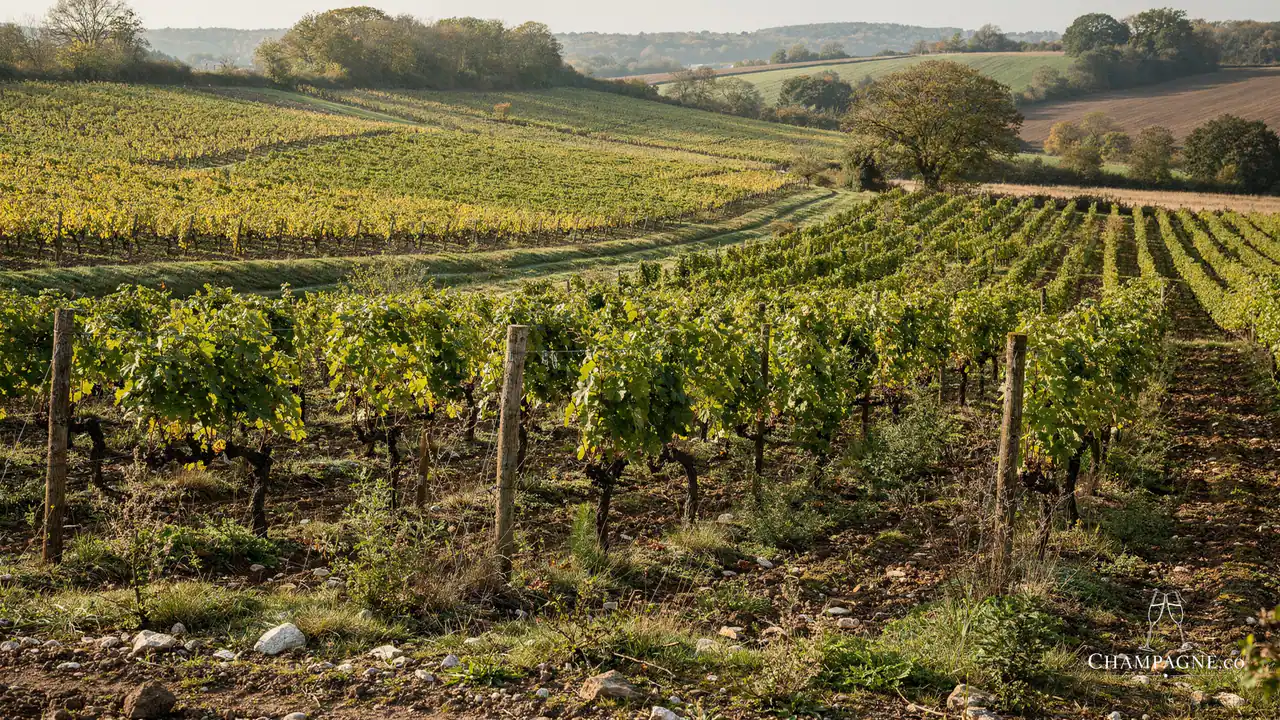
The current certified vineyard surface is 4 hectares, all under organic certification. The Association des Champagnes Biologiques records the planted mix as approximately 60% Pinot Noir, 30% Chardonnay and 10% Pinot Blanc.
Certification engagement began in 2007, with the 2010 harvest recorded as the first from certified-organic grapes. That is the firm certification basis used for the estate. Broader descriptions of biodynamic practice found in secondary sources are not treated as a formal biodynamic-certification claim.
The vineyard base is centred on Landreville in the Côte des Bar, where Pinot Noir is the majority variety. Chardonnay and Pinot Blanc broaden the estate palette and allow Dufour to build Champagne from all three rather than relying exclusively on the region's dominant black grape.
Cellar and release architecture
Bulles de Comptoir is designed as a sequence rather than as one static wine. The numbered release and subtitle are integral to the identity of each bottle because base harvest, reserve composition, tirage and disgorgement can change materially from one edition to the next.
For #13 Cuisine du Dimanche, current release records identify a blend of 60% Pinot Noir, 30% Chardonnay and 10% Pinot Blanc. Approximately 65% comes from the 2022 harvest, around 25% from a reserve system spanning 2010–2021, and roughly 10% from an older family reserve drawing on wines from 1982–2009. The documented lot was tiraged in February 2024 and disgorged in May 2025.
That layered reserve structure is more informative than treating Bulles de Comptoir as a conventional non-vintage label. The current wine is connected to many earlier years, but the exact proportions and dates belong to #13 rather than to every release in the series.
Champagne.co analysis
Charles Dufour's most interesting idea is continuity through change. Bulles de Comptoir does not aim to reproduce exactly the same blend every year. Instead, the numbered series makes each release visible while reserve wines connect the present bottle to earlier harvests.
The current #13 release shows this especially clearly. Most of the wine comes from 2022, but a quarter comes from a 2010–2021 reserve system and another portion reaches back into family wines from 1982–2009. In one bottle, the estate combines the immediate character of a recent harvest with two deeper layers of accumulated cellar history.
The certified vineyard mix reinforces that identity. Pinot Noir provides the Côte des Bar centre of gravity, Chardonnay adds a white-grape counterpoint, and Pinot Blanc gives the domaine a rarer third component. The point is not simply that the estate is organic or small; it is that Dufour uses a small, clearly documented vineyard base to build an intentionally evolving Champagne series.
Buying guidance
- Best current introduction: Bulles de Comptoir #13 Cuisine du Dimanche is the clearest reference for the present numbered series and its layered reserve-wine structure.
- For comparing Bulles de Comptoir releases: the number and subtitle matter. Earlier editions should be approached as distinct releases rather than assumed to share #13's blend or dates.
- For another Champagne project: Bistrotage belongs to a separate sourcing and release identity and offers a different route into Dufour's work.
- For still wine: Vin de Comptoir and the Coteaux Champenois bottlings sit outside the sparkling Champagne category.
- For non-wine products: Liqueur de Comptoir should likewise be treated separately from the Champagne range.
Loading current Champagne range…
Spotted something wrong? Report a correction
Every report goes to a human review queue. Nothing on this page changes automatically.