Charlier & Fils
Champagne Charlier & Fils is a family grower based in Montigny-sous-Châtillon, between Épernay and Dormans in the Vallée de la Marne. Its modern identity brings together the Charlier and Perrin families, with a winegrowing history that the producer traces…
Editorial profile
Champagne Charlier & Fils is a family grower based in Montigny-sous-Châtillon, between Épernay and Dormans in the Vallée de la Marne. Its modern identity brings together the Charlier and Perrin families, with a winegrowing history that the producer traces to 1892, when cooper Armand Perrin began selling Champagne made using barrels from his own cooperage.
The two family lines converged in the present estate when Carole Charlier and Yves Perrin took over in 1992. Their son Maxime Perrin, identified by the house as the fifth generation, joined in 2004. That continuity matters because the producer’s most distinctive cellar practice — vinification in large oak foudres — connects directly with its cooperage origins.
Why this producer matters
Charlier & Fils stands out for using large, mature oak foudres across its present Champagne range rather than reserving them for one prestige bottling. The cellar currently contains 43 foudres, and the producer describes an average period of about eight months in these vessels before bottling, with reserve wines held for around two to three years.
The vineyard is equally characteristic of its Vallée de la Marne setting. Meunier accounts for 69% of the current plantings, alongside 20% Chardonnay and 11% Pinot Noir, creating a clear link between the estate’s local grape base and its core wines.
Vineyards and farming
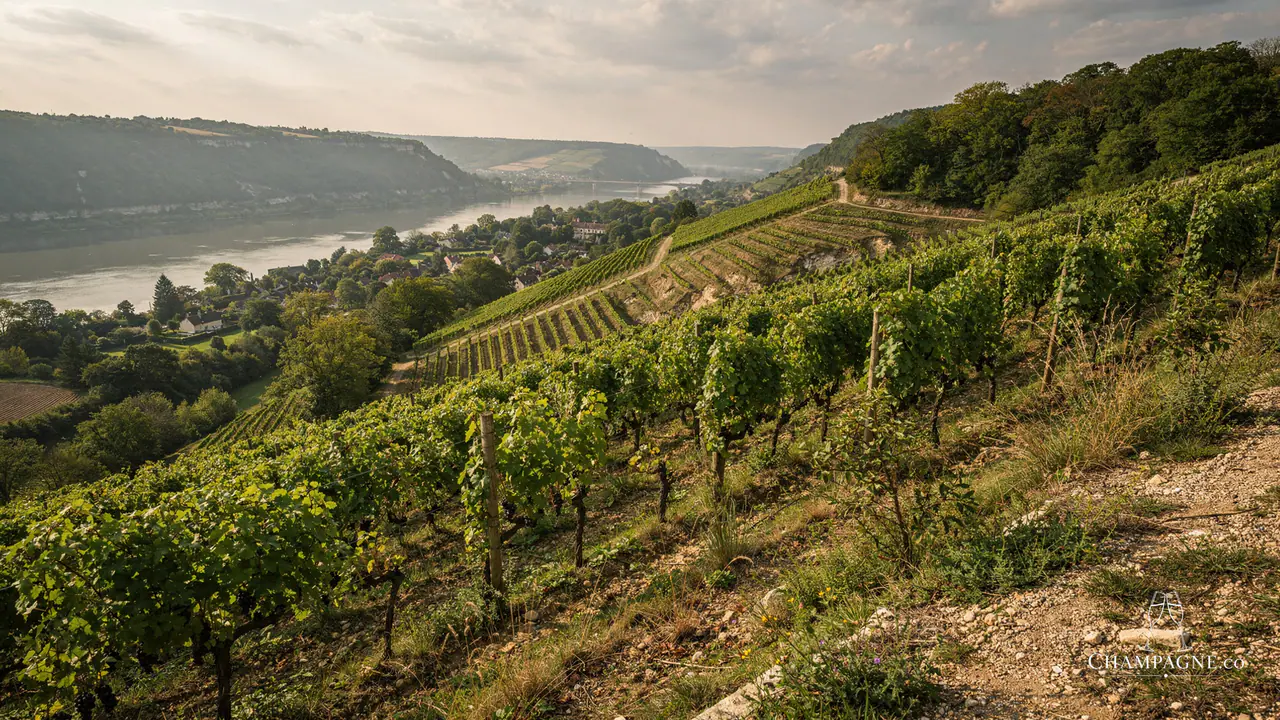
The estate currently comprises 41 plots across five hillsides on both banks of the Vallée de la Marne. The vineyards lie in Montigny-sous-Châtillon, Châtillon-sur-Marne, Mareuil-le-Port, Jonquery, Cuisles, Courthiézy and Œuilly.
The producer describes two principal soil contexts across those sites: limestone and clay-limestone. Its current vineyard programme includes grass cover, ploughing and the use of natural micro-organisms in soil management. These practices are useful evidence of the estate’s present farming approach but are not presented as an organic or biodynamic certification claim.
Cellar and winemaking
Large oak foudres form the centre of the cellar. Charlier & Fils currently works with 43 old foudres and vinifies the whole Champagne range in these vessels. Their age is significant: the objective is slow exchange with the wine rather than the pronounced flavour associated with new oak.
The general range spends around eight months in foudre before bottling, while reserve wines can remain in wood for two to three years. Bottle maturation is also comparatively extended, typically around three to four years for the main cuvées, with substantially longer ageing used for some vintage releases.
Champagne.co analysis
Charlier & Fils is best understood through the combination of Meunier-led Vallée de la Marne vineyards and a cellar built around large old oak vessels. Neither element is unusual on its own, but their combination across the whole range gives the estate a particularly coherent production identity.
The wines also offer a useful progression. Carte Noire reflects the broad estate blend and its Meunier majority. Rosé de Saignée uses the same local grape strength in a different production method. Coup de Foudre turns toward pure Chardonnay, while Spécial Club narrows the focus further through vintage selection and older-vine material.
Buying guidance
Carte Noire Brut is the natural first bottle: it is the clearest route into the house’s Meunier-led blend and foudre-based cellar style. Rosé de Saignée – Prestige is the more distinctive choice for readers interested in traditional saignée rosé rather than blended rosé.
For Chardonnay, Coup de Foudre 2018 provides the most direct current reference. Spécial Club 2015 sits at the more selective vintage end of the range and is the better comparison for readers wanting to see how the house applies its cellar approach to older-vine material and longer maturation.
Loading current Champagne range…
Spotted something wrong? Report a correction
Every report goes to a human review queue. Nothing on this page changes automatically.