Clandestin
Champagne Clandestin is a Côte des Bar négociant project created by Benoît Doussot in 2015 and now based in Landreville. Unlike a traditional family estate built around inherited holdings, Clandestin developed through partnerships with growers across the…
Editorial profile
Champagne Clandestin is a Côte des Bar négociant project created by Benoît Doussot in 2015 and now based in Landreville. Unlike a traditional family estate built around inherited holdings, Clandestin developed through partnerships with growers across the Aube, using organically farmed fruit and separating wines by parcel, geology and exposure.
The business is currently certified under the EU organic scheme through Ecocert for manufacture and processing at its Landreville address. The project has grown from a small initial network into a broader Côte des Bar sourcing operation, while keeping the wines organised around specific origins rather than a single permanent house blend.
Why this producer matters
Clandestin is useful for understanding a different model of contemporary Champagne production. Doussot did not begin with a large family vineyard base; instead, he built relationships with organic growers and made the source of the grapes part of the wine’s identity.
That approach is particularly clear in the contrast between Boréal and Austral. Both are Pinot Noir-led Blanc de Noirs, but Boréal is associated with north-facing parcels and Austral with south-facing parcels. Exposure is therefore treated as a primary organising idea rather than an incidental technical detail.
The range has since expanded beyond that north/south comparison into wines that isolate geological bands and individual sites, making Clandestin increasingly parcel-driven rather than simply a small négociant label.
Vineyards, geology and sourcing
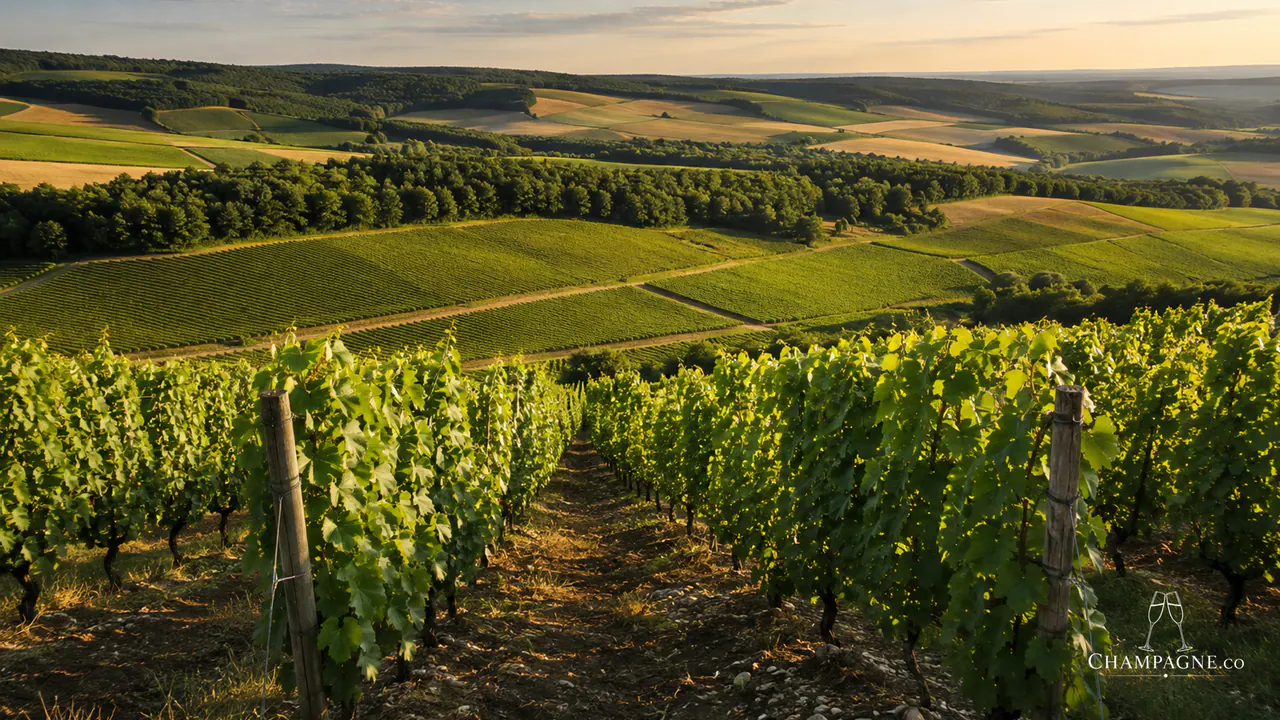
Clandestin works exclusively in the Côte des Bar, drawing from partner growers in the Barséquannais. Pinot Noir and Chardonnay are the two principal grapes in the programme.
The project pays close attention to the Côte des Bar’s layered limestone geology. In practical terms, parcels and even different parts of the same slope may be harvested and handled separately where their geological position differs. Kimmeridgian limestone is especially important within the sourcing philosophy, while Portlandian material appears higher on some slopes.
The partner-grower model does not mean anonymous fruit. Individual parcels remain distinct through harvest and early élevage, and the growers manage their vineyards through the season before Doussot and his team take responsibility for picking and cellar work.
Cellar and winemaking
Fruit is harvested by hand and brought to the Landreville cellar, where parcels are pressed and vinified separately. Fermentation takes place in French oak: Pinot Noir commonly uses larger barrels around 600 litres, while Chardonnay may use a combination of roughly 500-litre and 228-litre vessels.
Before the 2021 vintage, the broad pattern was approximately a year of barrel élevage before bottling for secondary fermentation. The larger Landreville winery, completed for the 2023 harvest, gives the project more capacity to extend both barrel and bottle maturation for selected wines rather than forcing every cuvée into the same timetable.
The new winery also consolidated work that had previously been split across several sites. Reception of juice, winemaking, ageing, disgorgement and shipment can now be handled from one principal Landreville base.
Champagne.co analysis
Clandestin is best understood as a sourcing-and-site project rather than a conventional house blend programme. The négociant structure is not hidden behind a generic brand identity: the grower partnerships, slope direction and geological position of the vineyards are central to how the wines are divided.
Boréal and Austral provide the clearest introduction because they make one variable — exposure — easy to understand. The newer geological and single-parcel wines then push the same idea further, asking the reader to compare sections of the Côte des Bar at increasingly fine resolution.
The cellar reinforces that approach by keeping parcels separate and using oak as the principal fermentation and maturation environment. The important point is not an abstract claim that barrel ageing is superior, but that Clandestin uses a consistent enough cellar framework for differences in grape source and site to remain meaningful.
Buying guidance
Start with Boréal and Austral side by side if possible. They are the most direct way to understand the project because they compare north- and south-facing Pinot Noir sources within the same producer philosophy.
Move to Les Revers for the Chardonnay side of Clandestin. For readers most interested in geology, Triologie KM1/KM2/KM3 is the natural next step because its structure explicitly separates Kimmeridgian layers.
The Les Passagers wines are the route into more specific parcel bottlings. Their identity is deliberately tied to site and release rather than to one permanently fixed house recipe.
Loading current Champagne range…
Spotted something wrong? Report a correction
Every report goes to a human review queue. Nothing on this page changes automatically.