Collery
Maison Collery is a Champagne house rooted in Aÿ-Champagne, where the brand was created by Jules-Anatole Collery in 1893. The house history presents him as an early local grower to bottle and commercialise his own Champagne rather than relying only on…
Editorial profile
Maison Collery is a Champagne house rooted in Aÿ-Champagne, where the brand was created by Jules-Anatole Collery in 1893. The house history presents him as an early local grower to bottle and commercialise his own Champagne rather than relying only on grape sales. Later generations combined vineyard, winemaking and commercial roles, keeping Aÿ at the centre of the family identity.
The modern range is built around Grand Cru fruit, Pinot Noir and Chardonnay, with Pinot Noir especially prominent. Rather than organising everything as variations on one non-vintage blend, Collery divides its Champagnes into three clear families: Blends, Singles and Vintages.
Why this producer matters
Collery offers a useful modern reading of Aÿ. Pinot Noir is the main structural grape in the core Brut, Extra-Brut, Rosé and Blanc de Noirs, while Chardonnay appears both as a blending partner and as a 100% Blanc de Blancs.
The range also gives cellar technique a visible role. Temperature-controlled stainless steel is the foundation, but selected portions of wines are matured in foudres or barrels. Wood is also used in preparing expedition liqueurs, with each cuvée receiving its own dosage treatment rather than one generic house solution.
Aÿ, grapes and cellar approach
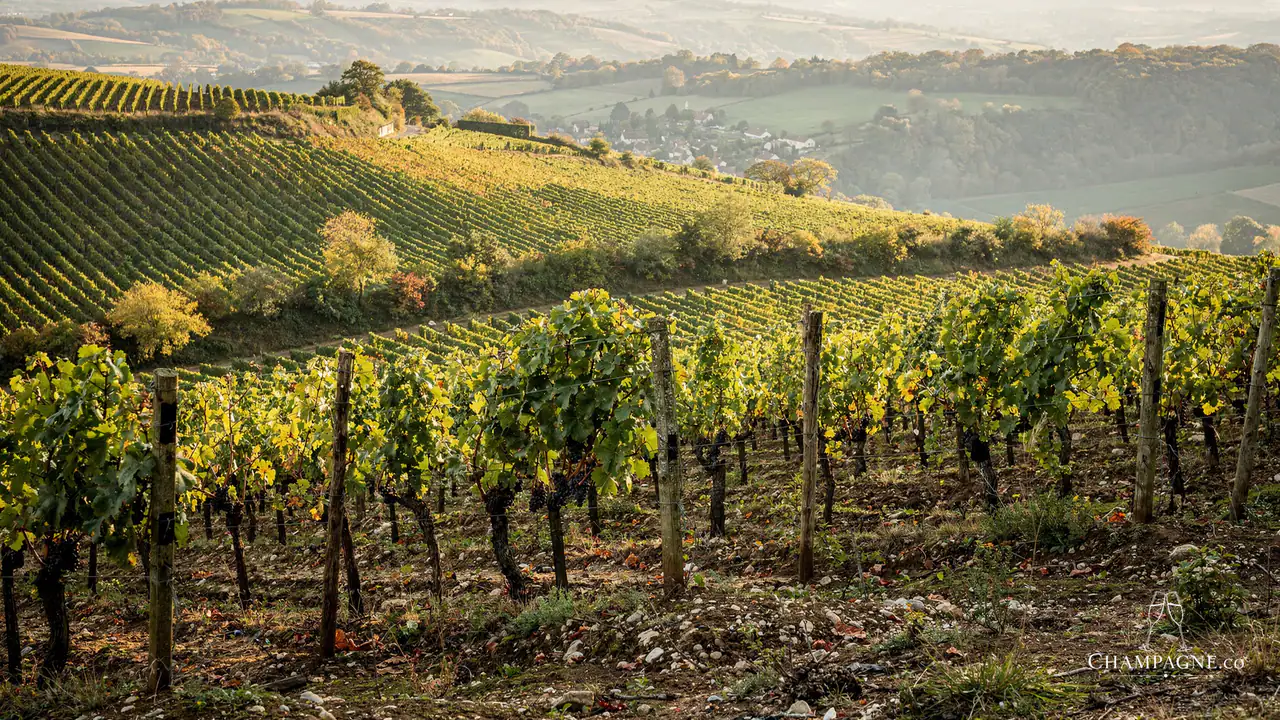
Aÿ lies on the southern flank of the Montagne de Reims and is historically associated with Pinot Noir. Collery uses that context as the anchor for its Grand Cru positioning while also working Chardonnay across the range.
Alcoholic and malolactic fermentations for the principal current Champagnes take place in temperature-controlled stainless-steel tanks. Wood is introduced selectively rather than universally. The current Brut and Extra-Brut, for example, each mature 20% of the blend in 40-hectolitre casks, while the Blanc de Noirs and Blanc de Blancs use larger 25-hectolitre foudres for part of their blends.
Dosage is another deliberate variable. Collery makes separate expedition liqueurs for individual cuvées, using previously used barrels from regions including Sauternes and Burgundy. The finished Champagnes in the current collection are Brut or Extra-Brut rather than being pushed toward one house-wide dosage level.
Champagne.co analysis
Collery is strongest editorially when treated as a set of comparisons rather than as a single house-style slogan. The core Brut and Extra-Brut hold the blend broadly constant while changing dosage. The Blanc de Noirs and Blanc de Blancs then isolate Pinot Noir and Chardonnay. EmpyreumatiC changes the equation again by adding a much more assertive wood programme to a vintage Pinot-dominant blend.
This makes Pinot Noir the thread running through the house without reducing the range to a single grape. Chardonnay is important both as a counterweight in the blends and as an independent single-variety wine.
Wood is similarly used as a tool rather than a universal recipe. Large foudres appear in the non-vintage wines, while the 2014 vintage uses smaller and more varied barrels. The result is a range where grape, dosage and vessel can each be compared independently.
Buying guidance
Start with NV Brut Grand Cru for the broadest introduction to Collery’s Pinot-led blend. Follow it with NV Extra-Brut Grand Cru if you want to examine how the same current grape balance changes at a lower dosage.
For grape-variety comparison, taste Blanc de Noirs against Blanc de Blancs. They are the clearest way to separate the Pinot Noir and Chardonnay sides of the house while keeping both within the Grand Cru collection.
Choose EmpyreumatiC 2014 for the most explicit vintage-and-wood expression. Its detailed 2014 élevage belongs to that release, so future vintages should be understood on their own terms rather than assumed to repeat the same barrel programme.
Loading current Champagne range…
Spotted something wrong? Report a correction
Every report goes to a human review queue. Nothing on this page changes automatically.