Cristian Senez
Champagne Cristian Senez is a family producer in Fontette, in the Côte des Bar. Its modern story is closely tied to founder Cristian Senez, who began acquiring vineyard land in the 1950s, developed his technical experience at the Fontette cooperative, and…
Editorial profile
Champagne Cristian Senez is a family producer in Fontette, in the Côte des Bar. Its modern story is closely tied to founder Cristian Senez, who began acquiring vineyard land in the 1950s, developed his technical experience at the Fontette cooperative, and built the family’s own Champagne operation with his wife Josette during the 1970s.
The first press and harvest facility were installed in 1973, followed by a cellar in 1974. Their daughter Angélique and her husband Frédéric returned to the domaine in 1990, and granddaughter Marion joined the family business in 2019, giving the house three generations of active family continuity.
The most consistent cellar signature is unusually clear: the Champagnes are made without malolactic fermentation and without fining. The current range combines Pinot Noir, Chardonnay and a notably visible role for Pinot Blanc, including a dedicated single-parcel 100% Pinot Blanc cuvée.
Why this producer matters
Cristian Senez is useful for understanding a Côte des Bar producer that does not rely only on Pinot Noir. Pinot Noir remains important, but Pinot Blanc is treated as a serious part of the contemporary portfolio through Cuvée des Filles, Brut Nature and Le Cornoyer.
The house also maintains a long-maturation strand. Older vintages remain commercially visible alongside the regular range, while the decision to block malolactic fermentation provides a common cellar framework across both young and mature wines.
This combination of family continuity, rare-variety use and mature releases gives the estate a more distinctive identity than a simple regional grower profile.
Family history and Fontette
Cristian Senez was born in 1937. His father planted a small family vineyard, and Cristian began acquiring his own vineyard land in 1955. By 1960 he was working as cellar and press manager at the Fontette cooperative, building the practical experience that later fed into the family house.
Cristian and Josette began constructing their own Champagne operation around 1970. After installing the first press in 1973, they retained part of their crop for estate Champagne and gradually expanded the business. The next generation arrived in 1990 through Angélique and Frédéric, with Marion joining in 2019 after wine-sector studies.
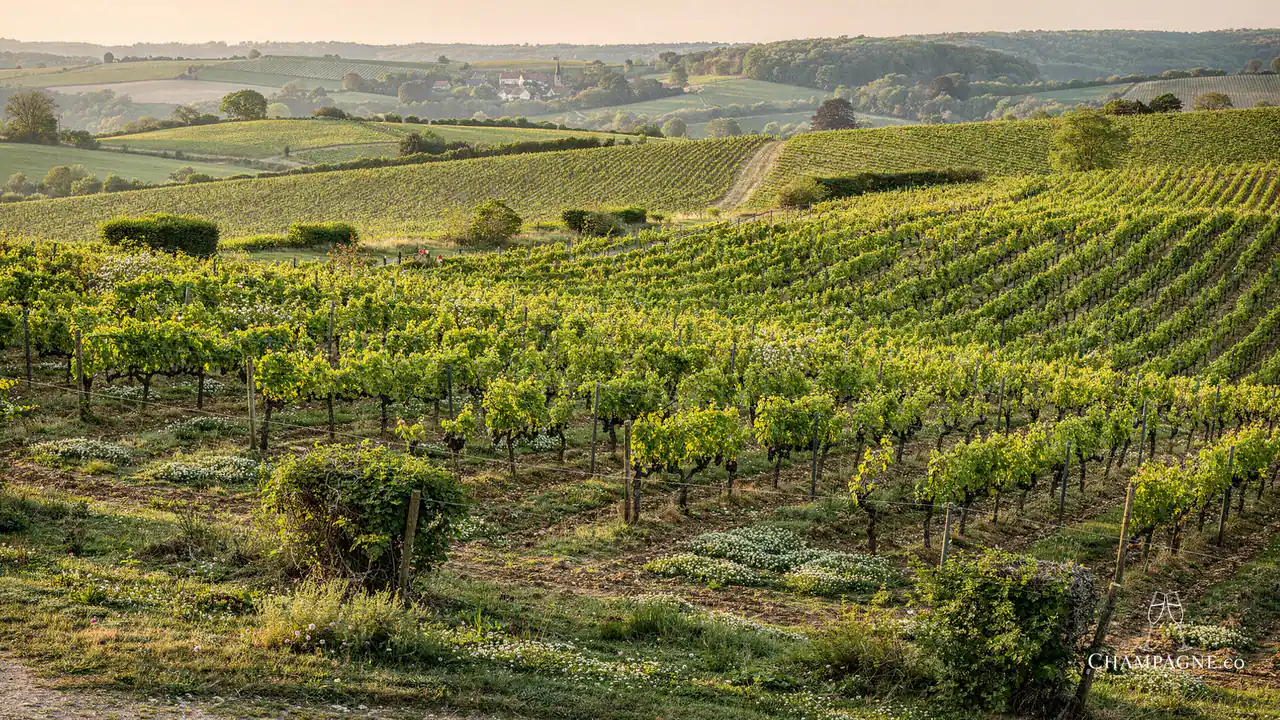
The vineyards are centred on Fontette and neighbouring Côte des Bar villages, where clay-limestone soils and rolling slopes support Pinot Noir, Chardonnay and Pinot Blanc.
Viticulture and cellar
The estate has followed reasoned viticulture for more than three decades and obtained Haute Valeur Environnementale (HVE) certification in 2020. Current vineyard practices include fermented plant extracts, clover cover crops, selective soil cultivation and the planting of hedges and shrubs to support biodiversity.
In the winery, modern stainless-steel tanks sit alongside traditional vertical presses. The house identifies no malolactic fermentation as a defining technical choice throughout the Champagne range, and the wines are also made without fining.
The combination matters most when read alongside the range: stainless steel and blocked malolactic fermentation provide a consistent foundation, while grape variety, dosage, rosé method and bottle age create the differences between cuvées.
Champagne.co analysis
Cristian Senez is best understood through three recurring ideas: blocked malolactic fermentation, Pinot Blanc and time.
The first gives the range a common cellar baseline. The second differentiates the domaine from many Côte des Bar producers: Pinot Blanc is not confined to a tiny experimental bottling but appears in several wines and reaches its clearest expression in Le Cornoyer. The third is visible in the continued presence of older vintage releases, where long bottle ageing is part of the commercial identity rather than merely an archive story.
The result is a range that can be read comparatively. Carte Blanche gives a pure Pinot Noir route; Cuvée des Filles shifts toward Pinot Blanc and Chardonnay; Brut Nature brings three grapes together without dosage; Le Cornoyer isolates Pinot Blanc; the mature 2002 wines show the long-ageing side of the house.
Buying guidance
Start with Carte Blanche for the clearest expression of the house’s Pinot Noir and no-malolactic approach. Then move to Cuvée des Filles if you want to see how Pinot Blanc changes the blend when paired with Chardonnay.
Brut Nature is the best route into the three-grape, zero-dosage side of the range, combining Pinot Noir and Chardonnay with a substantial 25% Pinot Blanc component.
Choose Le Cornoyer 2014 for the most focused Pinot Blanc experience and the clearest single-parcel identity. For mature Champagne, CS73 2002 and Millésime 2002 provide two distinct interpretations of the same year with opposite Pinot Noir/Chardonnay emphasis.
Loading current Champagne range…
Spotted something wrong? Report a correction
Every report goes to a human review queue. Nothing on this page changes automatically.