de Barfontarc
Champagne de Barfontarc is a Côte des Bar cooperative based in Baroville. Its roots go back to 1962, when growers from Baroville, Fontaine and Arconville joined forces to share pressing facilities; the Barfontarc name combines the opening syllables of…
Editorial profile
Champagne de Barfontarc is a Côte des Bar cooperative based in Baroville. Its roots go back to 1962, when growers from Baroville, Fontaine and Arconville joined forces to share pressing facilities; the Barfontarc name combines the opening syllables of those three villages.
Today the cooperative brings together 54 winegrowing families farming around 130 hectares across eight villages around Baroville. Pinot Noir dominates the vineyard at about 90%, with Chardonnay accounting for the remaining 10%, giving Barfontarc a clear southern-Champagne identity.
Why this producer matters
Barfontarc shows how a sizeable cooperative can move beyond a single house blend and use its collective vineyard base to build a more differentiated range. Alongside its core Héritage wines, the portfolio includes varietal Champagnes, vintage bottlings, zero-dosage releases, rosé de saignée and wines shaped by more selective élevage.
The cooperative also has a defined sustainability programme. It is engaged with Haute Valeur Environnementale certification, while 80% of its members’ vineyard area is reported as carrying the Viticulture Durable en Champagne label. Those programmes should be understood as sustainability credentials rather than as an organic-farming claim.
Côte des Bar vineyards
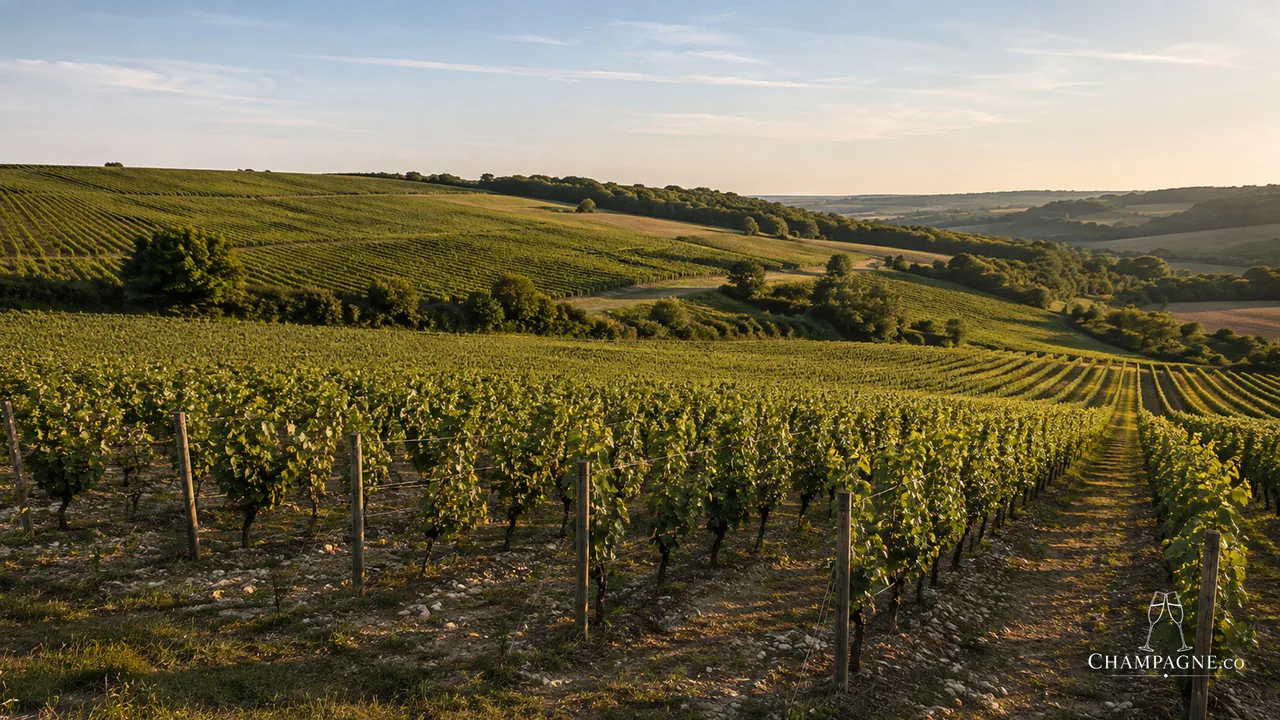
The member vineyards extend across Arconville, Arsonval, Baroville, Dolancourt, Fontaine, Montier-en-l’Isle, Rouvres-les-Vignes and Trannes. This is marl- and clay-limestone country in the Aube, where Pinot Noir is the dominant regional variety and also the central grape in Barfontarc’s holdings.
The scale of the cooperative gives it access to a broader mix of parcels than a small single-estate grower, but the range increasingly separates grape variety, vintage and cellar treatment rather than presenting everything through one blended house style.
Cellar and winemaking
Barfontarc uses a conventional Champagne toolkit across a notably broad range: non-vintage blends with reserve wine, varietal Blanc de Noirs and Blanc de Blancs, vintage cuvées, zero-dosage Champagne, rosé de saignée and selected wines with oak influence.
Technical details vary materially from one release to another. Héritage Brut, for example, is currently presented in its 51st blend as 80% Pinot Noir and 20% Chardonnay, with 81% from the 2022 harvest, 19% reserve wine from 2021 and a dosage of 9 g/L. Those figures describe that specific release, not a permanent recipe for the cuvée.
Champagne.co analysis
Barfontarc is most interesting when viewed as a large Pinot-led Côte des Bar collective that has steadily increased the resolution of its range. The cooperative scale supplies breadth; the cuvée structure then narrows that breadth through grape variety, vintage, dosage and élevage choices.
That makes the producer more useful to read horizontally than as a simple quality ladder. Héritage Brut gives the broad house expression, Blanc de Noirs isolates Pinot Noir, and the La Vigne au Roy pair shows how the same equal-parts Pinot Noir/Chardonnay vintage blend changes when dosage is removed.
The result is a cooperative identity that is still rooted in scale and shared production, but increasingly articulated through technical distinctions that allow drinkers to explore different sides of the same vineyard base.
Buying guidance
Start with Héritage Brut for the clearest introduction to Barfontarc’s Pinot-led house style and cooperative model.
Choose Caractère Blanc de Noirs if you want the most direct expression of the dominant grape in the member vineyards. For a more comparative purchase, the La Vigne au Roy 2016 and La Vigne au Roy Nature 2016 pair is particularly useful: the same 50/50 Pinot Noir-Chardonnay structure is presented with and without dosage.
Release details change, especially for non-vintage blends, so vintage, base harvest and dosage should be read as attributes of the specific bottle in hand rather than permanent specifications of the cuvée name.
Loading current Champagne range…
Spotted something wrong? Report a correction
Every report goes to a human review queue. Nothing on this page changes automatically.