de Castellane
Champagne de Castellane is an Épernay house founded in 1895 by Viscount Florens de Castellane. The brand became associated with the Union Champenoise complex in the early twentieth century and entered the Laurent-Perrier group in 1999. The house remains…
de Castellane — Champagne producer profile image.
Editorial profile
Champagne de Castellane is an Épernay house founded in 1895 by Viscount Florens de Castellane. The brand became associated with the Union Champenoise complex in the early twentieth century and entered the Laurent-Perrier group in 1999. The house remains closely identified with its historic Épernay site and red Saint Andrew’s cross emblem.
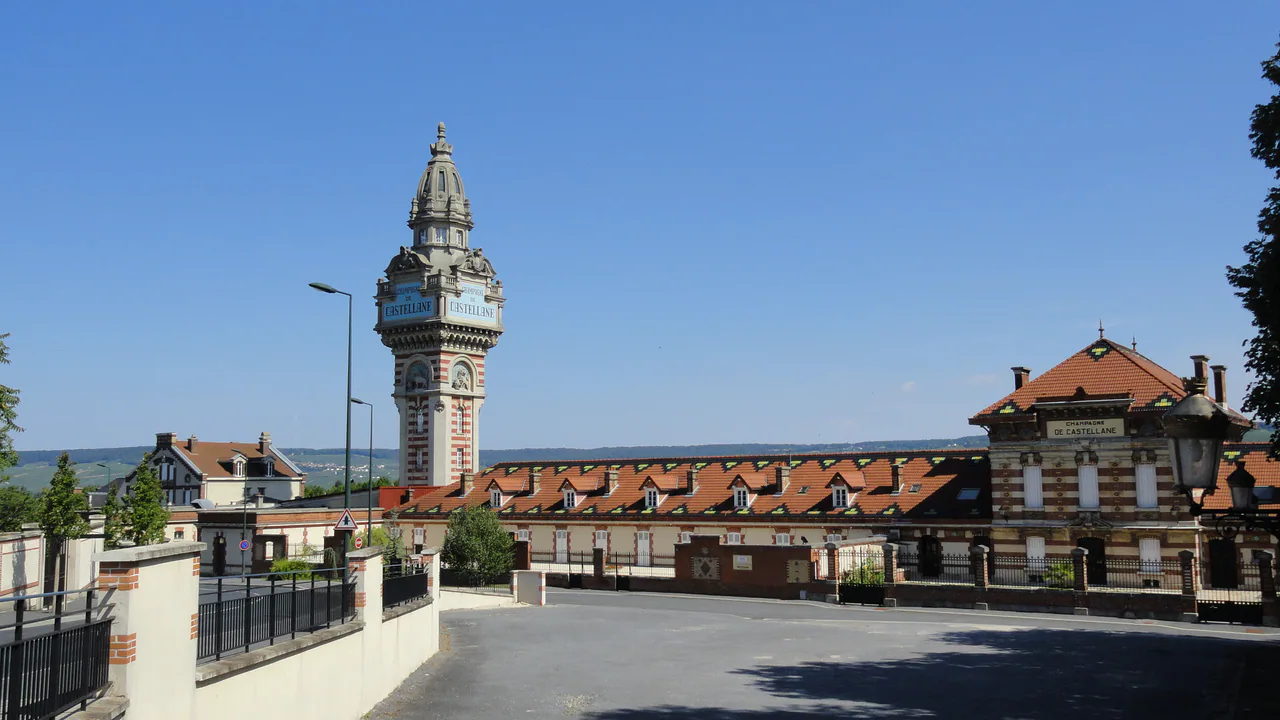
Its best-known architectural landmark is the 66-metre de Castellane tower, listed in the Inventory of Historic Buildings and rising above the eastern end of Épernay. The site also preserves a large heritage collection devoted to Champagne labels, posters and regional production history.
Why this producer matters
De Castellane combines a long-established négociant-house identity with one of Épernay’s most recognisable architectural landmarks. Its history links Belle Époque branding, the Union Champenoise period and the later Laurent-Perrier group era, while the wines remain built around classical multi-variety blending rather than a single-village or single-parcel model.
The house is also useful for understanding a traditional non-vintage Champagne framework: separate vinification of the three principal varieties, reserve-wine use, extended cellar ageing and a stable Brut blend designed for continuity across releases.
House history and Épernay identity
Florens de Castellane established the house in Épernay in 1895. In 1907 the Union Champenoise acquired the brand and integrated it into its Avenue de Champagne-area complex; the company later took the de Castellane name. The house subsequently passed through the Mérand family before entering the Laurent-Perrier group in 1999.
The tower remains the most visible symbol of the property. It rises 66 metres over eight floors and 237 steps, with panoramic views across Épernay and the surrounding vineyards. The site’s heritage collections include thousands of historic Champagne labels and collars as well as poster art connected with the house’s long history of visual promotion.
Winemaking and house approach
De Castellane works with Chardonnay, Pinot Noir and Meunier and vinifies wines from different crus and varieties separately before blending. The house’s public winemaking material places particular emphasis on preserving those components before the cellar master assembles the final cuvées.
For the standard Brut, the currently published specification is 35% Chardonnay, 35% Pinot Noir and 30% Meunier, with about 15% reserve wine. It spends a minimum of 24 months in cellar before disgorgement, is dosed at about 9 g/L, and then rests for at least three further months before release.
Champagne.co analysis
De Castellane is best understood as a traditional blending house whose distinction comes less from vineyard ownership narratives than from continuity of brand, cellar practice and place. The architecture and heritage are unusually visible, but the wine programme itself remains grounded in a familiar house-Champagne logic: multiple varieties, multiple crus, reserve wine and sufficient cellar time to create a recognisable non-vintage profile.
The standard Brut is therefore the most useful reference point. Its near-equal Chardonnay and Pinot Noir proportions, supported by Meunier and reserve wine, place it squarely in a classical three-grape style. The Rosé and Demi-Sec then show how the same broad house framework is adapted through colour, blend and dosage rather than through a radically different production philosophy.
Buying guidance
Start with the Brut if you want the clearest expression of de Castellane’s house style and its traditional three-grape blend.
Choose the Brut Rosé for a red-wine-influenced variation on that framework, or the Demi-Sec if you specifically want a markedly sweeter Champagne. Cuvée Commodore is the more selective house option for readers interested in the upper end of the range.
Because non-vintage specifications can evolve, blend percentages, reserve-wine proportions and dosage are most useful when read against the exact release in hand.
Loading current Champagne range…
Spotted something wrong? Report a correction
Every report goes to a human review queue. Nothing on this page changes automatically.