de Sousa & Fils
De Sousa & Fils is a family grower based in Avize, at the heart of the Côte des Blancs. The domaine is now run by the next generation of the De Sousa family — with Valentin De Sousa leading the cellar — following the work of Erick De Sousa.
Editorial profile
De Sousa & Fils is a family grower based in Avize, at the heart of the Côte des Blancs. The domaine is now run by the next generation of the De Sousa family — with Valentin De Sousa leading the cellar — following the work of Erick De Sousa.
The estate’s identity rests on Grand Cru Chardonnay from villages including Avize, Cramant and Oger, supplemented by Pinot Noir from Aÿ and Ambonnay for selected cuvées. Organic certification dates from 2010 and Demeter biodynamic certification from 2013, after the vineyards had already been worked with an increasingly low-input approach since the late 1990s.
Why this producer matters
De Sousa combines three features that are unusually coherent: a concentrated Côte des Blancs base, a high proportion of old vines, and a long-established organic/biodynamic programme. The house states that around three quarters of its vines are more than 45 years old, while selected older parcels have been vinified in small oak barrels since the 1995 vintage.
That old-vine and barrel programme is not applied indiscriminately. Steel remains important for much of the cellar work, while specific cuvées use oak, parcel selection or Grand Cru sourcing to create distinct expressions within the range.
Vineyards and farming
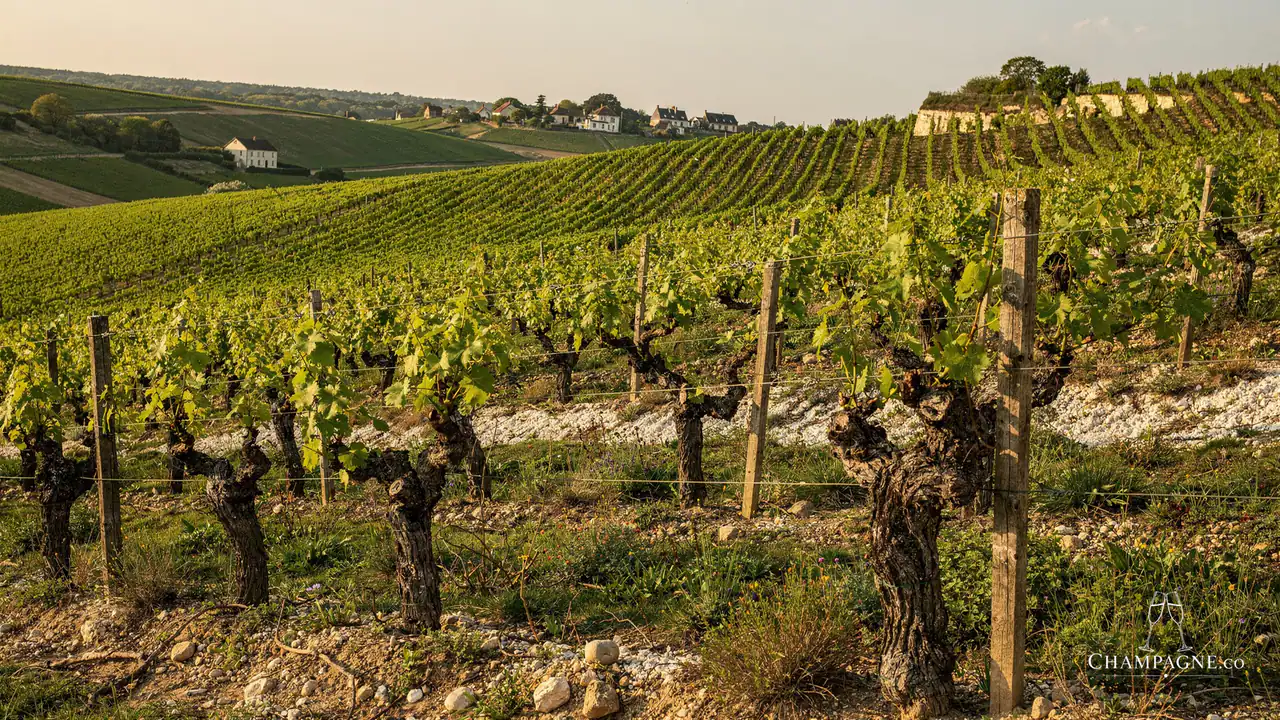
The domaine is rooted in Grand Cru villages including Avize, Cramant and Oger. Chalk-rich Côte des Blancs soils and Chardonnay dominate the estate’s identity, but Pinot Noir from Aÿ and Ambonnay plays an important role in wines such as 3A.
The vineyards have been certified organic since 2010 and Demeter biodynamic since 2013. Current estate material also describes biodynamic preparations, soil cultivation by tractor and horse on selected parcels, and a preference for replacing individual dead vines rather than routinely replanting entire blocks.
Cellar and winemaking
De Sousa uses coated steel tanks and barrels, with the vessel chosen according to the wine. Since 1995, selected old-vine lots have been vinified in small oak barrels; current cellar material describes old-vine fruit over 60 years old as the principal focus of that programme.
The house currently lists indigenous and cultured yeast sources, fermentation at around 18°C, minimal filtration or no filtration depending on the current cellar description, and no fining. Valentin De Sousa is identified as the current cellar master.
The broader point is stylistic rather than procedural: the estate preserves a clear steel-vinified core while using oak, old vines and parcel differentiation selectively at the upper end of the range.
Champagne.co analysis
De Sousa is best understood as a grower that uses old vines and biodynamic farming as practical tools rather than as decorative claims. The estate’s Grand Cru Chardonnay base provides continuity, while oak, grape variety and village origin are used to separate the more ambitious cuvées.
The range is therefore easier to navigate by method and origin than by price alone. Extra-Brut Réserve isolates Chardonnay; 3A brings together Avize, Aÿ and Ambonnay; Mycorhize narrows the focus to biodynamically cultivated Grand Cru Chardonnay; and Caudalies adds the strongest old-vine and oak component.
The family transition also matters. With the next generation now running the domaine, the current team is maintaining the farming and old-vine framework while giving the cellar a clear contemporary structure.
Buying guidance
Start with Tradition for the broadest view of the house, or Extra-Brut Réserve if you want a more direct Chardonnay-led introduction.
Choose 3A to explore the contrast between Côte des Blancs Chardonnay and Pinot Noir from Aÿ and Ambonnay. Mycorhize is the more focused biodynamic Grand Cru Chardonnay expression, while Cuvée des Caudalies is the clearest choice for readers interested in the domaine’s old-vine, barrel-vinified style.
Exact blends, vintages and dosage can vary between releases, so technical details are best read against the specific bottle rather than treated as permanent formulas.
Loading current Champagne range…
Spotted something wrong? Report a correction
Every report goes to a human review queue. Nothing on this page changes automatically.