Dehours & Fils
Champagne Dehours & Fils is a family grower based at Cerseuil, within Mareuil-le-Port on the left bank of the Vallée de la Marne. Its vineyard is unusually fragmented: 45 parcels spread across Mareuil-le-Port, Oeuilly and Troissy, with Meunier as the…
Editorial profile
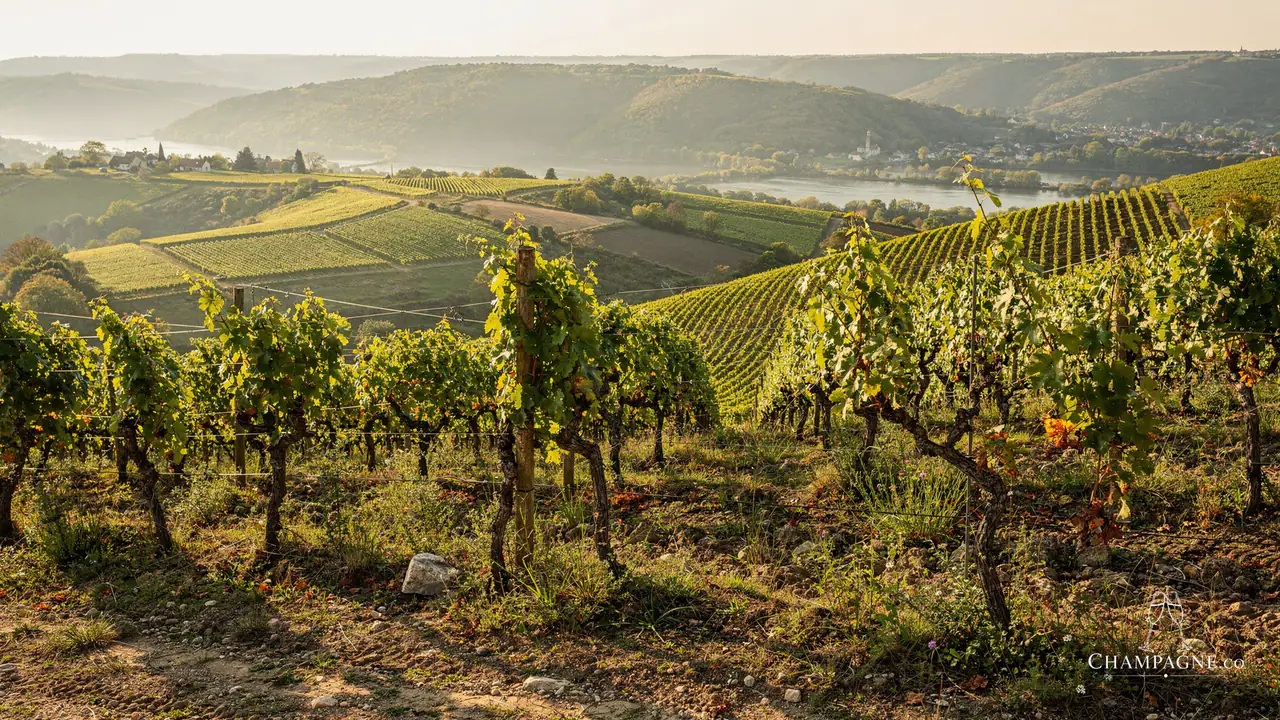
Champagne Dehours & Fils is a family grower based at Cerseuil, within Mareuil-le-Port on the left bank of the Vallée de la Marne. Its vineyard is unusually fragmented: 45 parcels spread across Mareuil-le-Port, Oeuilly and Troissy, with Meunier as the principal grape alongside Chardonnay and Pinot Noir and small plantings of other varieties in particular sites.
That fragmentation is central to the domaine's identity. Exposures, altitudes, vine ages and soils vary from parcel to parcel, while the broader geological picture is one of clay and sand over limestone bedrock. Rather than smoothing those differences into a single house style, Dehours has increasingly organised its range around individual places and the way they behave over successive harvests.
The family traces the domaine to 1930. After a period of outside financial involvement following the death of the founders' son, the family regained control in 1996. The first parcel-specific wines, Les Genevraux and Brisefer, followed in 1999. Jérôme, Caroline and Laurence Dehours remain involved in the domaine today.
Why this producer matters
Dehours is a useful reference point for contemporary Meunier-led Champagne because it combines a recognisably Vallée de la Marne base with a serious parcel programme. The wines are not simply divided by grape variety: the estate distinguishes sites by soil, exposure, vine material and the way each parcel is handled in the cellar.
A second defining idea is the use of perpetual reserves for the parcel cuvées. These were initiated from 2013, allowing successive harvests from the same place to be combined rather than making every parcel wine a conventional vintage statement. The approach gives Dehours a distinctive way of exploring site while moderating the effect of an individual year.
Vineyards and terroir
The 45 parcels lie in Mareuil-le-Port, Oeuilly and Troissy. Meunier is the estate's principal variety, but individual sites can be very different. Brisefer, for example, is an old Chardonnay parcel in Mareuil-le-Port with red-clay soils, while Les Genevraux is a massal-selection Meunier parcel planted in 1979 on clay over limestone stones in Troissy. La Croix Joly is another old-vine Meunier site in Troissy, on a gentle slope with clay-rich sand over limestone.
La Côte takes a different form: it brings together four neighbouring parcels above Port-à-Binson, mixing Meunier, Pinot Noir and small amounts of Chardonnay and other varieties. Maisoncelle is likewise mixed, with Pinot Noir dominant alongside Meunier, Pinot Blanc and Petit Meslier.
The estate is listed by Comité Champagne as Haute Valeur Environnementale (HVE).
Cellar and winemaking
The parcel programme makes extensive use of oak for fermentation and élevage. Current estate information describes barrel fermentation for several named parcels, with ageing in either barrels or larger oak vessels depending on the wine. Natural clarification without filtration or fining is used for the parcel wines described in the current range.
For the perpetual-reserve parcel cuvées, the reserve system began in 2013. The estate's current overview gives a 50% annual renewal rate, while the precise handling and dosage remain specific to each named wine and release.
Champagne.co analysis
Dehours is most interesting when viewed as a grower built around differences rather than uniformity. Meunier gives the estate a strong regional anchor, but the real story is the decision to keep looking more closely: first at individual parcels, then at massal selections and mixed plantings, and finally at how a place can be carried through time via perpetual reserve.
That makes the range especially rewarding for drinkers who want to compare interpretations of the Vallée de la Marne rather than simply choose between brut, rosé and vintage categories. The blended wines provide the broadest introduction; the named parcels reveal the domaine's more granular side.
Buying guidance
For a first bottle, start with one of the principal blended Champagnes to understand the estate's Meunier-led Vallée de la Marne profile. Buyers already familiar with the domaine should look to the named parcels, choosing according to site and grape rather than assuming that all of them share the same composition or cellar treatment.
For parcel wines, dosage, disgorgement, bottling and reserve composition can vary by wine and release. Use the information on the specific bottle when comparing different releases.
Loading current Champagne range…
Spotted something wrong? Report a correction
Every report goes to a human review queue. Nothing on this page changes automatically.