Delamotte
Delamotte is one of Champagne's historic houses, founded by François Delamotte in 1760. The house is now firmly identified with Le Mesnil-sur-Oger and the Côte des Blancs, where Chardonnay provides the clearest thread through a deliberately compact range.
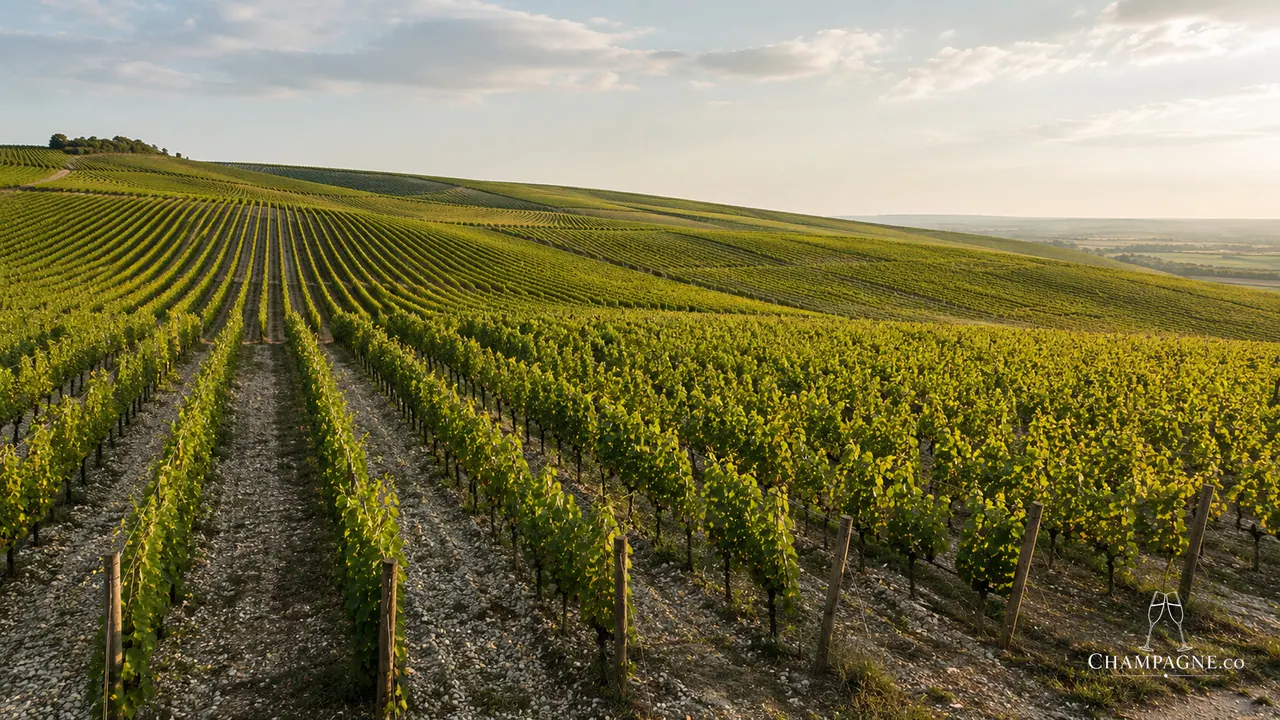
Editorial profile
Delamotte is one of Champagne's historic houses, founded by François Delamotte in 1760. The house is now firmly identified with Le Mesnil-sur-Oger and the Côte des Blancs, where Chardonnay provides the clearest thread through a deliberately compact range.
The modern catalogue contains four wines: Brut, Blanc de Blancs, Rosé and a vintage Blanc de Blancs. That restraint is useful in understanding Delamotte. Rather than a large hierarchy of labels, the range moves from a three-variety house Brut to increasingly explicit expressions of Côte des Blancs Chardonnay.
Why this producer matters
Delamotte combines the continuity of an old Champagne house with an unusually focused contemporary identity. Its historical roots reach back to the eighteenth century, but its present centre of gravity is the chalk and Chardonnay of the Côte des Blancs.
The house's small range also makes the stylistic progression easy to read. Brut provides the broad house introduction; Blanc de Blancs shifts the emphasis fully to Chardonnay; and the vintage Blanc de Blancs narrows that focus to a single harvest drawn from leading Côte des Blancs villages.
House and Côte des Blancs identity
François Delamotte was a vineyard owner in Reims when he founded the house in 1760. Delamotte is today based in Le Mesnil-sur-Oger, and its own current material places the Côte des Blancs at the heart of the wines.
For the Chardonnay cuvées, the relevant village network includes Le Mesnil-sur-Oger, Avize, Oger, Cramant, Chouilly and Oiry. The common geological theme is Champagne's chalk, but the house uses multiple villages rather than presenting the Côte des Blancs as a single homogeneous site.
Cellar and winemaking
The non-vintage Blanc de Blancs is 100% Chardonnay and is vinified in stainless steel. It spends four to five years on lees before disgorgement, substantially longer than the minimum ageing requirement for non-vintage Champagne.
The vintage Blanc de Blancs is release-specific. The 2018 currently documented by the house is 100% Chardonnay and spent four years on lees. Older vintages can have different ageing periods, so technical details should not be transferred from one vintage to another.
Champagne.co analysis
Delamotte's strength is clarity. The range is small enough that each bottle has an obvious job, while the progression toward Chardonnay and the Côte des Blancs gives the house a coherent identity without requiring a complicated prestige hierarchy.
For drinkers exploring Côte des Blancs Champagne, Delamotte is particularly useful because the non-vintage Blanc de Blancs and vintage Blanc de Blancs offer two different frames for the same broad regional idea: one built for continuity through blending and reserve wine, the other tied to the conditions of a single harvest.
Buying guidance
Start with Delamotte Brut if you want the broadest picture of the house. Choose Blanc de Blancs when Chardonnay and Côte des Blancs character are the priority. The vintage Blanc de Blancs is the more release-specific purchase and is best considered by vintage rather than as a permanently identical wine.
Because vintage availability changes, check the vintage stated on the bottle rather than assuming that the 2018 remains the current market release everywhere.
Loading current Champagne range…
Spotted something wrong? Report a correction
Every report goes to a human review queue. Nothing on this page changes automatically.