Devaux
Champagne Devaux is a Côte des Bar house based at Domaine de Villeneuve near Bar-sur-Seine. Its history reaches back to 1846, when the Devaux family established the house in Épernay. A decisive change came in 1987: with no family heir to continue the…
Editorial profile
Champagne Devaux is a Côte des Bar house based at Domaine de Villeneuve near Bar-sur-Seine. Its history reaches back to 1846, when the Devaux family established the house in Épernay. A decisive change came in 1987: with no family heir to continue the business, Jean-Pol Auguste Devaux entrusted the brand to Union Auboise, the winegrowers’ cooperative now known as Groupe Vinicole Champagne DEVAUX.
That structure is central to the modern identity. Devaux is not simply a historic marque transplanted south from Épernay; it is now closely tied to a network of partner growers in the Côte des Bar. Pinot Noir from this southern part of Champagne forms the backbone of the house’s blends, with Chardonnay used to bring freshness and length.
Why this producer matters
Devaux offers an unusually clear bridge between historic Champagne-house culture and the cooperative grower model of the Aube.
The house’s D Selection programme asks participating growers to work to a dedicated set of vineyard requirements. More than 100 growers are described as participating in this approach. In the cellar, Devaux also makes significant use of reserve wines matured in large oak vats and reserves its first-press juice for its Champagne blends.
Côte des Bar and vineyard identity
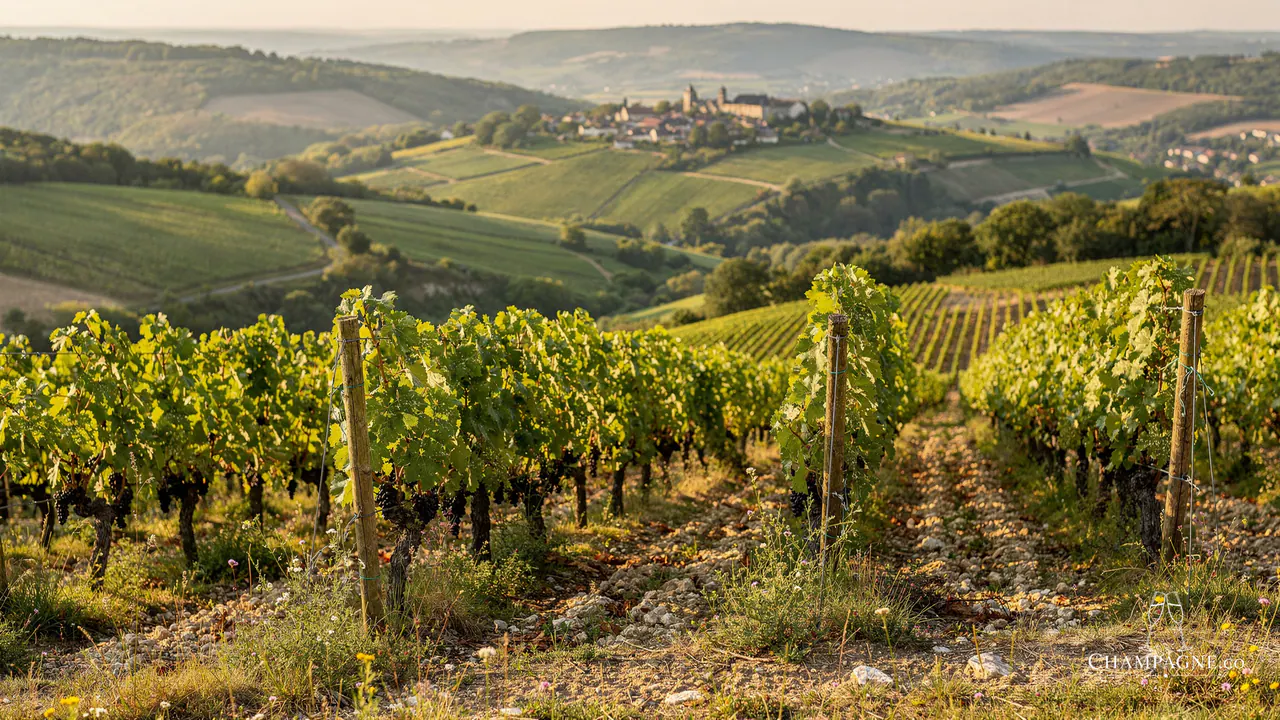
Devaux’s home territory is the Côte des Bar, where Pinot Noir is the dominant variety and the landscape differs markedly from the northern Champagne districts around Reims and Épernay. The house also draws Chardonnay from areas including the Côte des Blancs and Montgueux for relevant blends.
Its partner-grower model is supported by a formal sustainability programme. Devaux currently lists Viticulture Durable en Champagne and Haute Valeur Environnementale certification for vineyard practices, alongside ISO 14001 and ISO 22000 management standards.
Winemaking and cellar approach
Time in bottle is one of the clearest structural differences between the principal ranges. Collection D bottles receive at least five years of cellar ageing, while the Classics are presented with a minimum of three years’ maturation. Reserve wines are predominantly matured in oak vats, and Devaux differentiates its selections at pressing, including use of the cœur de cuvée for Collection D.
Cuvée D illustrates the approach. The current release specification gives a blend of 55% Pinot Noir and 45% Chardonnay, with 35–40% reserve wine, partial malolactic fermentation and at least five years’ ageing for the 75cl bottle. Those figures describe the current Cuvée D specification rather than a permanent formula for every future release.
Champagne.co analysis
Devaux is most interesting when viewed as a Côte des Bar producer with house-scale resources rather than as an Épernay-style house that happens to operate in the Aube. Its cooperative ownership gives it a broad grower base, while the D Selection programme, reserve-wine regime and extended maturation create a recognisable house framework around that fruit.
The range is therefore best read in two directions. Collection D emphasises cellar time and blending architecture; the Cœur wines bring the regional and vineyard identity closer to the surface. Together they show how Devaux combines the consistency expected of a house with a stronger sense of its southern Champagne base.
Buying guidance
For a first look at the house, Cuvée D is the logical reference point because it captures the mature, reserve-wine-led Collection D approach. Buyers specifically interested in the Côte des Bar and Pinot Noir should also look toward Cœur des Bar Blanc de Noirs. Ultra D suits those seeking the Collection D framework in an extra-brut expression, while Sténopé and vintage D releases are better treated as release-specific purchases because their details change with the vintage.
Still wines such as Rosé des Riceys and Coteaux Champenois should be considered separately from the Champagne range.
Loading current Champagne range…
Spotted something wrong? Report a correction
Every report goes to a human review queue. Nothing on this page changes automatically.