Dhondt-Grellet
Dhondt-Grellet is a small family grower based at Flavigny, beside the Côte des Blancs. Éric Dhondt and Édith Grellet began producing Champagne under their own name in 1986, bringing together family vineyard interests rather than continuing to sell all of…
Editorial profile
Dhondt-Grellet is a small family grower based at Flavigny, beside the Côte des Blancs. Éric Dhondt and Édith Grellet began producing Champagne under their own name in 1986, bringing together family vineyard interests rather than continuing to sell all of their grapes. Their son Adrien Dhondt later took over the winemaking direction, and current French company records list both Adrien and Alice Dhondt as managers of the present agricultural business.
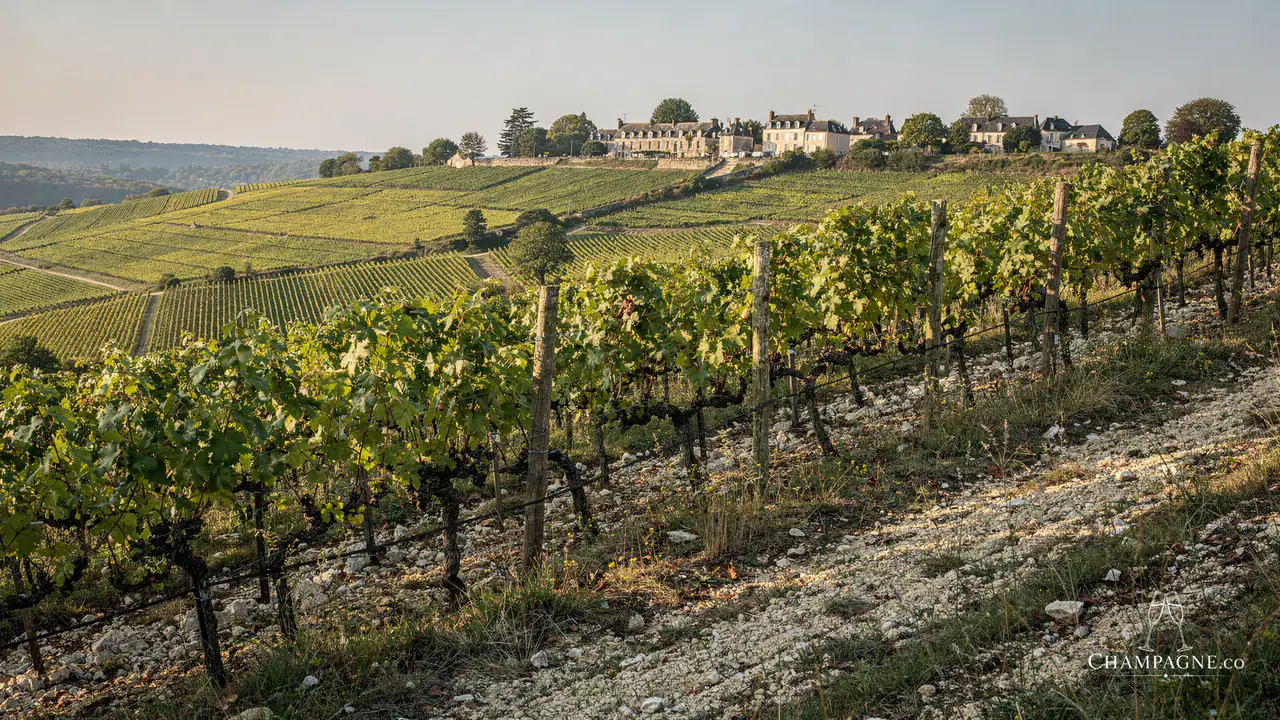
The domaine works roughly six hectares. Chardonnay provides the centre of gravity, particularly through holdings in Cramant, Chouilly and Cuis, while the family also has Chardonnay farther south in the Sézannais and a smaller Pinot Noir presence around Avenay-Val-d'Or in the Vallée de la Marne. That geography explains why the range is better understood through villages and individual sites than through a single generic house style.
The modern portfolio has become increasingly parcel-conscious. Village wines sit alongside named-site bottlings, giving the domaine a clear progression from a broad introduction to more narrowly defined Côte des Blancs expressions.
Why this producer matters
- Family Champagne production dates to 1986.
- The domaine remains small at about six hectares, with Chardonnay dominant.
- Cramant, Chouilly and Cuis form the core Côte des Blancs identity, with additional family holdings beyond those villages.
- Adrien Dhondt has developed a more parcel-specific range rather than relying on one blended hierarchy.
- Farming is described through organic and biodynamic methods without a formal certification claim.
- Barrel fermentation, ambient yeasts and long-running reserve-wine systems are important parts of the cellar architecture.
Vineyard and cellar identity
The vineyards are spread across Premier Cru and Grand Cru sectors as well as other family parcels. Cramant and Cuis are especially important because they recur both in the domaine's geography and in the names of its most recognisable wines. The smaller Avenay-Val-d'Or holding adds Pinot Noir to what is otherwise a strongly Chardonnay-led identity.
Current viticultural descriptions consistently point to ploughed soils, estate compost, avoidance of herbicides and insecticides, and the use of organic and biodynamic methods. Dhondt-Grellet is therefore best described as farming with those approaches rather than as a formally certified organic or biodynamic estate.
In the cellar, most wines are associated with fermentation and élevage in oak, generally with ambient yeasts. The domaine also works with perpetual reserve wines whose history reaches back to the family's first production in 1986. The broad introductory cuvée retains a more blended role, while the upper part of the range increasingly isolates village and parcel identity.
Champagne.co analysis
Dhondt-Grellet's significance lies in the way a very small family domaine has been reorganised around increasingly precise vineyard identity. The six-hectare scale matters: there is enough geographical diversity to compare Cuis, Cramant, Chouilly and other family holdings, but the estate remains compact enough for individual parcels to occupy a meaningful place in the range.
The most useful way to understand the wines is therefore as a progression. Dans un Premier Temps gives the broadest view of the domaine; Les Terres Fines and Cramant narrow that view to village identity; Les Nogers and Le Bateau take it to specific sites. Oak and perpetual reserves add continuity in the cellar, but the range is ultimately organised around origin rather than a single invariant blend formula.
Buying guidance
For a first bottle, Dans un Premier Temps is the most representative starting point because it introduces the wider estate rather than one parcel. Move to Les Terres Fines for a clearer Cuis Chardonnay reference, or Cramant for the Grand Cru side of the domaine.
For readers specifically interested in parcel Champagne, Les Nogers and Le Bateau are the most direct choices because their identities are tied to named sites. These wines are also the bottles where vintage or base-year differences matter most, so the exact release should be considered part of the buying decision rather than assuming every bottling is technically identical.
Loading current Champagne range…
Spotted something wrong? Report a correction
Every report goes to a human review queue. Nothing on this page changes automatically.