Domaine B. Girardin
Domaine B. Girardin is a family independent grower based in Mancy, immediately south of Épernay. The domaine was established in the early 1970s by Bernard Girardin as the family expanded its vineyards, created its own cellars and press, and developed…
Editorial profile
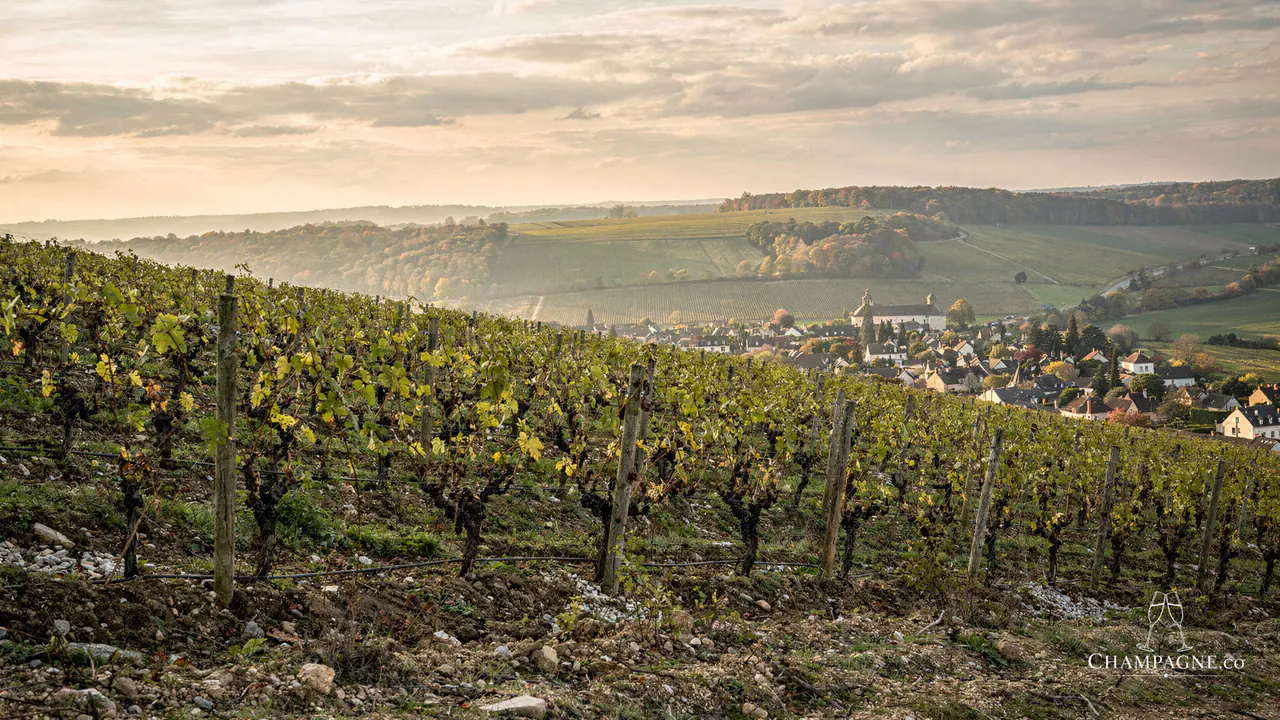
Domaine B. Girardin is a family independent grower based in Mancy, immediately south of Épernay. The domaine was established in the early 1970s by Bernard Girardin as the family expanded its vineyards, created its own cellars and press, and developed Champagne under its own name. The second generation, Sandrine, took charge in the mid-1990s; today the second and third generations work together.
The domaine is unusual in drawing its identity from two distinct vineyard areas: the Coteaux Sud d'Épernay around Mancy and vineyards in the Vitryat farther east. All of its Champagnes are made from estate-grown grapes, pressed and vinified in Mancy. Chardonnay, Meunier and Pinot Noir all appear in the range, with the two vineyard zones used both separately and in combination.
The portfolio is being reorganised into three collections — Première Partition, Hors du Temps and Anima Vinea. For now, the individual cuvées remain the clearest way to understand the domaine's unusually broad stylistic range.
Why this producer matters
- Family domaine founded in the early 1970s and now involving the second and third generations.
- Independent grower using only estate-grown grapes.
- Vineyard identity spans both the Coteaux Sud d'Épernay and the Vitryat.
- The estate works with all three principal Champagne grapes.
- HVE certification is current.
- Fermentation uses indigenous yeasts; stainless steel has been central since 2008.
- Oak barrels and amphorae have been used for no-input vinifications since the 2022 harvest.
- The range includes Brut, Blanc de Blancs, vintage Brut Nature, Meunier rosé and an unusual Doux Champagne.
Vineyard and cellar identity
The Mancy vineyards give the domaine its home base in the Coteaux Sud d'Épernay, while the Vitryat adds a second, geographically separate source of Chardonnay. Vibrato makes that contrast explicit by bringing Chardonnay from Mancy and Vitry-en-Perthois into the same Blanc de Blancs.
The domaine holds Haute Valeur Environnementale (HVE) certification. Most soils are cultivated, and the estate also trials organic treatments and biodynamic preparations. Those trials are part of the farming programme but do not amount to organic or biodynamic certification.
All grapes are pressed at the domaine in a pneumatic press. Fermentations use indigenous yeasts. Stainless-steel vinification has been used since 2008, while oak barrels and amphorae joined the cellar programme for no-input vinifications from the 2022 harvest. That gives the estate a broader vessel palette without implying that every wine follows the same élevage.
Champagne.co analysis
Domaine B. Girardin is best understood through contrast. The vineyard base is split between Mancy and the Vitryat; the cellar uses both stainless steel and alternative vessels; and the range moves from three-grape Brut to Chardonnay Blanc de Blancs, black-grape vintage wine, pure-Meunier rosé and Doux Champagne.
That breadth could look eclectic, but the musical naming system gives the range a coherent organising idea without needing to turn it into a quality ranking. More importantly, the cuvées are technically distinct enough to teach the reader something different about the domaine: Appoggiature shows assemblage, Vibrato shows two-terroir Chardonnay, Point d'Orgue shows vintage black grapes, Coloratura isolates old-vine Meunier, and Rubato explores dosage as a deliberate stylistic choice.
The new three-collection structure may eventually become the simplest way to navigate the estate; at present the individual wines provide the more useful map.
Buying guidance
Start with Appoggiature for the broadest view of the domaine. Choose Vibrato if the attraction is Chardonnay and the contrast between the Coteaux Sud d'Épernay and Vitryat.
For a more individual expression, Coloratura 2021 is the clearest route into old-vine Meunier and a single-harvest rosé, while Point d'Orgue 2012 is the mature vintage option built entirely from black grapes.
Rubato should be bought for a different reason: it is a deliberately sweet Doux Champagne, not a substitute for the estate's Brut or Brut Nature wines. Buyers who normally drink very dry Champagne should treat it as a separate style rather than as a higher or lower rung of the same ladder.
Loading current Champagne range…
Spotted something wrong? Report a correction
Every report goes to a human review queue. Nothing on this page changes automatically.