Domaine La Borderie
Domaine La Borderie is a small-volume family grower based at the Ferme de la Folie in Bar-sur-Seine, in the Côte des Bar. The family vineyard was assembled by Odile and Jean-Louis Normand, whose children Marie and Simon Normand took the project forward in…
Editorial profile
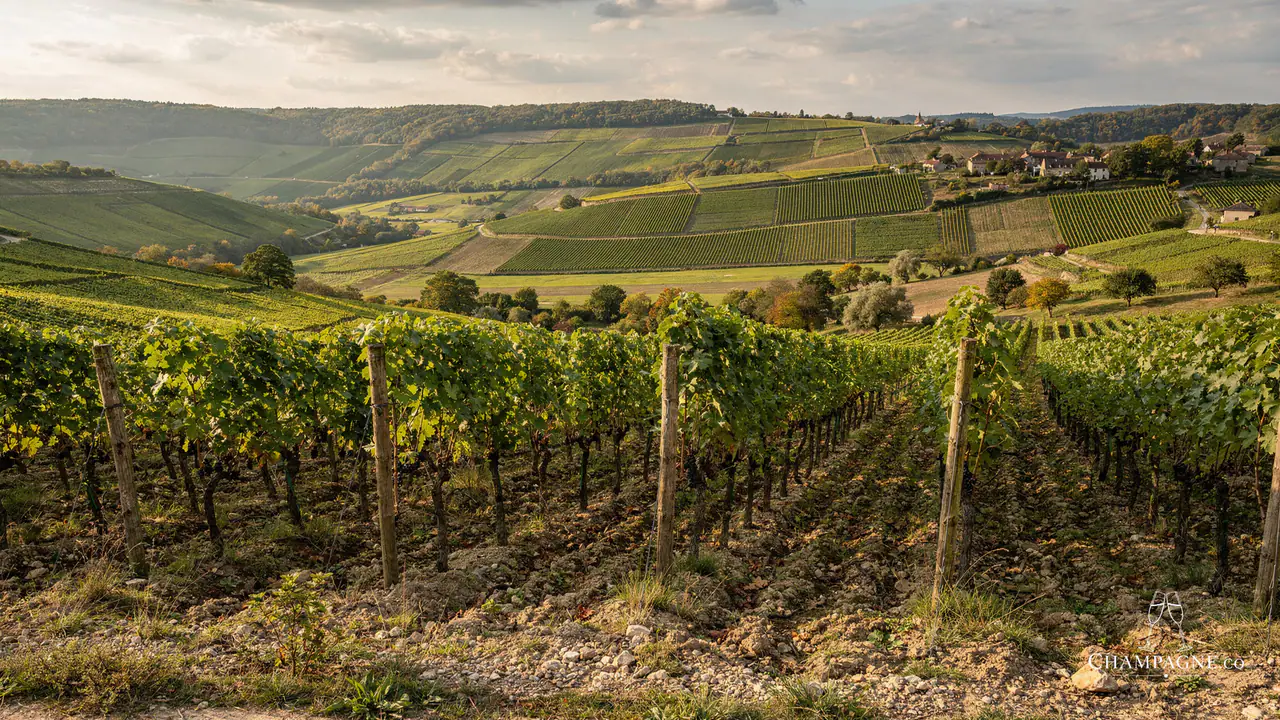
Domaine La Borderie is a small-volume family grower based at the Ferme de la Folie in Bar-sur-Seine, in the Côte des Bar. The family vineyard was assembled by Odile and Jean-Louis Normand, whose children Marie and Simon Normand took the project forward in 2013 after building experience both within and beyond the family estate.
Scale is important here. The wider family vineyard covers 11 hectares, but only about 1.5 hectares are currently reserved for wines bottled as Domaine La Borderie, representing roughly 10,000 bottles a year. The balance supplies cooperative and house customers. The domaine's identity therefore comes from selection rather than from putting the whole family vineyard under one label.
Four grape varieties are grown: Pinot Noir, Chardonnay, Meunier and Pinot Blanc. The cellar is designed to keep many parcels separate, allowing individual sites or small combinations of sites to become distinct wines rather than disappearing automatically into a single house blend.
Why this producer matters
- Family vineyard of 11 hectares, with about 1.5 hectares dedicated to Domaine La Borderie bottlings.
- Domaine-labelled production is roughly 10,000 bottles per year.
- Marie and Simon Normand have led the modern project since 2013.
- The estate grows Pinot Noir, Chardonnay, Meunier and Pinot Blanc.
- Around twenty parcels can be isolated separately in the cellar.
- The domaine is certified HVE and Viticulture Durable en Champagne (VDC).
- Herbicides, insecticides and acaricides have not been used in the vineyards since 2012.
- The range deliberately separates multi-site Champagne, parcel Champagne and Coteaux Champenois.
Vineyard and cellar identity
The vines average about 30 years of age and span varied exposures, geological situations and rootstocks. This diversity is important to the domaine because the cellar has been built to preserve it: around twenty parcels can be pressed and vinified separately, giving Marie and Simon the option to create single-site wines or highly selective blends.
Environmental practice is precisely defined. Domaine La Borderie holds HVE and VDC certification. Since 2012 the vineyards have been farmed without herbicides, insecticides or acaricides; disease control relies mainly on copper, sulphur and biocontrol products, with part of the vineyard used for trials based entirely on natural treatments. These practices do not amount to organic certification.
The range crosses appellation boundaries. Sparkling Champagne remains central, but the domaine also produces red and white Coteaux Champenois. Those still wines are part of the same parcel philosophy but are separate appellation products, not Champagne cuvées without bubbles.
Champagne.co analysis
Domaine La Borderie's defining feature is not simply small production; it is selective small production inside a much larger family vineyard. Only a fraction of the 11 hectares becomes domaine-labelled wine, which gives Marie and Simon room to choose particular parcels, exposures and grape combinations rather than needing every plot to fit one commercial range.
That selection is visible in the wines. Trois Contrées demonstrates how different sites can be assembled deliberately; Douce Folie isolates one Pinot Noir parcel and one harvest condition; Val Moré narrows the focus further; Les Devoix carries the same vineyard thinking into still wine. The domaine therefore makes most sense when read as a study in micro-terroir and selection, not as a conventional volume hierarchy.
Pinot Blanc adds another dimension. It is not present merely as a historical curiosity: it contributes directly to Trois Contrées alongside Pinot Noir and Chardonnay, giving the estate a practical four-variety identity rather than a purely three-grape one.
Buying guidance
Start with Trois Contrées for the broadest view of Domaine La Borderie. It combines three grapes, villages and exposures and therefore explains the estate more completely than any single parcel wine.
Choose Douce Folie if the attraction is Pinot Noir rosé from one site and one suitable harvest. Move to Val Moré when you want a more narrowly defined vintage Blanc de Noirs, or to La Confluente 2014 for the Chardonnay side of the domaine.
The Les Devoix wines are for buyers specifically interested in Côte des Bar still wine. They are Coteaux Champenois rather than sparkling Champagne and offer a different way of reading the same parcel-focused estate.
Loading current Champagne range…
Spotted something wrong? Report a correction
Every report goes to a human review queue. Nothing on this page changes automatically.