Domaine Méa
Domaine Méa is a family grower based in Louvois, on the Montagne de Reims. The estate traces five generations of family continuity through the Méa, Milesi and Moussié families. Sophie Moussié joined the family business in 2010, and her husband Franck…
Editorial profile
Domaine Méa is a family grower based in Louvois, on the Montagne de Reims. The estate traces five generations of family continuity through the Méa, Milesi and Moussié families. Sophie Moussié joined the family business in 2010, and her husband Franck joined her in 2019; they now lead the domaine with continuing support from Evelyne and Jean-Louis.
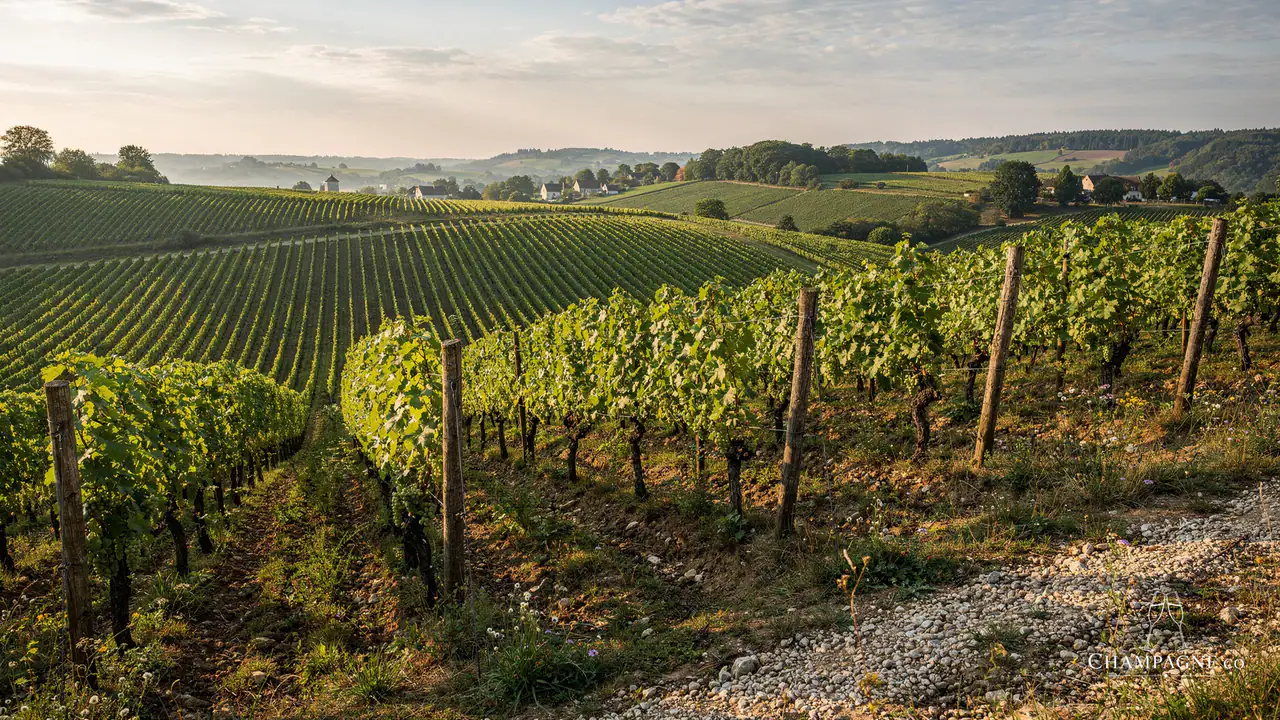
The vineyard is centred on the Montagne de Reims but is no longer confined to one side of it. Historic holdings include Louvois and Bouzy on the southern side and Ludes, Chigny-les-Roses and Montbré on the north. The domaine also works in Mareuil-sur-Aÿ and Hautvillers from 2023 and in Mailly Grand Cru from 2025. Its stated vineyard mix is 72% Pinot Noir, 20% Chardonnay and 8% Meunier.
Why this producer matters
Domaine Méa is useful to understand as a grower with a genuinely broad Montagne de Reims footprint rather than as a single-village specialist. The estate can draw on Pinot Noir-led southern sectors, cooler northern exposures and, more recently, sites beyond its historic core.
That diversity is reflected in the way the range is organised. Méa separates broad Montagne de Reims blends from wines focused on northern or southern terroirs, while also bottling Coteaux Champenois from Louvois and Bouzy. The structure makes geography more important than a simple ascending prestige ladder.
The farming programme is also in transition. The domaine states that it has used no chemical fertiliser, herbicides or pesticides since 2016 and that it entered organic-certification conversion in 2022. That is a conversion commitment rather than a claim here that certification has already been completed.
Vineyards and terroir
On the southern Montagne de Reims, the estate identifies Louvois and Bouzy as Grand Cru sources and Tauxières-Mutry as Premier Cru. These sites are principally south- and south-west-facing, with calcareous and clay-limestone soils that include Campanian chalk and local clay-flint material.
The northern holdings include Ludes, Montbré and Chigny-les-Roses, all Premier Cru, together with Mailly Grand Cru from 2025. Their generally north, north-east and north-west exposures create a different setting from the southern vineyards.
A further extension into the Marne Valley began in 2023, with Premier Cru sites in Mareuil-sur-Aÿ and Hautvillers. For buyers, the important point is not merely the number of villages but the domaine's ability to work across contrasting exposures and soil contexts while keeping those origins visible in the range.
Winemaking and cellar approach
Méa vinifies by parcel or terroir where useful, allowing the cellar to compare sites before final blending. The domaine describes approximately nine months of élevage for its still base wines before tirage, using a combination of enamelled vats, stainless steel and oak, with reserve wines held in its semi-underground cellars.
Technical choices vary by wine. Oak, amphora, reserve-wine systems, lees ageing and dosage are therefore best read at cuvée level rather than treated as fixed house rules. This is particularly important because the domaine explicitly says that dosage can change with the character of an assemblage and disgorgement.
Champagne.co analysis
Domaine Méa's strongest organising idea is geography made legible through the range. The domaine has enough spread across the Montagne de Reims to contrast northern and southern sectors rather than reducing its identity to Louvois alone, and its newer holdings in Mareuil-sur-Aÿ, Hautvillers and Mailly broaden that map further.
Pinot Noir remains the statistical centre of gravity, accounting for nearly three quarters of the stated vineyard mix, yet the range does not behave like a one-grape portfolio. Chardonnay is important in Le Grillon, Rosa and La Cuvée des Loups, while the Coteaux Champenois programme offers another way to read the same villages without secondary fermentation.
The cellar approach reinforces that geographic logic. Parcel or terroir separation comes before blending, and oak or amphora appears selectively rather than as a universal signature. Méa is therefore most coherent when viewed as a grower using different vessels and assemblages to interpret a relatively diverse vineyard base.
Buying guidance
Start with L’Assemblage for the broadest introduction to the domaine: it is designed to bring together the diversity of Méa's Montagne de Reims holdings and is Pinot Noir-led without being monovarietal.
Choose Le Grillon when you want to explore the cooler northern side of the range with a Chardonnay majority. For a more concentrated southern Grand Cru reference point, La Cuvée des Loups 2019 places Louvois and Bouzy together in equal Pinot Noir and Chardonnay proportions.
The two rosés serve different interests. Rosa is an assemblage rosé combining white Champagne base wine with Bouzy Rouge, while La Saignée de Bouzy is a Pinot Noir saignée raised in amphora. Buyers interested in still Champagne-region wines should look instead to Bouzy Rouge and Louvois Blanc, remembering that these are Coteaux Champenois rather than sparkling Champagne.
Release-specific blends, vintages, dosage and ageing can change, so technical numbers above apply only to the releases identified.
The dossier’s legacy project artwork is not treated as a cleared publication hero under the current real-image-first policy. A producer-specific publication hero remains a separate launch gate.
Loading current Champagne range…
Spotted something wrong? Report a correction
Every report goes to a human review queue. Nothing on this page changes automatically.