Edouard Brun & C°
Edouard Brun & C° is a family Champagne house in Aÿ, founded in 1898. The business passed into the Lefevre and Delescot family, and current industry records identify Philippe Delescot as managing director, cellar master and oenologist, with Emmanuel…
Editorial profile
Edouard Brun & C° is a family Champagne house in Aÿ, founded in 1898. The business passed into the Lefevre and Delescot family, and current industry records identify Philippe Delescot as managing director, cellar master and oenologist, with Emmanuel Delescot as chairman.
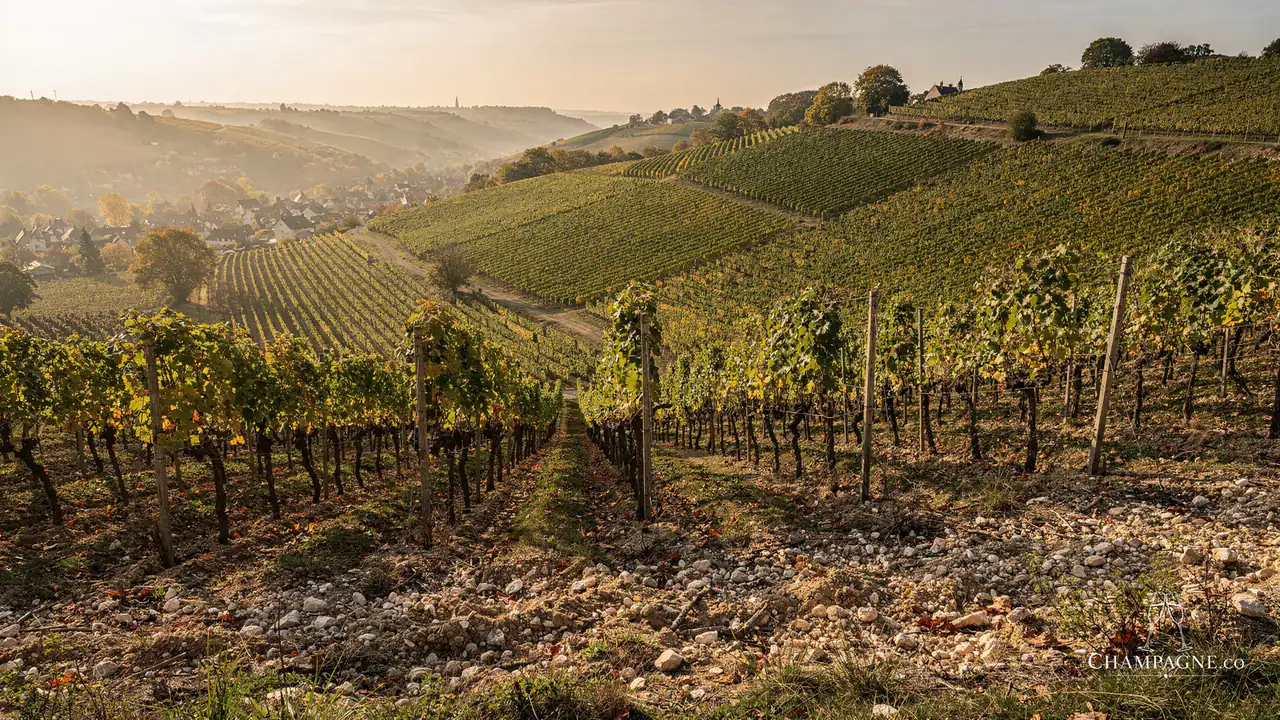
The house's own vineyard description puts its family holdings at around ten hectares, all in Premier Cru or Grand Cru villages. They extend beyond Aÿ into Mareuil-sur-Aÿ, Avenay-Val-d'Or, Hautvillers, Chigny-les-Roses and Ludes, and include Pinot Noir, Chardonnay and Meunier. Union des Maisons de Champagne data lists an eight-hectare vineyard estate; taken together, the records support a substantial family vineyard base while illustrating why a single hectare figure should not be treated as immutable.
Why this producer matters
Edouard Brun combines the structure of a Champagne house with a notably strong family-vineyard identity. Its Aÿ base and classified holdings give Pinot Noir an important role, yet the range also includes Chardonnay-led wines. The cellar approach reinforces that breadth: harvest juices are separated by village and classification and can be vinified in tank, barrel or larger wood before the family makes the final blends.
This makes the house useful for readers who want to explore how a smaller Aÿ maison can work across varieties, crus, dosage levels and ageing regimes without losing a clear geographic centre.
Vineyards and winemaking
The family vineyard spans Premier Cru and Grand Cru sites in six named villages. The house states that all three principal Champagne varieties are planted. At harvest, juices are handled separately by village and cru, with both stainless steel and wood used in vinification.
The current technical pages show that this is not merely a broad statement of intent. Réserve 1er Cru is currently specified as 75% Pinot Noir and 25% Chardonnay, with the Pinot fermented in barrel and the Chardonnay in temperature-controlled tank. L'Elégante is 80% Chardonnay and 20% Pinot Noir, while Brut Nature reverses the stylistic emphasis through long ageing and zero dosage.
Champagne.co analysis
Edouard Brun is best approached through contrasts. Aÿ and Pinot Noir provide one axis; Chardonnay-led L'Elégante and Blanc de Blancs provide another. Réserve 1er Cru shows the house's use of barrel-fermented Pinot, while Brut Nature demonstrates what extended ageing and zero dosage can do within the same producer's vocabulary.
The estate is therefore more interesting than a simple 'small family house' label suggests. Its classified-vineyard base and village-by-village handling give the range a coherent foundation, but the wines are deliberately varied in blend and style.
Buying guidance
Réserve 1er Cru is the logical starting point for a Pinot-led view of the house. Choose Blanc de Blancs or L'Elégante if Chardonnay is the priority, with L'Elégante offering the longer-aged, more ambitious route. Brut Nature is the clearest choice for readers who prefer zero dosage and extended ageing. Cuvée Spéciale provides the most accessible three-variety introduction to the broader house style.
Loading current Champagne range…
Spotted something wrong? Report a correction
Every report goes to a human review queue. Nothing on this page changes automatically.