Elise Bougy
Élise Bougy is a small grower based in Les Mesneux, with vineyards split between Les Mesneux Premier Cru on the Montagne de Reims and Le Mesnil-sur-Oger Grand Cru in the Côte des Blancs. Current records place the domaine at roughly three hectares, planted…
Editorial profile
Élise Bougy is a small grower based in Les Mesneux, with vineyards split between Les Mesneux Premier Cru on the Montagne de Reims and Le Mesnil-sur-Oger Grand Cru in the Côte des Blancs. Current records place the domaine at roughly three hectares, planted across Chardonnay, Pinot Noir and Meunier.
Bougy returned to the family vineyard after earlier work in the wine trade. Her separate agency, Les Bouchons d'Élise, was founded in 2014; the Champagne estate should be understood independently from that commercial activity.
Why this producer matters
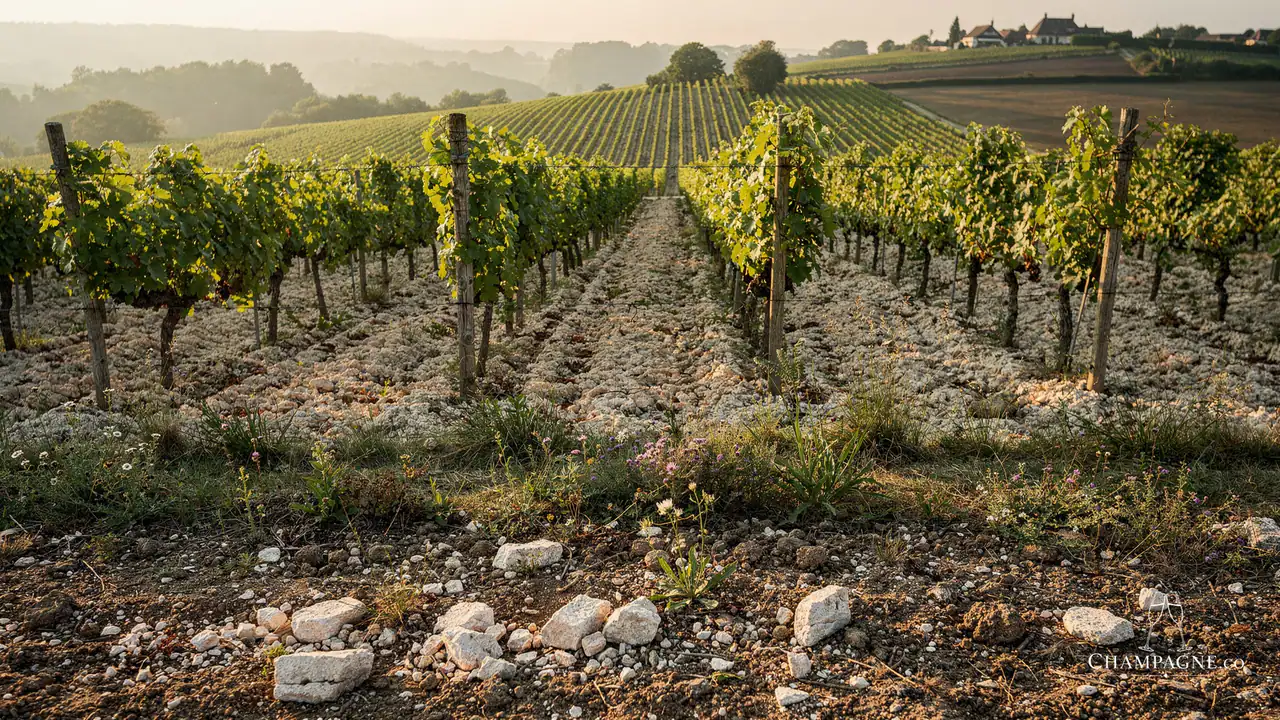
Few estates of this size provide such a direct comparison between two contrasting parts of Champagne. Les Mesneux supplies dark-skinned varieties and the family parcel Le Mont-Chainqueux, while Le Mesnil-sur-Oger supplies Chardonnay from Côte des Blancs chalk. The resulting range is organised around individual parcels rather than a broad house blend.
The estate is certified organic. Biodynamic methods are also reported in current specialist distribution records, but Champagne.co keeps the formal certification claim to organic status unless a separate current certification is established.
Vineyards and terroir
Around two-thirds of the vineyard is associated with Les Mesneux, with the remainder in Le Mesnil-sur-Oger. Le Mont-Chainqueux in Les Mesneux was planted by Bougy's grandparents in 1965. In Le Mesnil-sur-Oger, Les Coullemets and Chétillon de Haut provide the Chardonnay side of the estate.
That split is the key to reading the domaine: Les Mesneux and Le Mesnil-sur-Oger are not blended into a generic identity but presented through distinct parcel wines.
Cellar and winemaking
Current specialist records describe ambient-yeast fermentation, malolactic conversion and élevage in a mixture of wooden vessels and, depending on the wine, stainless steel. The wines are made in very small quantities and parcel identity is preserved through bottling.
Technical details vary by release.
Champagne.co analysis
Élise Bougy is most useful as a study in contrast. Le Mont-Chainqueux shows the Les Mesneux side of the domaine through Pinot Noir and Meunier, while Chétillon de Haut and Les Coullemets move to Chardonnay and Le Mesnil-sur-Oger. That makes the producer's tiny scale an advantage editorially: the range can be understood through a small number of clearly differentiated places.
The estate's limited production also means availability can be irregular. A bottle's parcel, base or vintage and disgorgement context matter more than any attempt to impose a permanent hierarchy on the wines.
Buying guidance
Start with Le Mont-Chainqueux if you want the Les Mesneux side of the estate, or Chétillon de Haut / Les Coullemets if your priority is Le Mesnil-sur-Oger Chardonnay. Vibration releases are scarcer and should be assessed by the exact bottling. Keep the still Coteaux Champenois wines separate when comparing prices or building a mixed purchase.
Because production is small, verify the exact cuvée and release shown by the seller rather than assuming that a parcel wine offered in one market is identical to a differently dated bottle elsewhere.
Loading current Champagne range…
Spotted something wrong? Report a correction
Every report goes to a human review queue. Nothing on this page changes automatically.