Étienne Sandrin
Anne and Étienne Sandrin returned to the family domaine in Celles-sur-Ource in 2006. Their project is rooted in the Côte des Bar and organised around farming and individual sites rather than a conventional prestige hierarchy. The domaine began organic…
Editorial profile
Anne and Étienne Sandrin returned to the family domaine in Celles-sur-Ource in 2006. Their project is rooted in the Côte des Bar and organised around farming and individual sites rather than a conventional prestige hierarchy. The domaine began organic conversion in 2014 and moved into biodynamic farming in 2015; Demeter France currently lists EARL Sandrin-Roussel as Demeter-certified.
The range is built around named places and vintages. Current producer material identifies À Travers Celles, Mouille-Brant, Val Champignat, Beauregard, Les Bondonnots, Grille Besace and Le Bruyant, giving the portfolio a strong site-led structure.
Why this producer matters
Sandrin is a clear example of a Côte des Bar grower using certified biodynamic farming and parcel identity as the organising principles of the domaine. The significance lies less in a long list of technical interventions than in the deliberate separation of places and years.
Demeter's current listing independently corroborates both the Celles-sur-Ource identity and biodynamic certification, and describes the cellar philosophy in explicitly parcel-and-vintage terms. That external certification record gives the farming claim firmer footing than producer marketing alone.
Vineyard and farming approach
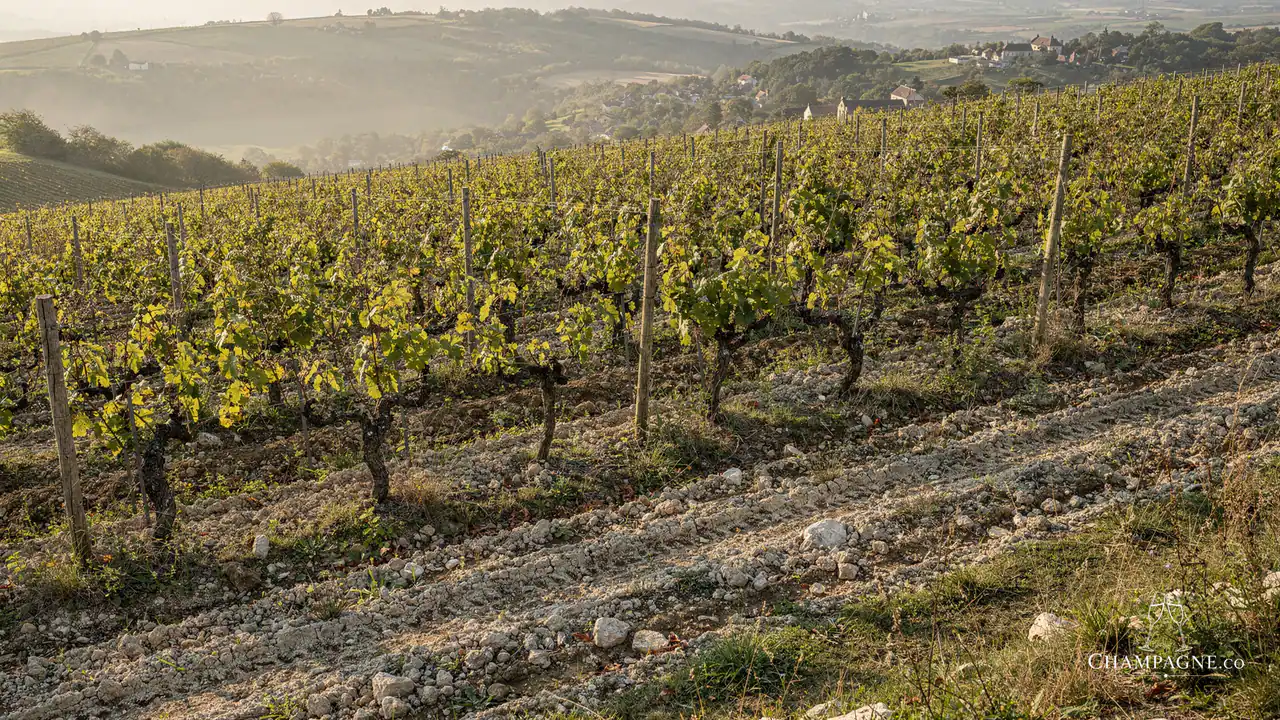
The domaine is based in Celles-sur-Ource, in the Aube's Côte des Bar. Sandrin's own account describes organic conversion beginning in 2014 and biodynamic work from 2015. Plant-based preparations and close observation of the estate's gardens, orchards and vines form part of the stated farming approach.
The wines are presented through named contrées rather than by flattening the vineyard into a single generic soil description. That distinction matters editorially: the domaine's identity is about differences between sites, so soil, blend and cellar specifications should remain attached to the relevant wine and vintage.
Winemaking and cellar approach
The producer's current presentation gives priority to one place, one wine and one year rather than a fixed house recipe. Demeter's listing similarly describes the cellar choice as a parcel, a wine and a winemaker's year.
They are not reliable permanent specifications for the entire domaine simply because they appear for one bottling.
Champagne.co analysis
Sandrin's range makes most sense when read as a map rather than a ladder. The wines are not primarily organised as progressively more prestigious cuvées; they are a set of viewpoints on places around a biodynamically farmed family domaine in Celles-sur-Ource.
That structure also explains why technical restraint is important when describing the producer. The durable facts are the family return, the biodynamic certification and the parcel-led architecture. Exact cellar numbers belong to individual releases.
Buying guidance
À Travers Celles is the logical entry point for readers who want the broadest introduction to Sandrin before moving into individual named sites. The parcel wines are better approached by exact vintage and site rather than by assuming one fixed style hierarchy across the range.
For buyers specifically interested in biodynamic Champagne, the current Demeter certification is a meaningful independently verified attribute. For the named contrées, check the precise release when comparing blend, dosage or cellar details because those can change with the wine and year.
Loading current Champagne range…
Spotted something wrong? Report a correction
Every report goes to a human review queue. Nothing on this page changes automatically.