Fleury
Champagne Fleury is a family estate in Courteron, in the Côte des Bar, where the family has grown vines since 1895. The domaine is now led by the fourth generation, with Morgane, Jean-Sébastien and Benoît Fleury carrying forward the work begun by their…
Editorial profile
Champagne Fleury is a family estate in Courteron, in the Côte des Bar, where the family has grown vines since 1895. The domaine is now led by the fourth generation, with Morgane, Jean-Sébastien and Benoît Fleury carrying forward the work begun by their father Jean-Pierre.
Fleury occupies an important place in Champagne's farming history. Jean-Pierre Fleury began converting the vineyard to biodynamics in 1989, becoming the first Champagne grower to make that commitment at estate scale. The Association des Champagnes Biologiques records the first certified-organic harvest in 1992 and today lists 100% of the 15-hectare vineyard as certified organic.
Why this producer matters
Fleury matters because biodynamics is not a recent stylistic add-on to the brand; it has shaped the estate for more than three decades. The current generation has extended that approach through agroforestry, horse work, permanent cover-crop trials, renewed interest in less common Champagne varieties and experiments with sulphur-free vinification.
The estate is also unusually diverse for a Côte des Bar producer. Its certified vineyard includes Pinot Noir, Chardonnay, Meunier, Pinot Blanc and Pinot Gris, allowing the family to work beyond the conventional three-grape palette.
Vineyards and farming
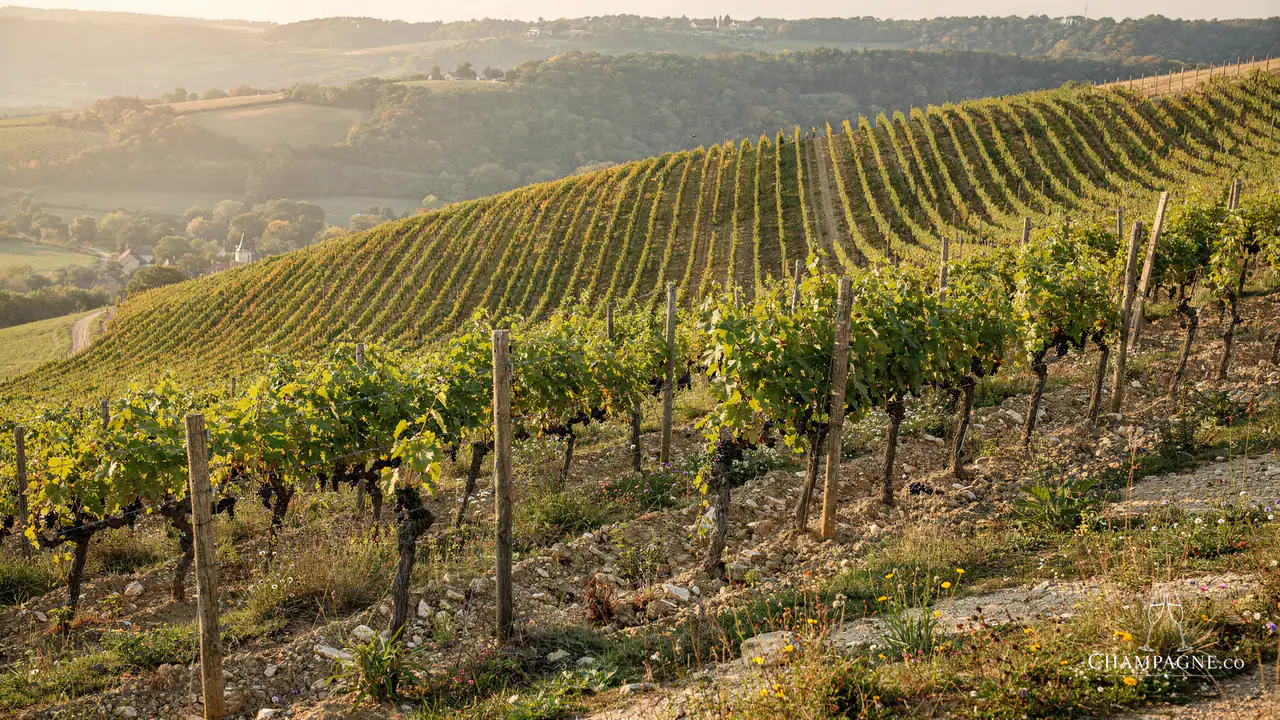
The 15-hectare vineyard is centred on Courteron in the Seine valley, over the Kimmeridgian geology characteristic of this part of the Côte des Bar. Pinot Noir is the dominant grape, with Chardonnay and smaller plantings of Meunier, Pinot Blanc and Pinot Gris broadening the range.
Organic certification covers the whole estate. Biodynamic farming, biodiversity work and agroforestry are central to the current programme rather than isolated experimental parcels.
Champagne.co analysis
Fleury is best understood as a farming-led Côte des Bar estate whose wine range has expanded with its viticultural thinking. The key story is not simply that the vineyard is organic, but that a decision made in 1989 became the platform for later work with biodiversity, forgotten varieties, horse cultivation and lower-intervention cellar methods.
That gives the range two useful reference points. Blanc de Noirs shows the traditional Pinot Noir foundation of Courteron, while wines such as Sonate and Notes Blanches show how the current generation pushes beyond that foundation without abandoning the estate's farming identity.
Buying guidance
Start with Blanc de Noirs for the clearest introduction to Fleury and the Côte des Bar foundation. Choose Fleur de l'Europe for the long-established Brut Nature side of the range.
Look to Sonate for the more experimental, low-intervention expression and Notes Blanches when the interest is in the estate's white-variety programme. For vintage and library bottles, always retain the exact year and release information because Fleury has a long back catalogue and technical details evolve over time.
Loading current Champagne range…
Spotted something wrong? Report a correction
Every report goes to a human review queue. Nothing on this page changes automatically.