Fluteau
Champagne Fluteau is a family producer in Gyé-sur-Seine, in the Côte des Bar. The house was founded in 1935 by Georges Fluteau and Emile Hérard and has remained in family hands through successive generations.
Editorial profile
Champagne Fluteau is a family producer in Gyé-sur-Seine, in the Côte des Bar. The house was founded in 1935 by Georges Fluteau and Emile Hérard and has remained in family hands through successive generations.
The current generation combines long family continuity with a modernised estate structure. Jérémy Fluteau joined after oenology studies in 2008, while Adeline Fluteau and Mathilde Bertillon joined the business in 2022 and now handle administration, communication and commercial relationships.
The estate works only with grapes from its own vineyards. Pinot Noir is the dominant variety, with Chardonnay representing roughly 15% of the vineyard. The domaine has held Haute Valeur Environnementale certification since 2017.
Why this producer matters
Fluteau is a useful example of a Côte des Bar grower that has retained a clearly estate-grown model while developing a surprisingly varied range. The same Pinot Noir-led vineyard base is expressed through multi-vintage blending, long-aged vintage wine, zero-dosage oak élevage, rosé and single-parcel bottling.
The producer also handles the full production chain on site — pressing, vinification, bottling, ageing, riddling, disgorgement and labelling — which gives the family direct control from vineyard to finished bottle.
Vineyards and cellar approach
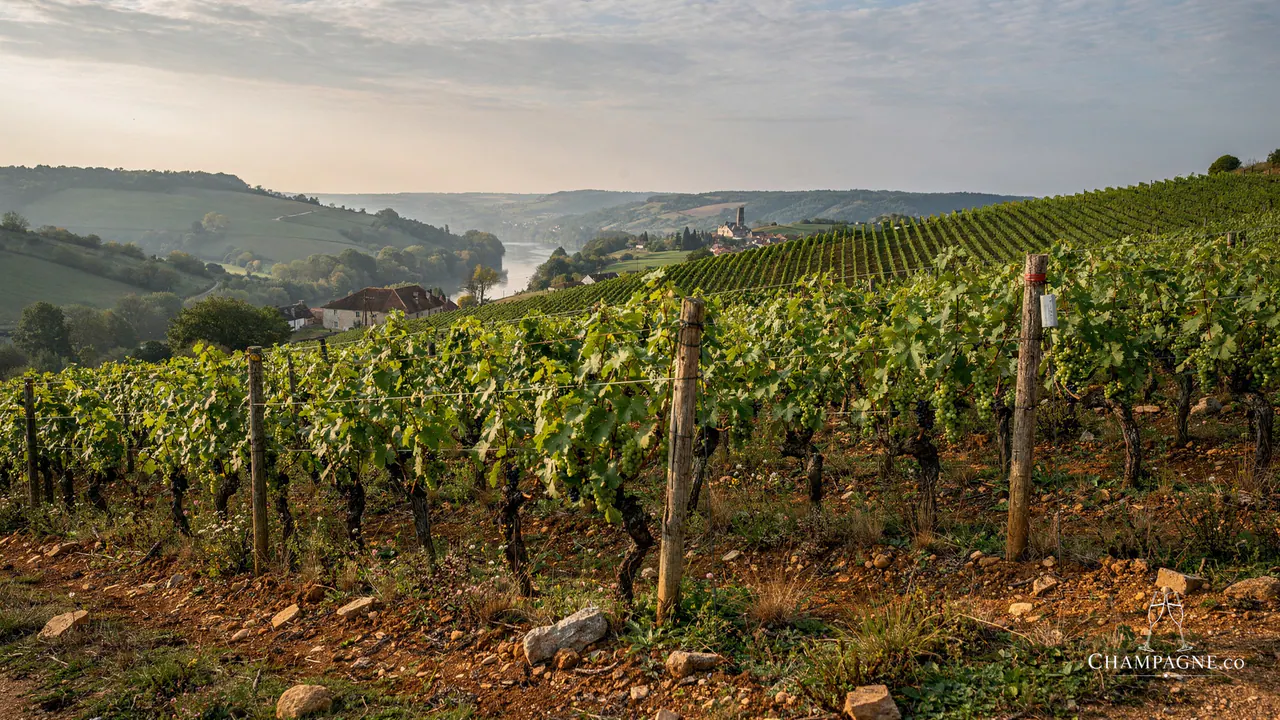
The vineyards lie on slopes along the Seine valley around Gyé-sur-Seine, where Pinot Noir is particularly well suited to the clay-rich soils and cool Côte des Bar climate. Harvesting is manual, and the estate emphasises careful handling so intact bunches reach the press.
In the cellar, temperature-controlled stainless steel is the main tool for the broader range, supported by a substantial reserve-wine collection. Secondary fermentation and ageing take place in underground hillside cellars held at around 14–15°C. The house states that stock rotation is roughly five years, so prolonged bottle ageing is an important feature even before the more specialist cuvées are considered.
Oak is used selectively rather than as the default house method. That distinction matters when comparing the core wines with Retrospective.
Champagne.co analysis
Fluteau is best understood through the contrast between continuity and experimentation. The estate remains firmly rooted in its own Gyé-sur-Seine vineyards and a Pinot Noir-dominant Côte des Bar identity, yet the range is not stylistically narrow.
Symbiose shows what extended ageing can do with an equal Pinot Noir/Chardonnay blend. Retrospective changes the cellar regime through barrel fermentation and zero dosage. Coeur de Cuvée narrows the focus to one old parcel and combines current-harvest fruit with a solera reserve component. Those three wines reveal more about Fluteau than a generic description of a family grower would.
Buying guidance
For the broadest introduction, start with Écho or Écho Rosé. Choose Symbiose for a mature, long-aged vintage expression, Retrospective for the oak-fermented, zero-dosage side of the domaine, and Coeur de Cuvée for the most explicitly parcel-focused Pinot Noir bottling.
Check the exact release on every bottle: blend, reserve proportion, dosage and ageing are deliberately different across the range and should not be treated as permanent house-wide formulas.
Loading current Champagne range…
Spotted something wrong? Report a correction
Every report goes to a human review queue. Nothing on this page changes automatically.