Forget-Chemin
Forget-Chemin is a fourth-generation grower-producer based in Ludes, on the Montagne de Reims. The estate’s present-day identity is unusually broad for a grower of its scale: its 13 hectares are divided among 70 parcels in 11 crus, reaching beyond Ludes…
Editorial profile
Forget-Chemin is a fourth-generation grower-producer based in Ludes, on the Montagne de Reims. The estate’s present-day identity is unusually broad for a grower of its scale: its 13 hectares are divided among 70 parcels in 11 crus, reaching beyond Ludes into the Montagne de Reims, Vallée de la Marne, Vallée de l’Ardre and Massif de Saint-Thierry.
That spread gives Forget-Chemin a useful point of difference. Grand Cru parcels at Mailly-Champagne and Verzenay sit alongside Premier Cru holdings in Ludes, Chigny-les-Roses and Taissy, while further parcels extend through Vandières, Verneuil, Mareuil-le-Port, Treslon, Faverolles and Pevy. The result is not a single-village story but a family domaine built around multiple sectors of Champagne.
Why this producer matters
Forget-Chemin combines the continuity of a family grower with a vineyard base that is geographically diverse. The Forget-Chemin name dates from the marriage of Edmond Forget and Denise Chemin in 1959, while the family’s own cellar and press at the present Ludes address go back to Paul Forget’s establishment there in 1945. Thierry Forget has directed the estate since 1991, following earlier generations of the family.
The domaine also has a long association with the Club Trésors de Champagne, which it joined in 1973. Its current range therefore moves between accessible non-vintage bottlings, family-named cuvées and a vintage Spécial Club wine.
Vineyard and terroir
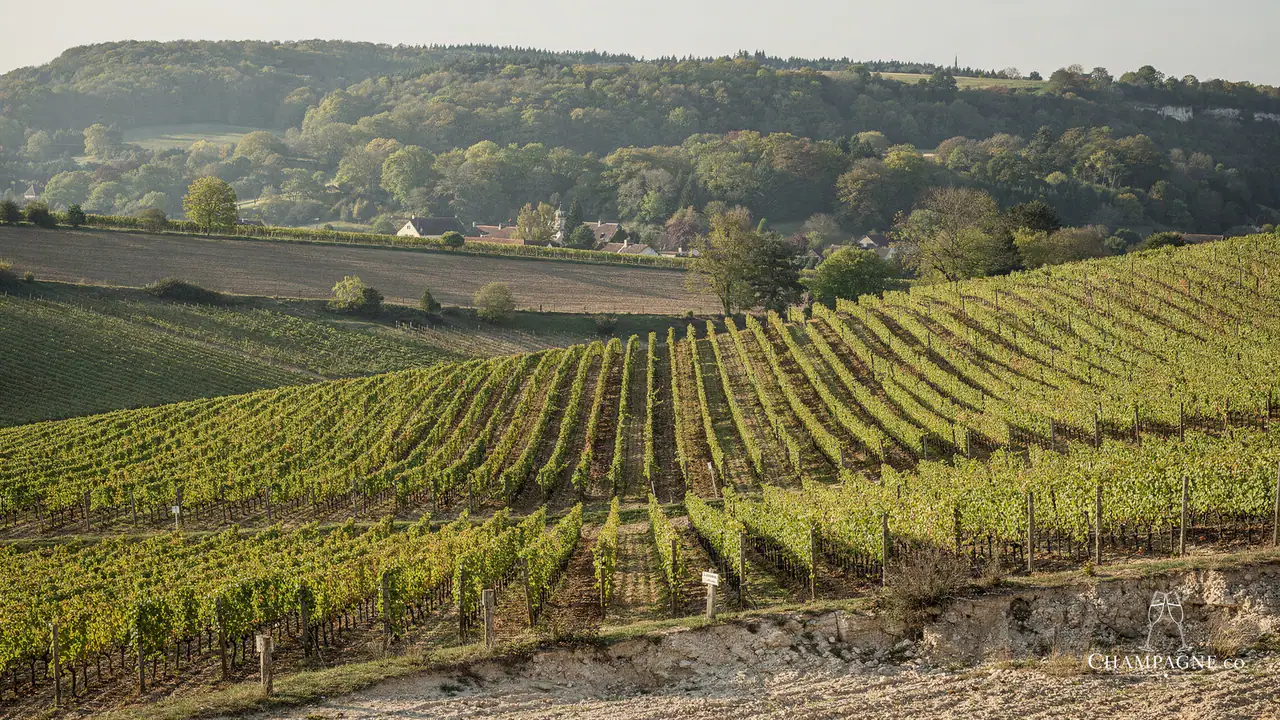
The current vineyard comprises 13 hectares across 70 parcels and 11 crus. The three principal Champagne varieties are all represented, with the producer associating Meunier particularly with its Vallée de l’Ardre and Vallée de la Marne sites, Chardonnay chiefly with Ludes, and Pinot Noir with Mailly-Champagne and Verzenay.
The vineyard map spans several soil contexts rather than one uniform terroir: chalk on the Montagne de Reims, calcareous sand in the Massif de Saint-Thierry, and marl and clay in the valleys. That diversity is central to understanding the domaine’s range and gives its blending programme access to contrasting sectors of Champagne.
Forget-Chemin obtained HVE level 3 certification in 2014 and Viticulture Durable en Champagne certification in 2017. The estate is also experimenting with Voltis, having planted an experimental parcel at Ludes in 2024 as part of Champagne’s work with disease-resistant varieties.
Cellar and winemaking
Forget-Chemin identifies itself as a récoltant-manipulant and states that its wines are produced through the estate’s own cellar operations from harvest through bottling. The winery was expanded and modernised in the early 2000s, including its pressing facilities.
Technical details vary by cuvée and edition, so they are most useful when read at release level rather than treated as permanent house rules. Héritage Paul Forget is a clear example: the producer presents it as an edition-based wine whose composition may change from one release to the next.
Champagne.co analysis
Forget-Chemin is most interesting not because it fits neatly into one fashionable grower category, but because it combines a traditional family structure with a genuinely dispersed parcel base. Ludes is the centre of gravity, yet the estate draws on four distinct Champagne sectors and both Grand Cru and Premier Cru villages. That makes the vineyard map itself one of the best ways to understand the producer.
The range also rewards separating enduring house identity from release-specific detail. The Carte Blanche wines provide continuity, while Héritage and Spécial Club are better approached as changing or vintage-specific expressions rather than fixed recipes.
Buying guidance
For a first look at Forget-Chemin, the Carte Blanche wines provide the clearest route into the estate’s regular style, with dosage level offering a practical way to choose between them. Buyers looking for a more particular expression should consider Héritage Paul Forget by edition, checking the exact release details rather than relying on specifications from an earlier number. Spécial Club is the more explicitly vintage-led option and should likewise be assessed by the vintage currently on sale.
Because the producer’s range includes both recurring and edition-specific wines, the bottle or current release page is the safest reference for blend and technical details when purchasing.
Loading current Champagne range…
Spotted something wrong? Report a correction
Every report goes to a human review queue. Nothing on this page changes automatically.