Franck Bonville
Franck Bonville is a family grower based in Avize, at the heart of the Côte des Blancs, with a vineyard devoted entirely to Chardonnay. The estate currently reports 15 hectares and holdings across Cramant, Avize, Oger and Le Mesnil-sur-Oger, giving it a…
Editorial profile
Franck Bonville is a family grower based in Avize, at the heart of the Côte des Blancs, with a vineyard devoted entirely to Chardonnay. The estate currently reports 15 hectares and holdings across Cramant, Avize, Oger and Le Mesnil-sur-Oger, giving it a concentrated view of four of the Côte des Blancs’ most important Chardonnay villages.
The domaine is now led by Olivier Bonville and his son-in-law Ferdinand Ruelle-Dudel. Grapes are pressed and vinified in Avize, and the estate retains the récoltant-manipulant model from vineyard work through ageing, disgorgement and commercialisation.
Why this producer matters
Franck Bonville is a useful reference point for understanding how one family can interpret the Côte des Blancs at several scales. The range begins with blended Grand Cru Blanc de Blancs, then moves toward vintage wines, individual parcels and a village trilogy that separates Avize, Oger and Le Mesnil-sur-Oger.
The family has worked in Champagne for four generations. Franck Bonville, Olivier’s grandfather, structured the modern vineyard in the 1950s, and the current generation continues to build the range around Chardonnay, chalk and geographical identity.
Vineyard and terroir
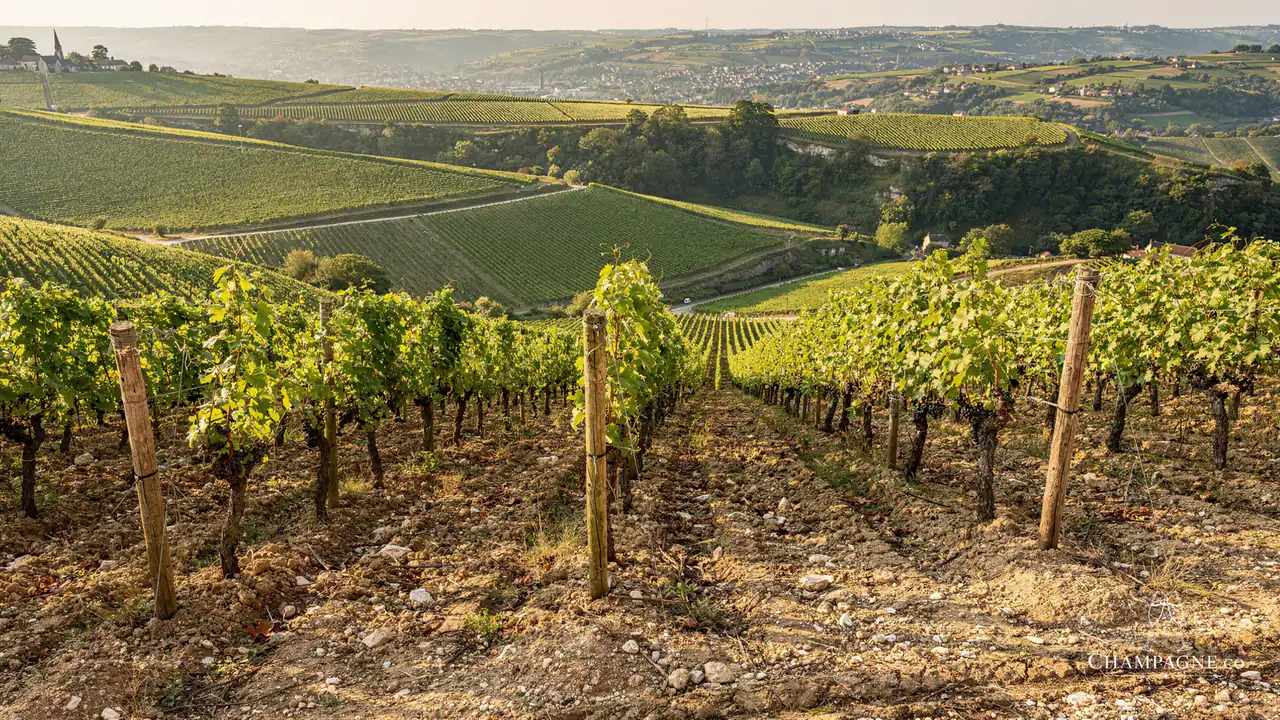
The vineyard is entirely planted to Chardonnay and extends across Cramant, Avize, Oger and Le Mesnil-sur-Oger. Avize is the largest part of the holding, while the estate also works parcels in neighbouring crus along the east- and south-east-facing Côte des Blancs.
Chalk is the central geological reference, but the producer emphasises that slope position, orientation, chalk depth and overlying material vary from parcel to parcel. That variation is important to the domaine’s approach: Bonville does not treat the Côte des Blancs as a single uniform terroir, and its village and parcel wines are designed to make those distinctions visible.
Cellar and winemaking
Stainless steel is the principal fermentation vessel and an important part of the house style, although barrels and demi-muids are also used for selected wines. The producer states that malolactic fermentation is systematically completed across its Chardonnays.
The range is built around both blending and geographical separation. Reserve wines contribute to the non-vintage Brut, while certain cuvées are defined by a single year, a single parcel or a selection of parcels from one village. Technical details therefore need to remain tied to the exact wine and release rather than being generalised across the domaine.
Champagne.co analysis
Franck Bonville’s strength is clarity of origin. This is not simply a Chardonnay specialist with a large Côte des Blancs footprint; the range is increasingly organised to show what changes when the same family, grape variety and broad chalk landscape are narrowed from a regional blend to a village or individual parcel.
That makes the producer particularly useful for comparative drinking. The core Brut shows the blending side of the estate, while the Pur wines and Les Belles Voyes move progressively closer to specific places.
Buying guidance
The Brut Grand Cru Blanc de Blancs is the logical starting point for a broad view of the Bonville style. Unisson offers a step toward a more age-shaped expression, while the Pur trilogy is the most direct choice for buyers interested in comparing Avize, Oger and Le Mesnil-sur-Oger within one producer’s range. Les Belles Voyes is the more focused option for a single-parcel interpretation.
For vintage and parcel wines, check the exact current release before relying on vintage, parcel composition, élevage or ageing information from an older bottle.
Loading current Champagne range…
Spotted something wrong? Report a correction
Every report goes to a human review queue. Nothing on this page changes automatically.