Françoise Bedel
Françoise Bedel & Fils is a family grower based in Crouttes-sur-Marne in the western Vallée de la Marne. The estate’s vineyard spreads across Crouttes-sur-Marne, Nanteuil-sur-Marne, Charly-sur-Marne and Villiers-Saint-Denis, with vines aged roughly 30 to…
Editorial profile
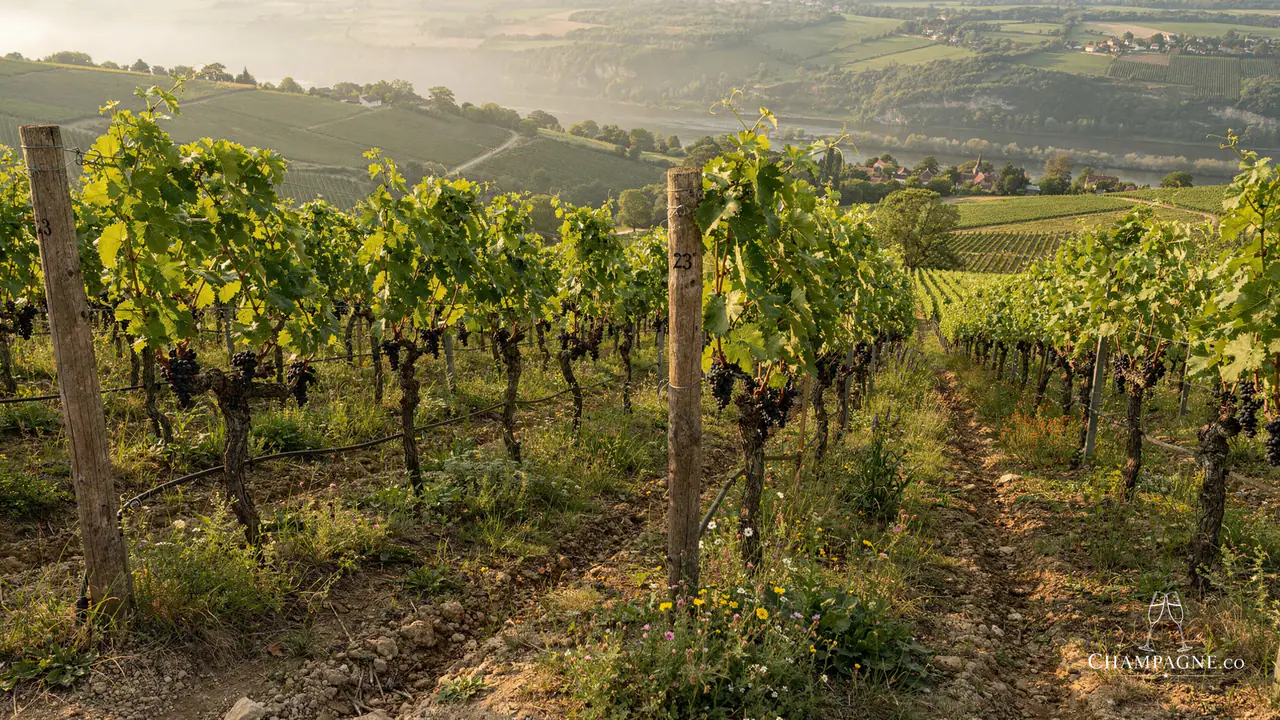
Françoise Bedel & Fils is a family grower based in Crouttes-sur-Marne in the western Vallée de la Marne. The estate’s vineyard spreads across Crouttes-sur-Marne, Nanteuil-sur-Marne, Charly-sur-Marne and Villiers-Saint-Denis, with vines aged roughly 30 to 60 years.
Meunier dominates the vineyard at 79%, supported by 14% Chardonnay and 7% Pinot Noir. The estate states that the whole domaine has been farmed biodynamically since 1998, making its farming history one of the clearest ways to understand the producer.
Why this producer matters
Françoise Bedel is notable for combining a strongly Meunier-led Vallée de la Marne identity with long-established whole-estate biodynamic farming. Françoise Bedel took over part of the family property in 1979, following the first generation represented by Fernand and Marie-Louise Bedel.
The vineyard is not confined to one village or one soil type. Parcels sit on both sides of the Marne, allowing the domaine to work with contrasting subsoils and to build both blended and more terroir-specific cuvées.
Vineyard and terroir
The vineyard is divided among four communes. Crouttes-sur-Marne and Charly-sur-Marne are planted to Meunier and Chardonnay; Nanteuil-sur-Marne includes Meunier and Pinot Noir; and Villiers-Saint-Denis contributes Chardonnay.
The producer describes clay-limestone and calcareous-silt soils across the holdings. That variation, together with the estate’s biodynamic approach, underpins a range in which Meunier remains central without excluding Chardonnay or Pinot Noir.
Cellar and winemaking
The estate records manual harvesting, separate pressing by grape variety, and separation of parcels and lieux-dits in the cellar. Those choices allow the domaine to preserve different components before deciding whether they belong in a blend or a more site-focused wine.
Because the portfolio includes recurring cuvées, vintages and library releases, technical details such as blend, dosage, disgorgement and ageing should always remain attached to the exact bottle in question rather than being treated as permanent estate-wide rules.
Champagne.co analysis
Françoise Bedel is best approached through the relationship between Meunier, biodynamic farming and a geographically spread western Marne vineyard. The estate is frequently described simply as a biodynamic producer, but the more useful point is that the farming philosophy has been applied across a mixed set of villages and soils for decades.
The range also rewards a distinction between the recurring cuvées and the domaine’s older vintage or library wines. The former offer the clearest view of the continuing house identity; the latter show how the estate’s wines are held and released over time.
Buying guidance
Origin’elle, Dis, Vin Secret and Entre Ciel et Terre are the most practical starting points for understanding the current domaine. Buyers interested in mature Champagne can also look to the estate’s vinothèque, but older vintage availability should always be checked directly because library stock changes.
For any bottle, especially a vintage or older release, use the exact release information for blend, dosage, disgorgement and ageing rather than carrying technical data across different years or cuvées.
Loading current Champagne range…
Spotted something wrong? Report a correction
Every report goes to a human review queue. Nothing on this page changes automatically.