Gonet-Médeville
Gonet-Médeville is the Champagne domaine created in Bisseuil in 2000 by Xavier Gonet and Julie Médeville. The partnership joins two wine backgrounds: Xavier comes from the Gonet family of Le Mesnil-sur-Oger, while Julie is part of the Médeville family of…
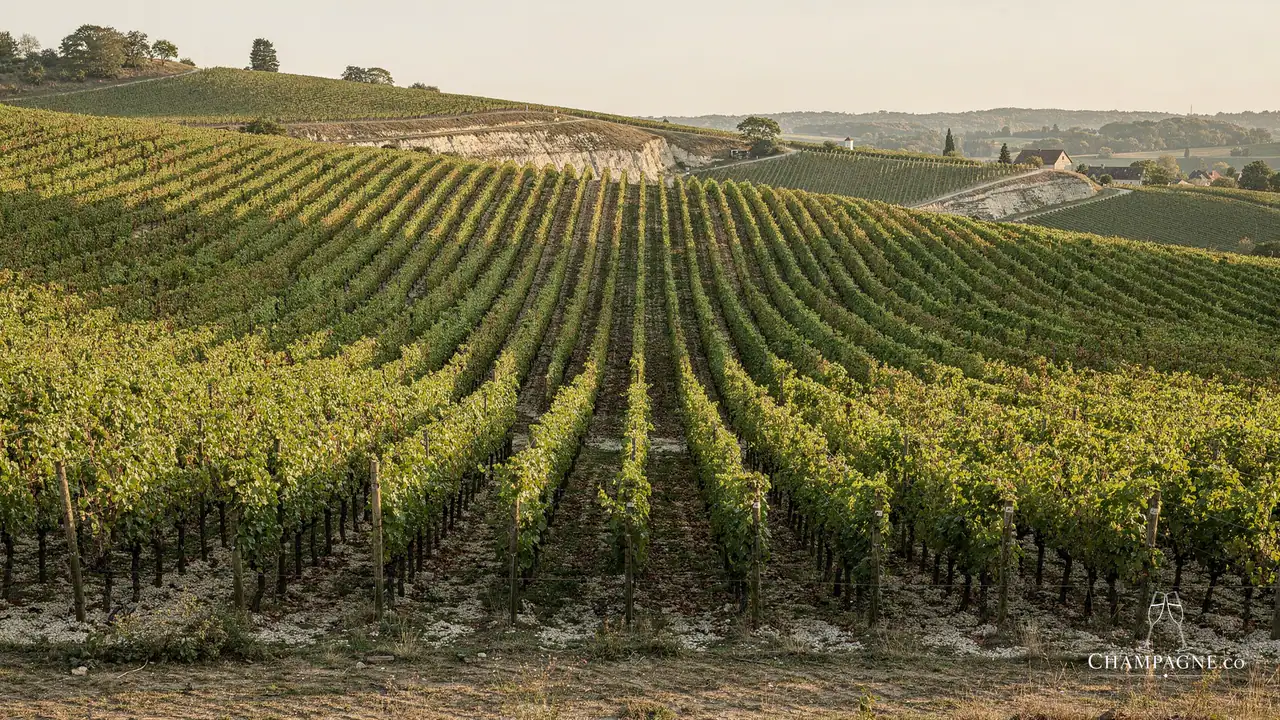
Editorial profile
Gonet-Médeville is the Champagne domaine created in Bisseuil in 2000 by Xavier Gonet and Julie Médeville. The partnership joins two wine backgrounds: Xavier comes from the Gonet family of Le Mesnil-sur-Oger, while Julie is part of the Médeville family of Bordeaux.
The domaine is particularly useful for understanding how one grower can work across several distinct Champagne villages without losing a clear identity. Its own vineyard material lists Grand Cru parcels in Le Mesnil-sur-Oger, Oger and Ambonnay, together with Premier Cru holdings in Bisseuil, Mareuil-sur-Aÿ and Trépail. Chardonnay, Pinot Noir and Meunier therefore enter the range from different sectors and sites rather than from one compact village holding.
Why this producer matters
Gonet-Médeville combines Côte des Blancs Chardonnay, Montagne de Reims Pinot Noir and additional Premier Cru material within a small grower framework, with parcels separated by village and site rather than absorbed into one undifferentiated holding.
That spread gives the range a meaningful internal logic. The entry wines can draw on more than one village, while the producer also has the raw material for more tightly defined expressions.
Vineyards and terroir
The domaine describes its Champagne vineyards as being on notably chalky soils around Épernay. Its Grand Cru holdings include Chardonnay sites at Le Mesnil-sur-Oger and Oger and Pinot Noir sites at Ambonnay. Premier Cru Bisseuil supplies both Chardonnay and Pinot Noir; Mareuil-sur-Aÿ contributes Meunier and Trépail contributes Chardonnay.
This geographic mix matters because Gonet-Médeville is not simply a Bisseuil-only proposition despite being based there. The estate’s identity is better understood as a network of carefully separated Champagne parcels spanning Côte des Blancs and Montagne de Reims territory, with Bisseuil as the operational home.
Winemaking and cellar approach
Current producer technical material shows a recurring use of temperature-controlled tanks alongside older casks, with the balance varying by wine. The Blanc de Noirs technical sheet, for example, specifies a majority of tank vinification with a substantial old-cask component, while the rosé sheet describes vinification in old casks. These are cuvée-specific details rather than a claim that every Gonet-Médeville wine follows one fixed recipe.
The same discipline applies to ageing and dosage. The producer publishes individual technical specifications for particular wines, so figures should be read as specifications of those documented cuvées, not permanent house-wide rules.
Champagne.co analysis
Gonet-Médeville’s interest lies in the contrast between a compact grower identity and a surprisingly broad vineyard map. Bisseuil anchors the domaine, but the wines can move between Chardonnay from the Côte des Blancs, Pinot Noir from Ambonnay and Bisseuil, and Meunier from Mareuil-sur-Aÿ. That makes grape and village origin especially useful when navigating the range.
The cellar information reinforces the same point. Tank and older wood are tools used in different proportions rather than a single stylistic slogan. Readers are therefore better served by following each cuvée’s origin and current technical sheet than by assuming one universal formula across the portfolio.
Buying guidance
For a first look at the producer, Cuvée Tradition offers the broadest view of its multi-village blending. The Blanc de Noirs is the more direct choice for readers specifically interested in Bisseuil Pinot Noir, while the Rosé adds Ambonnay red-wine material to the domaine’s Chardonnay-and-Pinot framework.
Parcel and vintage bottlings are better approached as individual releases: check the exact vineyard or village, vintage and current technical specification rather than extrapolating from an older bottle. That release-by-release approach is particularly important for the domaine's limited site-specific wines.
Loading current Champagne range…
Spotted something wrong? Report a correction
Every report goes to a human review queue. Nothing on this page changes automatically.