Goutorbe-Bouillot
Champagne Goutorbe-Bouillot is a family grower based in Damery in the Vallée de la Marne. The producer's history brings together the Bouillot, Goutorbe and Papleux families, all tied to viticulture in and around Damery. The current family account says…
Editorial profile
Champagne Goutorbe-Bouillot is a family grower based in Damery in the Vallée de la Marne. The producer's history brings together the Bouillot, Goutorbe and Papleux families, all tied to viticulture in and around Damery. The current family account says Dominique, Dominique and their son Bastien work the estate, with Bastien having returned to the family business after experience in the international wine trade and later viticulture-oenology training.
Current authoritative sources differ slightly on vineyard area. The producer's own history states 8 hectares, while the Vignerons Indépendants de Champagne directory lists 9 hectares with a planting mix of roughly 40% Meunier, 35% Chardonnay and 25% Pinot Noir. The safest current description is therefore an estate of about 8–9 hectares rather than forcing one source to overrule the other without further evidence.
Why this producer matters
Goutorbe-Bouillot is particularly distinctive for the way it uses perpetual reserves as a structural part of the range. The house maintains one reserve dating from 1980 and a Chardonnay-focused reserve begun in 2000, turning continuity between harvests into a visible part of the producer's identity rather than a hidden blending tool.
That sits naturally with the estate's Damery base. Meunier remains important, but the current portfolio also gives Chardonnay and Pinot Noir clear standalone roles. The result is a range that moves between Vallée de la Marne blending, chalk-focused Chardonnay and longer-running reserve programmes.
Vineyards and terroir
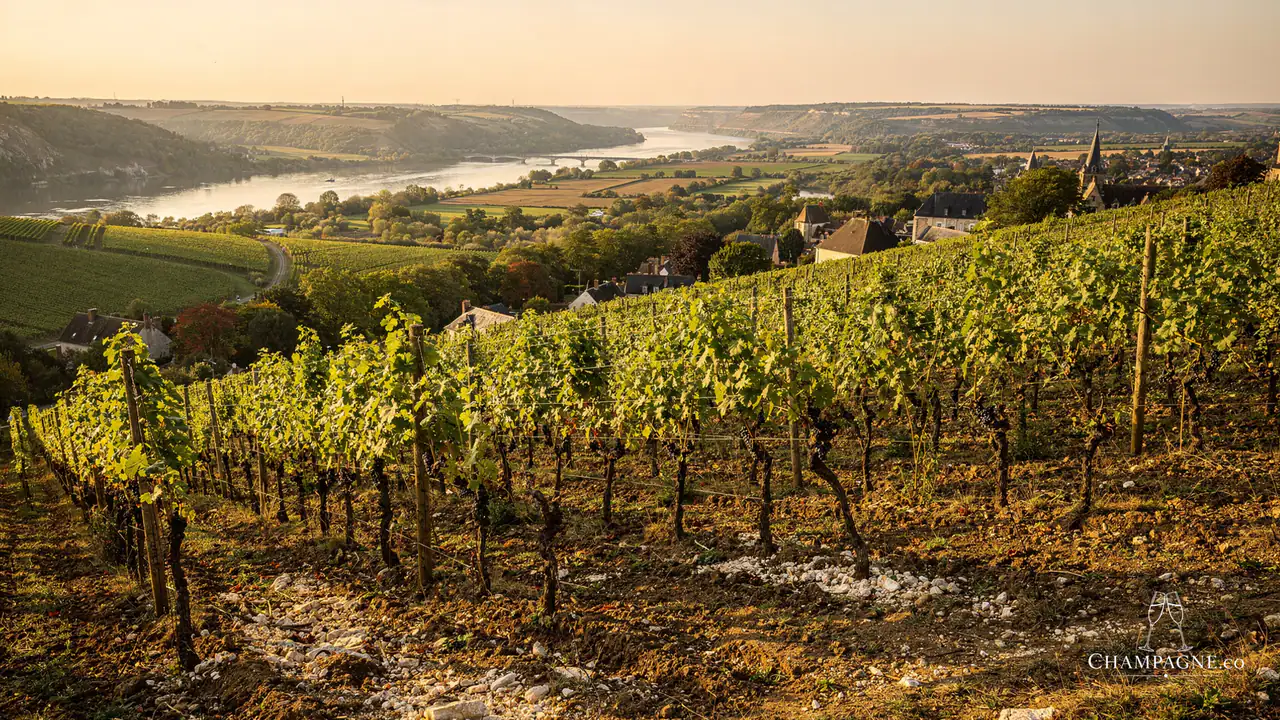
The estate is centred on Damery, with its vineyards reflecting the Vallée de la Marne's mixture of Meunier, Pinot Noir and Chardonnay. The current Vignerons Indépendants directory records the vineyard at 40% Meunier, 35% Chardonnay and 25% Pinot Noir.
Producer material also distinguishes different site types within the holding. Champ de Craie is associated with chalkier Chardonnay parcels, while Noir Coteaux draws attention to Pinot Noir from favourably exposed slopes around Damery and Cumières. These are cuvée-specific expressions of the vineyard rather than evidence that every parcel is bottled separately.
Winemaking and cellar approach
Perpetual reserve is the clearest cellar signature. In the producer's description of Reflets de Rivière, roughly one third of the blend comes from its reserve system, while Champ de Craie and Noir Coteaux are likewise described with a reserve component. Exact proportions remain tied to the documented release and should not be assumed for every future bottling.
The two Rétrospective series make this approach explicit. Rétrospective 80 develops from a reserve maintained since 1980 across successive generations, while Rétrospective 00 applies the same principle specifically to Chardonnay from the Damery slopes beginning with the 2000 harvest.
Champagne.co analysis
Goutorbe-Bouillot's interest lies in the clarity of its internal architecture. The estate does not rely on one grape or one village story alone. Instead, Meunier-led Damery Champagne, chalk-driven Chardonnay, Pinot-Noir-focused cuvées and long-running reserve programmes each occupy recognisable positions.
The perpetual reserves are especially important because they connect family history to current winemaking in a concrete way. Rétrospective 80 and 00 are not simply old wines; they are ongoing blending systems that carry material from earlier harvests into later editions. That makes time itself part of the producer's house style.
Buying guidance
For a first look at the range, Reflets de Rivière gives the broadest introduction to the producer's Vallée de la Marne identity. Champ de Craie foregrounds Chardonnay, while Noir Coteaux foregrounds Pinot Noir.
The Rétrospective wines are the clearest choice for readers specifically interested in perpetual-reserve Champagne. Check the exact edition suffix when comparing releases, because the edition is part of the wine's identity. Vintage wines such as Cuvée Louise B 2016 and Clos des Monnaies 2012 should likewise be treated release by release rather than as evergreen specifications.
Loading current Champagne range…
Spotted something wrong? Report a correction
Every report goes to a human review queue. Nothing on this page changes automatically.