Guy Charlemagne
Guy Charlemagne is a family grower-producer in Le Mesnil-sur-Oger Grand Cru in the Côte des Blancs. The domaine dates its activity in the village to 1892 and records five generations of family continuity. After Gustave, Louis, Guy and Philippe Charlemagne,…
Editorial profile
Guy Charlemagne is a family grower-producer in Le Mesnil-sur-Oger Grand Cru in the Côte des Blancs. The domaine dates its activity in the village to 1892 and records five generations of family continuity. After Gustave, Louis, Guy and Philippe Charlemagne, Justine and Marie Charlemagne now lead the estate.
The producer's current English site describes approximately 12 hectares, primarily in Le Mesnil-sur-Oger, divided among 17 lieux-dits and 29 plots. Its French page gives a lower rounded figure of about ten hectares.
Why this producer matters
Guy Charlemagne is unusually concentrated on one Grand Cru village. Its current estate presentation says the family works mainly in Le Mesnil-sur-Oger and makes Blanc de Blancs Grand Cru Champagne intended to reflect different parts of that terroir.
The vineyard structure supports that approach. The domaine names sites including Les Chétillons, Les Coullemets, Les Hauts Jardins, Les Mussettes, Mont-Joly and Aillerand du Midi, and says its old vines average around 58 years in the current English presentation. That gives the range a clear progression from a multi-parcel non-vintage wine to vintage lieu-dit expressions.
Vineyards and terroir
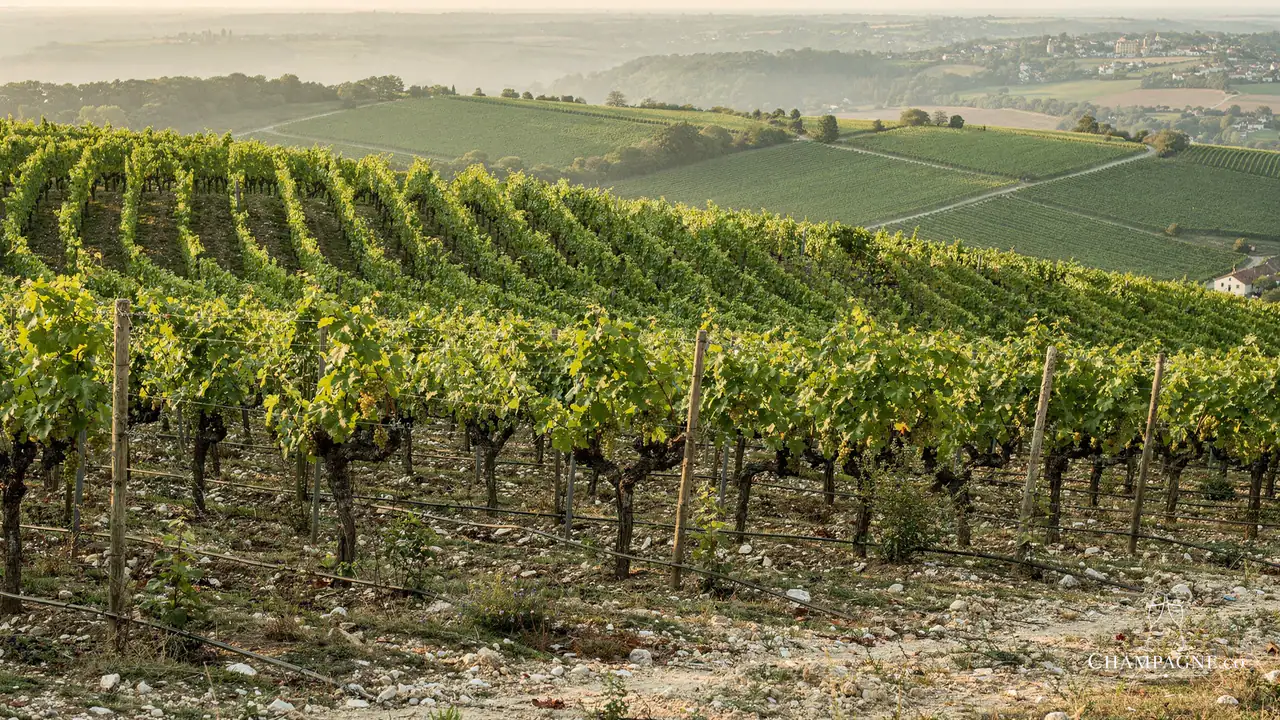
The estate's centre of gravity is firmly Le Mesnil-sur-Oger. Current producer material identifies 17 lieux-dits across 29 parcels and highlights massal selection in older vines. The village's chalk-rich Côte des Blancs setting and the domaine's Chardonnay focus are therefore central to the identity of the wines.
Comité Champagne currently records the producer as Haute Valeur Environnementale, Viticulture Durable en Champagne and Vigneron Indépendant. Those credentials support the current vineyard picture without implying any additional certification beyond what the official directory states.
Winemaking and cellar approach
The domaine presses, vinifies and ages its wines at its historic address in the upper part of Le Mesnil-sur-Oger. Its current range presentation emphasises extended lees ageing for La Grande Réserve and vintage/site specificity for the Mesnillésimes rather than publishing one cellar formula for every wine.
The current public material supports a terroir-led structure, but it does not justify turning one cuvée's technical sheet into a permanent estate-wide recipe.
Champagne.co analysis
Guy Charlemagne is best understood through concentration rather than breadth. The estate's identity is not built around sourcing from many regions of Champagne; it is built around repeated readings of Le Mesnil-sur-Oger Chardonnay.
La Grande Réserve gives the composite view by drawing from multiple plots. The Mesnillésimes then narrow that view to specific sites and vintages. For readers, that makes parcel and release information much more useful than a generic ranking of the wines.
Buying guidance
Start with La Grande Réserve for the clearest overview of Guy Charlemagne's Le Mesnil style. Move to a Mesnillésime when the purpose is to compare a specific lieu-dit or vintage within the same village.
For the Mesnillésimes, always keep the site name and vintage attached to the bottle. These wines are designed around a particular place and year, so technical details from one release should not be carried over to another.
Loading current Champagne range…
Spotted something wrong? Report a correction
Every report goes to a human review queue. Nothing on this page changes automatically.