H. Blin
Champagne H. Blin is a union of winegrowers based in Vincelles in the Vallée de la Marne. It was founded in 1947 at the initiative of Henri Blin and 28 other local growers. The current organisation brings together 115 winegrowers farming about 105 hectares…
Editorial profile
Champagne H. Blin is a union of winegrowers based in Vincelles in the Vallée de la Marne. It was founded in 1947 at the initiative of Henri Blin and 28 other local growers. The current organisation brings together 115 winegrowers farming about 105 hectares in Vincelles and neighbouring villages.
The producer identifies Meunier as its signature grape and the defining variety of the Vincelles terroir. Simon Blin, grandson of Henri Blin, has been president since 2009, while Sébastien Barbier is the current cellar master.
Why this producer matters
H. Blin offers a cooperative perspective on grower Champagne. Its 105-hectare vineyard is not a single-family estate but the combined work of many growers, giving the cellar a broad parcel base within one part of the Vallée de la Marne.
Meunier is the central thread, yet the current range also includes Chardonnay, Pinot Noir and even a 100% Petit Meslier bottling. That makes H. Blin useful for readers who want to see how a Meunier-focused union can use a larger collective vineyard to explore more than one grape or wine style.
Vineyards and terroir
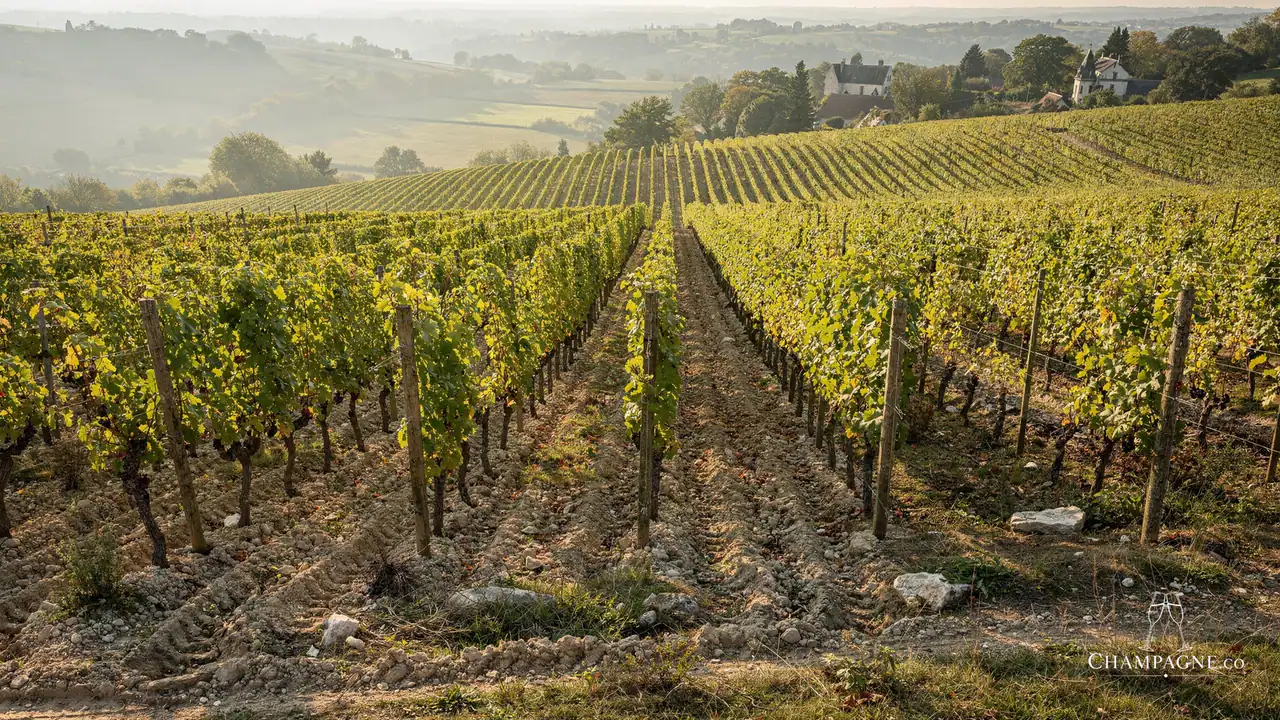
The vineyards are centred on Vincelles and surrounding Vallée de la Marne villages. H. Blin describes the local soils as clay-limestone and the vineyards as benefiting from predominantly south and south-east exposure.
The producer currently states that 80% of its plots are certified VDC or HVE and that 10 hectares are cultivated organically. Comité Champagne independently lists organic farming, Haute Valeur Environnementale and Viticulture Durable credentials. These figures describe a collective vineyard and should not be read as if one family owned or farmed all 105 hectares.
Winemaking and cellar approach
Sébastien Barbier leads the cellar, with Meunier as a particular focus. Since May 2025, H. Blin has added a parcel-focused micro-winery combining small stainless-steel vats with a barrel cellar. The producer says the oak vessels are made from trees from the Vincelles forest and are used selectively rather than across every wine.
That development adds a more granular, parcel-led tool to a cellar built around collective blending. Exact oak use, dosage, vintage and ageing therefore remain cuvée-specific rather than house-wide rules.
Champagne.co analysis
H. Blin's defining feature is the relationship between collective scale and local focus. More than a hundred growers contribute to a vineyard of roughly 105 hectares, yet the organisation presents Vincelles and Meunier as a coherent centre of gravity rather than dissolving the wines into a generic regional blend.
The 2025 micro-winery is an important evolution because it creates more scope to isolate parcels and selected oak treatments inside that larger cooperative structure. The range therefore spans both classic union blending and increasingly specific small-lot work.
Buying guidance
Start with Brut Tradition for the broadest view of H. Blin, or choose Blanc de Noirs if the producer's Meunier-led identity is the main attraction. The organic Blanc de Blancs and Blanc de Noirs are useful for readers specifically seeking wines from the certified-organic part of the vineyard base.
For more unusual bottles, look for the 100% Petit Meslier. Treat vintage-labelled wines such as Millésime 2018, Blanc de Noirs 2016 and Rosé de Saignée 2018 as exact releases and verify the current vintage when buying.
Loading current Champagne range…
Spotted something wrong? Report a correction
Every report goes to a human review queue. Nothing on this page changes automatically.