Hervieux-Dumez
Hervieux-Dumez is a family grower-producer based in Sacy Premier Cru on the Montagne de Reims. The domaine traces its Champagne identity to Henri Hervieux and Juliette Dumez, who married in 1920 and created Champagne Hervieux-Dumez. The current family team…
Editorial profile
Hervieux-Dumez is a family grower-producer based in Sacy Premier Cru on the Montagne de Reims. The domaine traces its Champagne identity to Henri Hervieux and Juliette Dumez, who married in 1920 and created Champagne Hervieux-Dumez. The current family team is Laurent, Clément and Timothée, continuing four generations of winegrowing.
The producer works across roughly 50 parcels in Sacy, Ecueil and Chamery, all Premier Cru villages. It identifies itself as a récoltant-manipulant and says its Champagnes are made from grapes harvested from its own parcels, giving the range a clear estate-grown foundation.
Why this producer matters
Hervieux-Dumez is useful for the way one Premier Cru domaine uses a relatively fragmented vineyard to build several kinds of wine. The current portfolio moves from three-grape blends through single-variety Chardonnay and Pinot Noir to oak-aged and vintage prestige cuvées.
The producer has also been a member of Club Trésors de Champagne since 1971, giving it access to the Spécial Club category. That adds a separately selected vintage expression to a range that already makes reserve wine, grape variety and cellar treatment easy to compare.
Vineyards and terroir
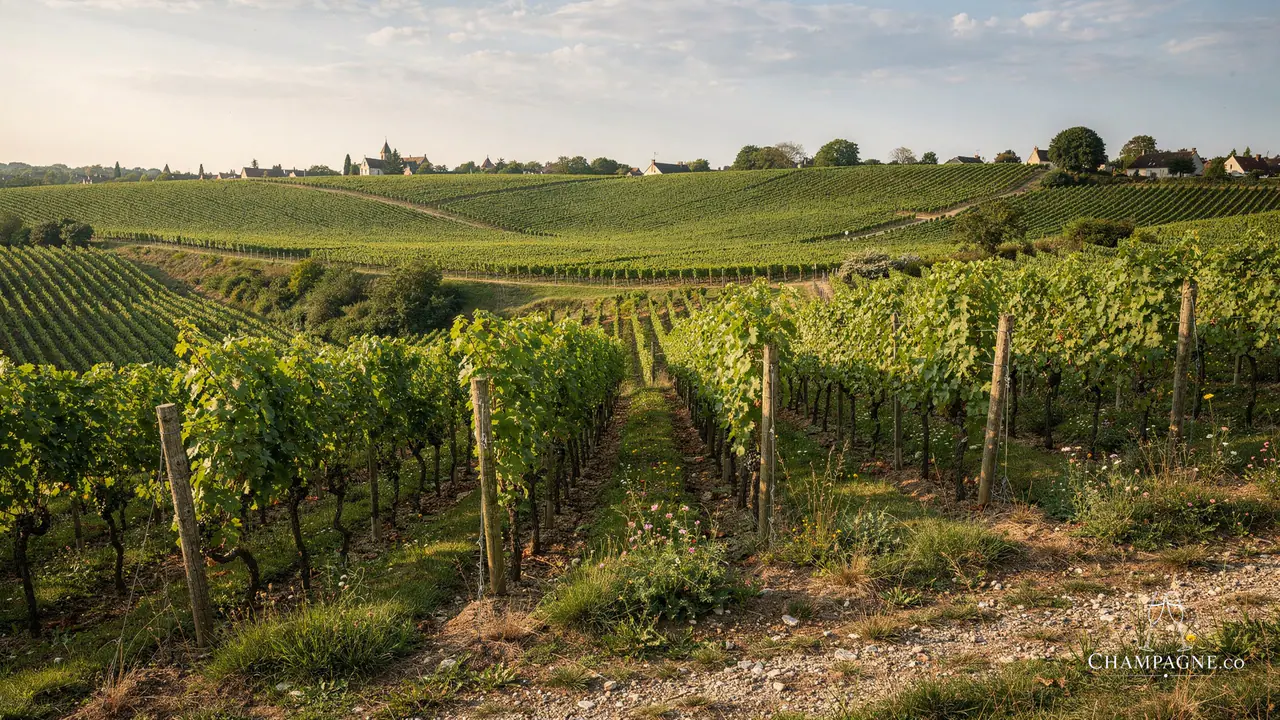
The domaine's approximately 50 parcels are spread across Sacy, Ecueil and Chamery. Its current terroir page describes a mix of clay-limestone, silt and sandy soils, rather than presenting the holding as geologically uniform.
That parcel diversity is reflected in the cuvées. Brut Réserve currently draws from Sacy, Chamery, Ecueil and Villedommange, while Les Grains Blancs is Chardonnay from Sacy and Chamery.
Winemaking and cellar approach
Hervieux-Dumez says it manages the full winemaking process at the domaine. Stainless steel provides the principal cellar framework, while selected wines use reserve material or oak. The range therefore does not follow one single vessel or ageing recipe.
Brut Réserve currently contains at least 50% reserve wine. La Vieille Cave is aged for one year in oak foudre, while Spécial Club is a vintage wine subject to the Club Trésors selection process. Blend, reserve percentage, dosage, vessel and vintage remain tied to the exact release.
Champagne.co analysis
Hervieux-Dumez is best understood through comparison within one estate. Brut Tradition establishes the three-grape baseline; Brut Réserve increases the role of older reserve material; Les Grains Blancs and Les Grains Noirs isolate grape variety; La Vieille Cave introduces a defined oak treatment; and Spécial Club adds the vintage-selection framework.
That progression makes the range particularly informative without requiring a simple quality hierarchy. The same family vineyard can be read through blend, variety, reserve strategy, vessel and vintage, with each cuvée changing one or more of those variables.
Buying guidance
Start with Brut Réserve for the most useful view of the house's blended and reserve-wine identity. Choose Les Grains Blancs for Chardonnay or Les Grains Noirs for Pinot Noir when grape variety is the main point of comparison.
Look to La Vieille Cave for the domaine's oak-led expression and Spécial Club for the vintage prestige tier. Keep exact vintage, dosage and blend information attached to the bottle being purchased, particularly for Spécial Club and other limited releases.
Loading current Champagne range…
Spotted something wrong? Report a correction
Every report goes to a human review queue. Nothing on this page changes automatically.