Hubert Noiret
Champagne Hubert Noiret is a family grower-producer in Villevenard, in the Coteaux du Petit Morin. The current house dates from 2003, when Nathalie Hubert Noiret and Jean-Michel Noiret brought together two winegrowing family lines under the Hubert Noiret…
Editorial profile
Champagne Hubert Noiret is a family grower-producer in Villevenard, in the Coteaux du Petit Morin. The current house dates from 2003, when Nathalie Hubert Noiret and Jean-Michel Noiret brought together two winegrowing family lines under the Hubert Noiret name. The Hubert side traces its vineyard history to the eighteenth century, while the Noiret family also brought several generations of vineyard experience to the partnership.
The producer is especially useful for understanding the Petit Morin beyond a single house style. Its current range moves from multi-parcel blends to site-specific bottlings built around individual parcels, allowing the wines to be read as a progression from a broader Villevenard expression toward more narrowly defined vineyard material.
Why this producer matters
Hubert Noiret connects long family continuity with a relatively recent producer identity. That distinction matters: the vineyard history is old, but the Champagne Hubert Noiret brand itself was launched in 2003. The range now gives unusual visibility to individual sites around Villevenard and nearby Baye, particularly through Pièce des Aulnes, Clos Prieur and Raisonnance.
The producer has also progressively reworked its viticulture around soil cultivation, cover crops, composted organic matter and low-dose natural materials for vine protection. Local tourism material records a move toward biodynamic practice beginning in 2011. The current producer pages describe practical farming measures rather than relying only on a broad sustainability claim, which gives the profile a firmer factual basis.
Vineyards, soils and farming
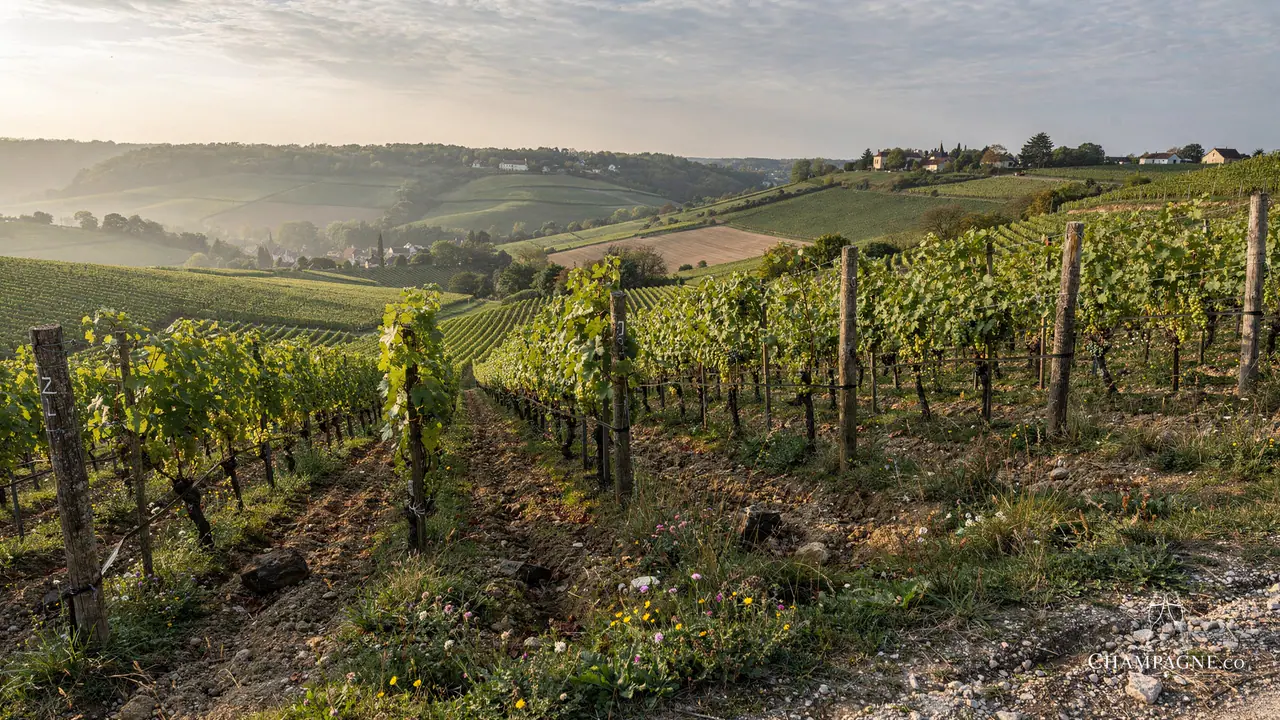
Villevenard sits in the Coteaux du Petit Morin, south-west of the better-known Côte des Blancs axis. Hubert Noiret's own technical pages describe a varied local geology rather than a single uniform soil profile. Cuvée Origines draws on Villevenard parcels with clay-limestone and sandy components over chalk and with black flint present; the current release page gives a south-east exposure. Raisonnance is tied to the Bois de Mallet parcel at Baye, where the producer describes shallow clay-loam soils with small black flints and millstone fragments, on a south-west exposure.
For the parcel wines, the distinctions become more precise. Pièce des Aulnes comes from a south-facing Meunier parcel planted in 1962 on clay-limestone soil. Clos Prieur is a south-facing Chardonnay parcel planted in 1964 on a sandier calcareous soil. The 3 Symboles bottling is associated with the Les Bacons parcel at Villevenard, where the producer describes shallow clay-limestone soil, black flint and chalk beneath.
Across its current technical pages, the estate describes soil cultivation, diverse cover-crop sowing, composted cattle manure and plant-based preparations, decoctions and mineral materials for vine protection. These practices are more informative than a simple farming label because they show how the vineyard programme is being implemented parcel by parcel.
Cellar and winemaking
The cellar approach changes with the role of each cuvée. The current Origines and Raisonnance technical pages describe hand harvesting, automatic pressing and élevage in stainless-steel and concrete vessels. The current Origines page identifies the release as based on the 2022 harvest and gives three to four years of bottle ageing on lees; the Raisonnance page currently describes a 2019-base release with the same stated bottle-ageing range.
The parcel wines move in a different direction. Pièce des Aulnes and Clos Prieur are described as manually harvested and traditionally pressed, with fermentation and élevage in 228- and 300-litre oak barrels. The producer's 3 Symboles page also describes barrel ageing, using 300-litre oak for ten to twelve months on fine lees for the 2013 vintage shown on the current page.
These details are release-specific rather than permanent house specifications. They show that Hubert Noiret uses different vessels and élevage choices according to the cuvée rather than applying one fixed cellar recipe across the range.
Champagne.co analysis
Hubert Noiret is most distinctive when read as a producer using its range to make the Petit Morin legible at different scales. Origines establishes the wider house framework; Raisonnance shifts attention toward a named Baye parcel; Pièce des Aulnes, Clos Prieur and 3 Symboles then isolate specific vineyard material and grape varieties. The value of the range is therefore not just the number of cuvées but the way it moves from blend to parcel, and from multi-variety wines toward Meunier- or Chardonnay-specific expressions.
The vineyard programme reinforces that structure. The estate's own technical material repeatedly returns to soil work, cover crops, compost and low-dose natural preparations, while the parcel pages provide unusually specific information about planting dates, exposures and soil types. Taken together, those facts make Hubert Noiret a useful reference point for readers interested in how a small Petit Morin producer links farming decisions, individual sites and cuvée design.
Buying guidance
For a first look at the producer, Origines is the logical starting point because it shows the multi-parcel, multi-variety foundation of the range. Raisonnance is the next useful step for readers who want to see how the house treats a named site outside the broader Villevenard blend.
The parcel wines then separate the major questions more clearly. Pièce des Aulnes is the direct route into the producer's single-parcel Meunier work, while Clos Prieur provides a Chardonnay-focused counterpart from an old south-facing parcel. 3 Symboles is relevant for readers interested in another Chardonnay parcel and a longer, explicitly documented oak élevage for the 2013 release currently described by the estate.
Because the producer publishes release-level technical information, buyers should check the exact bottle or current technical sheet when dosage, base year, vintage or élevage matters. Those specifications can change from one release to another even when the cuvée name remains the same.
Editorial QA record
Outcome: REMEDIATED — PASS
Fresh research completed against current producer and authoritative material. Public prose is newly written and independently structured. Release-specific blend, dosage, vintage, base-year and élevage information is explicitly bounded to the release documented by the producer. Source URLs, methodology and QA material remain in this internal section and are excluded from consumer publication by the Champagne publication policy.
Loading current Champagne range…
Spotted something wrong? Report a correction
Every report goes to a human review queue. Nothing on this page changes automatically.