Hugues Godmé
Champagne Hugues Godmé is a family producer based in Verzenay on the Montagne de Reims. The estate's current Biodyvin record describes five generations of winegrowing and a vineyard spread across Verzenay and Verzy, both Grand Cru villages, together with…
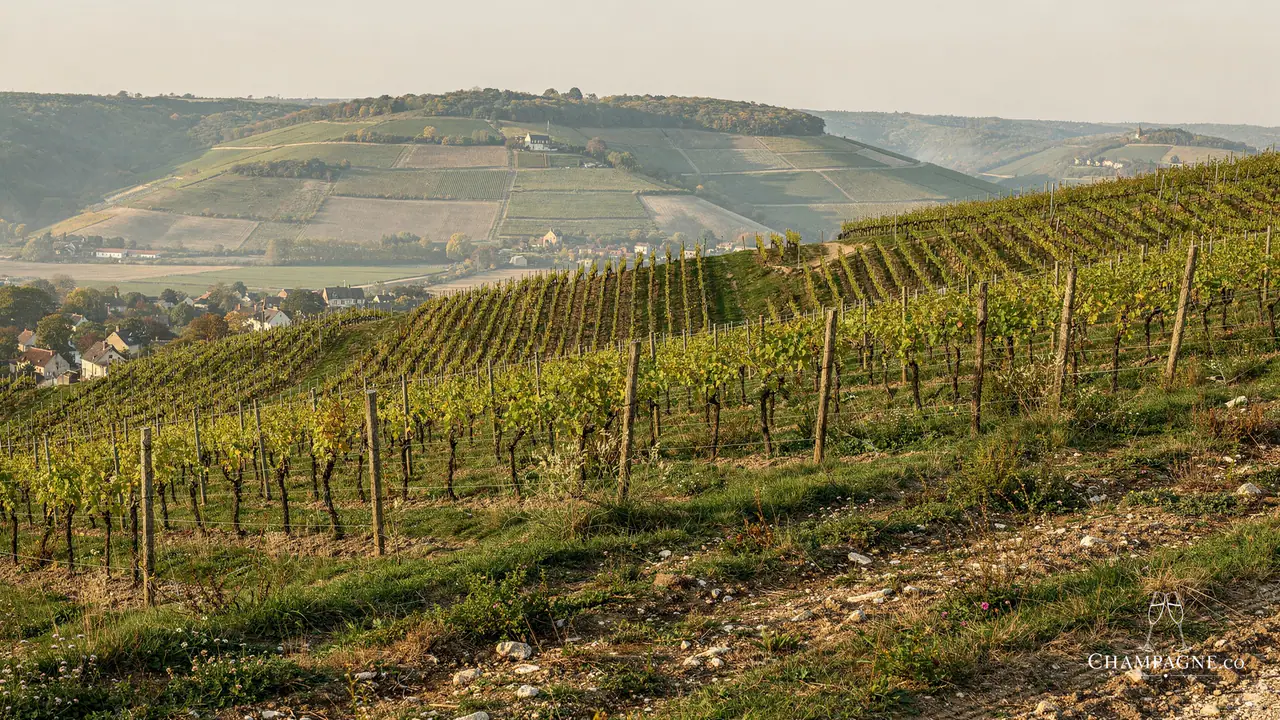
Editorial profile
Champagne Hugues Godmé is a family producer based in Verzenay on the Montagne de Reims. The estate's current Biodyvin record describes five generations of winegrowing and a vineyard spread across Verzenay and Verzy, both Grand Cru villages, together with the Premier Cru villages of Villers-Marmery and Villedommange. Hugues and Dominique Godmé have also been joined by their daughter Lucille, giving the estate a clear multi-generational continuity in both vineyard work and direct production.
The producer's identity is closely tied to certified organic and biodynamic viticulture. The Association des Champagnes Biologiques records the estate's first certified organic harvest in 2013 and states that its certified organic surface covers Chardonnay, Pinot Noir and Meunier. Biodyvin currently lists Champagne Hugues Godmé as a certified member, while Comité Champagne describes the estate's cultivation as biodynamic.
Why this producer matters
Hugues Godmé is significant because the estate combines the classic northern Montagne de Reims villages of Verzenay and Verzy with Chardonnay-bearing sites in Villers-Marmery and additional Premier Cru parcels at Villedommange. That geographic spread gives the producer access to all three principal Champagne varieties and to markedly different exposures and village identities within one compact Montagne de Reims framework.
The farming record is equally important. Godmé's conversion was not a recent marketing overlay: current certification records trace the organic commitment to 2010, the first certified organic harvest to 2013 and the estate's biodynamic certification to the following period. The result is a producer whose vineyard philosophy can be discussed with unusually firm certification evidence rather than with vague sustainability language.
Vineyards and terroir
Biodyvin's current producer record places the estate across Verzenay, Verzy, Villers-Marmery and Villedommange. It also describes roughly eighty separate parcels, ranging widely in vine age. That fragmentation is central to how the estate works: parcels are distinguished by age, exposure, soil and subsoil before harvest rather than being treated as one homogeneous Montagne de Reims holding.
This matters because the four villages do not play the same role. Verzenay and Verzy are core Pinot Noir territory on the northern Montagne, while Villers-Marmery is particularly associated with Chardonnay on the eastern side of the massif. Villedommange adds another Premier Cru component. Godmé's range can therefore move between village blends, grape-focused bottlings and parcel wines without leaving the Montagne de Reims.
Organic and biodynamic farming
The Association des Champagnes Biologiques records 100% of the estate surface in its certification file as organic and identifies Chardonnay, Pinot Noir and Meunier among the certified varieties. Biodyvin separately confirms the producer's current certification under its biodynamic label.
The practical philosophy described by Biodyvin is parcel-led. Vineyard decisions are adapted to season, vine age, exposure and soil, with grapes harvested by hand and sorted before pressing at the estate. The producer's current certification profile therefore supports a stronger statement than simply calling the wines 'natural' or 'sustainable': organic and biodynamic practice is an independently documented part of the estate's farming system.
Cellar and winemaking
Comité Champagne records both traditional vat and oak-barrel use at the estate, and Biodyvin gives more detail on the cellar logic. Godmé favours native yeasts, avoids fining, works with relatively low sulphur and vinifies in small tanks or oak barrels. The current Biodyvin profile also states that the chalk cellars are used for ageing periods ranging from around thirty months to more than ten years depending on the cuvée.
The key point is flexibility rather than one fixed recipe. Each harvest can give rise to several different champagnes, based on one, two or all three principal Champagne varieties and assembled either from a single year or across multiple years. Vintage bottlings are reserved for selected harvests. That structure allows vineyard identity and grape composition to determine the cellar route rather than forcing every wine into the same formula.
Champagne.co analysis
Hugues Godmé is best understood as a Montagne de Reims producer built around controlled fragmentation. Four villages, roughly eighty parcels, three grape varieties and several cellar routes give the estate many possible combinations, but the farming programme creates a common discipline underneath them. The interesting question is therefore not whether one grape or one village defines the house; it is how Godmé separates and recombines those components.
That makes the estate particularly useful for readers who want to understand the Montagne de Reims as more than Pinot Noir from Grand Cru villages. Villers-Marmery brings Chardonnay into the picture, Villedommange broadens the Premier Cru base, and the long-certified biodynamic programme provides a consistent viticultural framework across those sites. The cellar then preserves that differentiation through small-vessel vinification, native yeasts and extended bottle ageing where appropriate.
Buying guidance
For a first bottle, a multi-variety cuvée such as Jardins Premiers / La Réserve is the clearest way to see how the estate combines its different villages and grape varieties. It represents the blended side of the producer before the range narrows toward grape- or parcel-specific wines.
Readers interested in Chardonnay should look for Les Alouettes Saint-Bets, associated with Villers-Marmery. Those wanting the Verzenay Pinot Noir side of the estate should look toward Les Champs Saint-Martin. Older vintages and disgorgements of these wines remain on the market, so the exact release matters: vintage, dosage, disgorgement date and time on lees should always be read from the bottle or current technical information rather than assumed from the cuvée name alone.
Editorial QA record
Outcome: REMEDIATED — PASS
Fresh research completed against current certification bodies, Comité Champagne and the producer's current web presence. Conflicting surface figures in third-party/certification records were not merged or presented as a single vineyard-area claim. Public prose is independently written. Release-specific facts are not generalized across vintages, and internal source/QA material is excluded from consumer publication.
Loading current Champagne range…
Spotted something wrong? Report a correction
Every report goes to a human review queue. Nothing on this page changes automatically.