J Vignier
J. Vignier is a Chardonnay-focused Champagne project built around selected vineyards in the Côte des Blancs and the Coteaux du Sézannais. The producer's current site describes Nathalie and Jean Vignier as the ninth generation of their family and records…
Editorial profile
J. Vignier is a Chardonnay-focused Champagne project built around selected vineyards in the Côte des Blancs and the Coteaux du Sézannais. The producer's current site describes Nathalie and Jean Vignier as the ninth generation of their family and records their collaboration since 2008 with Sebastian Nickel, an oenologist and biologist.
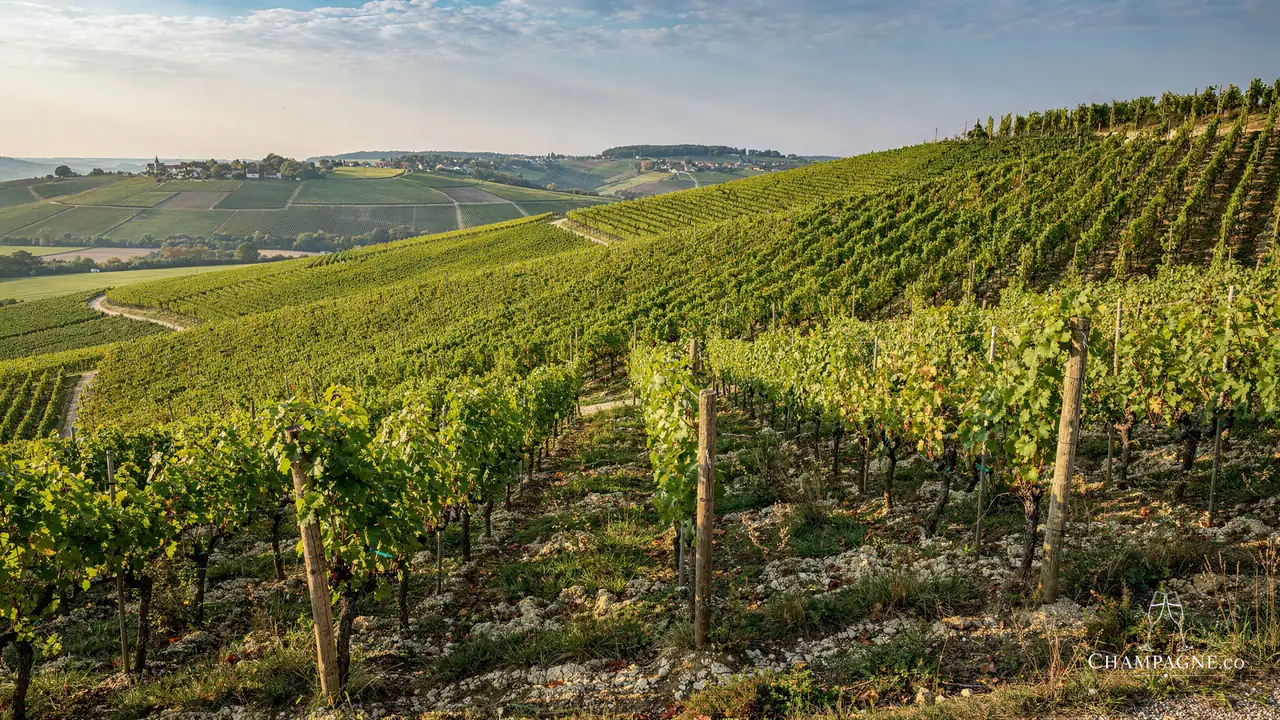
The project is deliberately narrower than a conventional three-grape Champagne house. Its terroir wines are centred on Chardonnay, with fruit from family vineyards including Cramant, Oiry and Chouilly on the Côte des Blancs and vineyards farther south in the Sézannais. This gives J. Vignier a clear editorial subject: one grape interpreted across two distinct southern Champagne landscapes.
Why this producer matters
J. Vignier matters because it uses Chardonnay to compare origins rather than simply to reinforce the prestige of the Côte des Blancs. Grand Cru vineyards in Cramant, Oiry and Chouilly provide one reference point, while the Sézannais supplies another, geographically separate set of soils and exposures.
The current producer material also gives the range a disciplined structure. Wines are organised as Sélections de terroirs, Sélections parcellaires and Cuvées éphémères. That makes provenance and the scale of selection — broader terroir, individual parcel or temporary release — more useful to the reader than a conventional ladder of prestige labels.
Vineyards and terroir
The producer identifies vineyards in Cramant, Oiry and Chouilly, all on the Côte des Blancs, together with holdings in the Coteaux du Sézannais. Chardonnay is the sole grape used for the J. Vignier terroir wines according to the current first-party presentation.
The two areas provide the central contrast in the project. Côte des Blancs sites offer the classic chalk-dominated Grand Cru reference, while the Sézannais lies farther south and provides a different geological and climatic context for Chardonnay. J. Vignier's range is therefore best read through origin: which part of the family vineyard a wine represents, and whether that origin is presented as a regional selection or an individual parcel.
The producer describes a reasoned viticultural approach, fruit from its own selected vineyards, yield control where required and sorting at harvest. These are producer-described practices rather than evidence of organic or biodynamic certification.
Cellar and winemaking
The current producer presentation describes stainless-steel vinification, malolactic fermentation and extended lees ageing, with the wines generally positioned at Extra-Brut dosage. The estate gives an approximate four-to-eight-year range for time on lees depending on cuvée and vintage.
These choices are relevant because they keep the cellar framework comparatively restrained while the vineyard selection does most of the differentiating work. Exact ageing, dosage, vintage and disgorgement remain release-specific and should be read from the current bottle or technical material rather than assumed permanently from the house approach.
Champagne.co analysis
J. Vignier's real distinction is the use of a single grape to make geography visible. Many Chardonnay-led Champagne producers naturally concentrate on the Côte des Blancs; J. Vignier deliberately places that territory beside the Sézannais. The comparison is therefore not Chardonnay versus another variety, but Chardonnay under different geological and regional conditions.
The three-part range structure reinforces that idea. Terroir selections provide the broad view, parcel selections tighten the lens to one site, and ephemeral cuvées allow the project to explore an individual vintage or idea without turning every experiment into a permanent label.
Buying guidance
For a first encounter with J. Vignier, begin with a Sélection de terroirs because it shows the producer's broader regional proposition. A bottle identified with the Sézannais is particularly useful for understanding why this project extends beyond the familiar Côte des Blancs frame.
Move next to a Sélection parcellaire when the aim is to study one vineyard more closely. The parcel name and vintage are essential information here, because these wines are designed around site specificity rather than a standard house blend.
When buying any J. Vignier bottle, check the current label or technical information for vintage, parcel, dosage, disgorgement and ageing because those details belong to the individual release.
Editorial QA record
Outcome: REMEDIATED — PASS
Fresh current research completed. The previous public body contained internal/process language and catalogue cautions, so it was rewritten into reader-facing editorial. Current first-party material supports the project identity and range architecture but does not reliably expose a complete bottle-by-bottle live catalogue. individual names are therefore identified as market-visible releases rather than asserted as a complete permanent range. No certification claim is inferred from the producer's reasoned-viticulture language. Release-specific technical facts remain bounded to the exact bottle.
Loading current Champagne range…
Spotted something wrong? Report a correction
Every report goes to a human review queue. Nothing on this page changes automatically.