Jacques Defrance
Champagne Jacques Defrance is a family producer in Les Riceys, in the Côte des Bar, with a history traced by the family and Comité Champagne to 1867. The current estate presentation identifies Christophe Defrance, his wife Marie-Dominique and their…
Editorial profile
Champagne Jacques Defrance is a family producer in Les Riceys, in the Côte des Bar, with a history traced by the family and Comité Champagne to 1867. The current estate presentation identifies Christophe Defrance, his wife Marie-Dominique and their daughter Anne-Sophie as the family team shaping the domaine today.
The estate's identity is broader than sparkling Champagne alone. Pinot Noir and Chardonnay form the main vineyard base, Pinot Blanc is retained as a distinctive part of the terroir range, and the family also produces Rosé des Riceys, the still appellation for which Les Riceys is famous. Those categories need to remain clearly separated because they express different appellations and winemaking traditions from the same village.
Why this producer matters
Jacques Defrance is valuable for understanding Les Riceys through more than Pinot Noir Champagne. The current range uses Pinot Noir, Chardonnay and Pinot Blanc in separate terroir-focused bottlings, while Rosé des Riceys keeps the village's still-wine tradition visible alongside the sparkling wines.
The estate also has a clearly documented environmental progression. Its current commitment page states Terra Vitis certification since 2017 and HVE III certification more recently. Comité Champagne records the removal of insecticides, anti-botrytis treatments and herbicides from the programme and states that all soils are now cultivated mechanically. These are specific, verifiable practices and certifications rather than a vague sustainability claim.
Family, village and vineyard
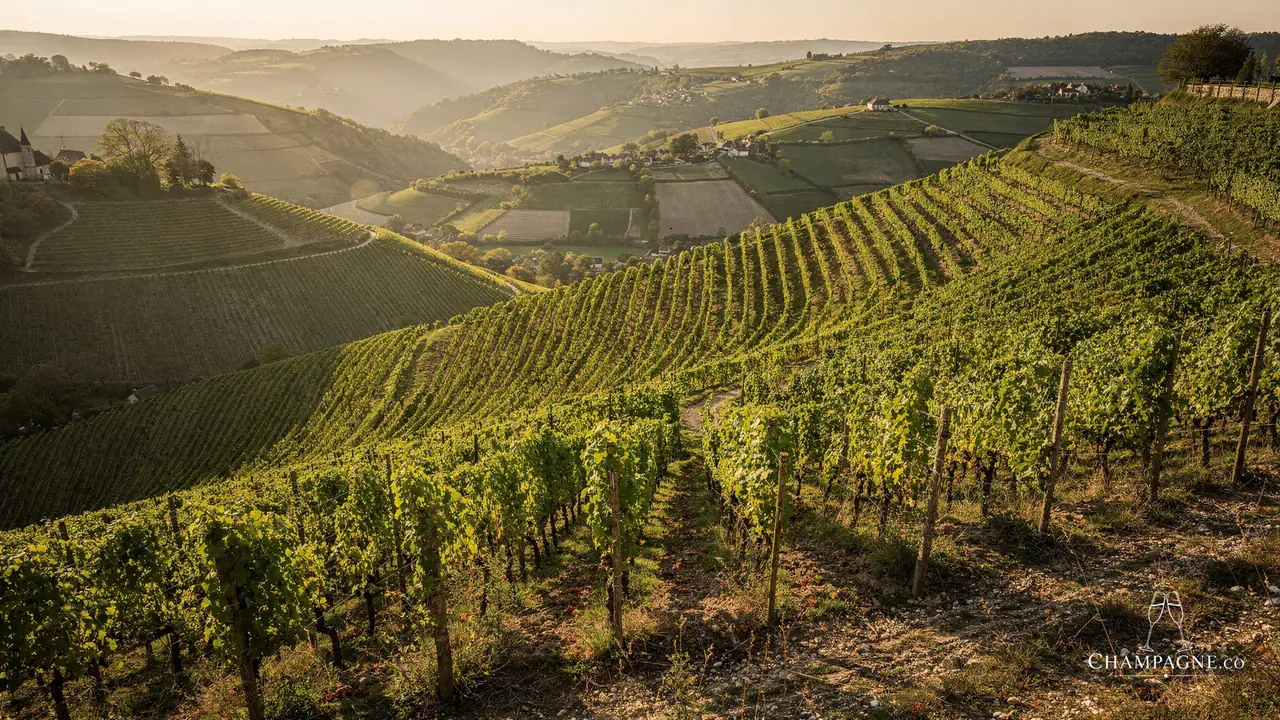
Les Riceys is the anchor of the estate. The family has worked there through four generations since 1867, and current producer material describes Pinot Noir and Chardonnay as the principal varieties. Pinot Blanc, an older Champagne variety with a much smaller regional footprint, is preserved within the Cœur de Terroir range.
This grape diversity is significant because the range uses it explicitly. Pinot Noir underpins the Blanc de Noirs side and the Rosé des Riceys tradition; Chardonnay appears both in blends and as a Blanc de Blancs; Pinot Blanc is given its own cuvée rather than disappearing anonymously into a blend.
Farming and certification
Champagne Jacques Defrance states that it has been Terra Vitis certified since 2017 and is also HVE III certified. The producer says its current farming programme prioritises traceability, soil fertility, biodiversity and reduced intervention.
Those facts support a strong sustainability section without converting Terra Vitis or HVE into an organic or biodynamic claim.
Cellar and range structure
The current producer site organises the wines into several clear families: Cœur de Tradition, Cœur de Terroir, vintage releases and Natives. This is more useful than treating the estate as one generic house style because each family has a different role.
Cœur de Tradition contains the broad estate blends. Cœur de Terroir narrows the range toward grape and village identity. The vintage collection preserves specific harvests over long periods, while the Native wines explore more particular cellar or vineyard ideas, including rosé and perpetual-reserve approaches.
Champagne.co analysis
Jacques Defrance is most interesting when read as a Les Riceys producer preserving several local identities at once. Pinot Noir gives the estate its strongest link to the village, but Chardonnay and Pinot Blanc prevent the range from becoming one-dimensional. Rosé des Riceys adds a still-wine tradition that cannot be understood through Champagne production alone.
The range architecture reinforces that breadth. Tradition wines provide the general introduction; Terroir wines isolate grape varieties; vintages show the role of time; Native wines give the estate room to explore specific techniques such as maceration or perpetual reserve. Taken together, the domaine is less about one signature blend than about using several categories to show what Les Riceys can support.
The environmental programme is also relevant to that interpretation. Mechanical soil cultivation and the elimination of several categories of vineyard inputs give a concrete basis to the estate's sustainability claims, while Terra Vitis and HVE III provide independently recognisable frameworks without implying organic certification.
Buying guidance
For a first bottle, Brut Tradition is the simplest entry into the estate. Brut Nature is useful for readers who want to compare a Pinot Noir-led blend without dosage, while Brut Prestige shifts the focus toward Chardonnay and reserve wine.
To understand the vineyard and grape side more clearly, move to the Cœur de Terroir wines. Extra-Brut Excellence is the direct Pinot Noir route, Brut Terre Blanche the Chardonnay route, and Brut Exception the unusual Pinot Blanc route. Tasting across those three is a more informative way to understand the estate than treating one as a simple quality ranking above another.
Readers interested in Les Riceys specifically should also consider the estate's Rosé des Riceys, while remembering that it is a still wine under a separate appellation. For longer-aged or more specialist Champagne, the exact vintage releases and Native Solera-Brut are the logical places to look. Vintage, dosage, reserve composition and cellar ageing should always be checked against the specific release.
Loading current Champagne range…
Spotted something wrong? Report a correction
Every report goes to a human review queue. Nothing on this page changes automatically.