Jacquinot & Fils
Champagne Jacquinot & Fils is a family house in Épernay with a 17-hectare vineyard and a history that connects estate viticulture with the commercial traditions of the town. Pierre Jacquinot began developing the family vineyard after the First World War,…
Editorial profile
Champagne Jacquinot & Fils is a family house in Épernay with a 17-hectare vineyard and a history that connects estate viticulture with the commercial traditions of the town. Pierre Jacquinot began developing the family vineyard after the First World War, installed his own press in 1929 and, in 1947, founded Champagne Jacquinot & Fils with his sons Jacques and Jean-Guy.
Jean-Manuel Jacquinot, Jean-Guy's son, has been responsible for production since 1998 and now leads the house with François Nicolet. The Union des Maisons de Champagne currently records Jean-Manuel as chairman, managing director, cellar master and oenologist, with François responsible for commercialisation.
Why this producer matters
Jacquinot & Fils is useful for understanding a house that combines its own vineyard base with an Épernay cellar identity. The estate currently grows all three principal Champagne varieties — Chardonnay, Pinot Noir and Meunier — and has built part of its modern range around showing those grapes separately as single-variety wines.
That trilogy gives the house a particularly clear reader route. Blanc de Blancs isolates Chardonnay, Blanc de Noirs isolates Pinot Noir and Blanc de Meuniers isolates Meunier. Beyond them, the range moves into vintage and old-vine selections such as Symphonie and Harmonie, so the portfolio can be understood as a progression from house blend to grape, then to selected vintages and parcels.
Family, vineyard and cellars
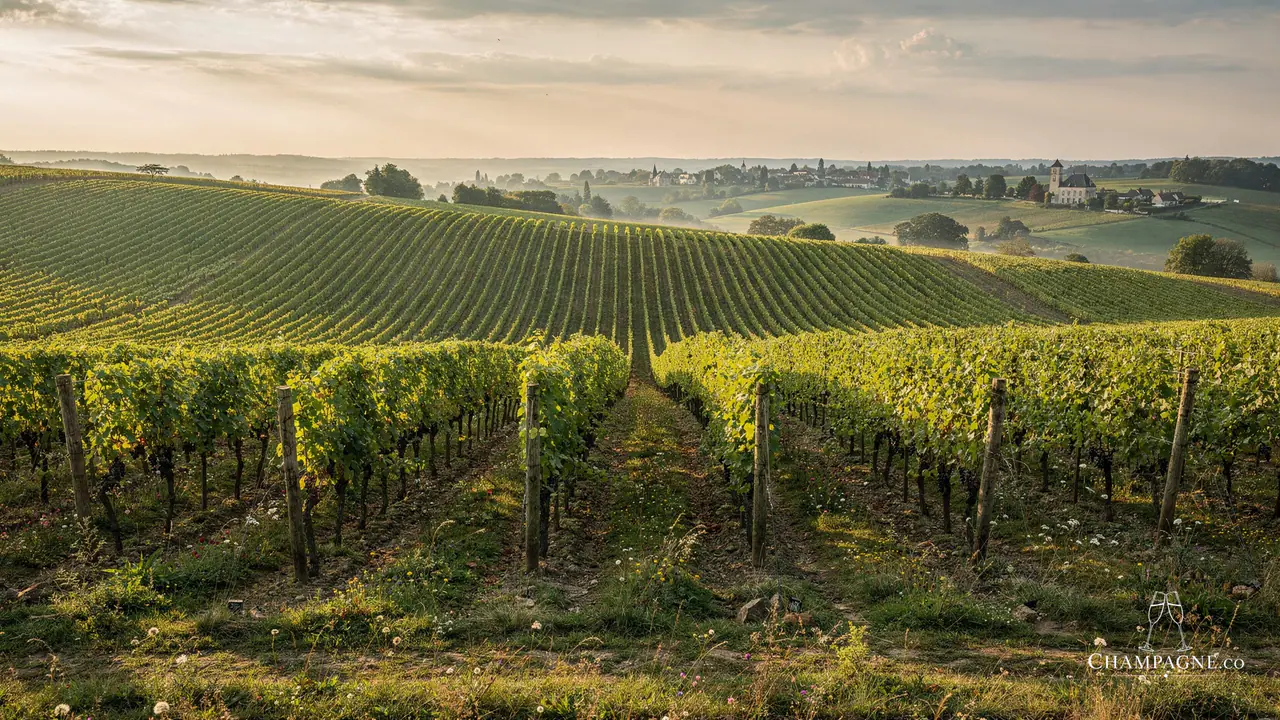
The family estate covers 17 hectares according to both current first-party material and the Union des Maisons de Champagne. The producer says Chardonnay, Pinot Noir and Meunier are all cultivated, resolving an inconsistency in the current Comité Champagne tourism entry, which still summarises the wines as Chardonnay and Pinot Noir only. The live producer catalogue and 100% Meunier bottling provide stronger current evidence for the three-grape vineyard identity.
The Épernay cellars add a separate historical layer. Comité Champagne records them as hand-dug in 1870, around 19 metres below ground, with a stable temperature of approximately 12°C. The family moved its Champagne business into these cellars when Jacquinot & Fils was created in 1947.
The estate describes its farming as viticulture raisonnée. Several current individual wines, including the three single-variety parcel wines and Private Cuvée, are explicitly labelled by the producer as certified Viticulture Durable en Champagne. In the absence of a current source stating that the entire 17-hectare estate carries the certification, the certification is best retained at wine/release level rather than enlarged into an estate-wide claim.
Champagne.co analysis
Jacquinot & Fils is most coherent when the range is read by increasing specificity. Private Cuvée establishes the broad house blend. The three single-variety wines then separate Chardonnay, Pinot Noir and Meunier. Symphonie and Harmonie move toward selected vintages and older vineyard material, while Collection Pierre Jacquinot carries the family-history element into the upper end of the range.
The three-grape parcel trilogy is especially useful because it gives Meunier equal visibility rather than leaving it hidden within a blend.
The house's underground Épernay cellars and 17-hectare estate make it a hybrid in the useful sense of the term: it has the physical and commercial identity of an Épernay maison but a substantial family vineyard from which it can build parcel and single-variety wines.
Buying guidance
For a first bottle, Private Cuvée Brut is the most direct introduction. Readers should note whether the bottle is Brut, Extra-Brut, Brut Nature or Demi-Sec because the producer sells several dosage versions under the same family name.
For a more educational comparison, the Blanc de Blancs, Blanc de Noirs and Blanc de Meuniers form the clearest trio. They allow the three main Champagne grapes to be considered separately within one producer's range, with the Blanc de Blancs and Blanc de Noirs explicitly identified as single-parcel wines and the Meunier completing the same concept.
Move to Symphonie or Harmonie for selected-vintage and old-vine material. Harmonie Blanche is the more explicitly Chardonnay-focused route and includes a documented oak-vinified component. The exact vintage should always be checked on the bottle because the producer itself warns that website photography may show a different year.
For collectors, Blanc de Blancs 70 and Collection Pierre Jacquinot sit outside the basic house-and-grape progression and should be catalogued by exact release rather than treated as fixed technical formulas.
Editorial QA record
Outcome: REMEDIATED — PASS
Fresh research completed against current producer, UMC and Comité Champagne records. The current producer site and live 100% Meunier cuvée resolve the stale external summary that mentions only Chardonnay and Pinot Noir. it has been replaced by reader-facing prose. Viticulture Durable en Champagne is not expanded from certified individual cuvées into an unsupported estate-wide certification statement.
Loading current Champagne range…
Spotted something wrong? Report a correction
Every report goes to a human review queue. Nothing on this page changes automatically.