Janisson-Baradon et Fils
Janisson-Baradon et Fils is a fifth-generation family Champagne producer on the western slopes of Épernay. The house was created in 1922 by Georges Baradon, a remueur, and his son-in-law Maurice Janisson, a cooper, who joined their surnames to establish…
Editorial profile
Janisson-Baradon et Fils is a fifth-generation family Champagne producer on the western slopes of Épernay. The house was created in 1922 by Georges Baradon, a remueur, and his son-in-law Maurice Janisson, a cooper, who joined their surnames to establish the marque. Today the family business is led by brothers Cyril and Maxence Janisson, with Cyril focused on the commercial side and Maxence on vineyard and winemaking work before they come together for blending.
The estate currently describes more than 9 hectares across 18 parcels. Pinot Noir is the largest component at approximately 45% of the surface, followed by Chardonnay at 35% and Meunier at 20%. A separate 40-are parcel also carries four of Champagne's less common permitted varieties: Arbanne, Petit Meslier, Pinot Gris and Pinot Blanc.
Why this producer matters
Janisson-Baradon is particularly useful for understanding the western slopes of Épernay through both blending and parcel wines. The estate's broad range begins with multi-variety house cuvées, but Toulette, Tue Bœuf and Conges isolate Chardonnay, Pinot Noir and Meunier respectively. That gives readers a direct route from the house blend into individual grape-and-site expressions.
The estate also combines a documented low-dosage policy with a relatively varied cellar. Current first-party material states that all cuvées are dosed below 9 g/l and that around half fall into the Brut Nature or Extra-Brut categories. At the same time, reserve wines can be held in wood, the main cellar uses concrete, enamelled steel and stainless steel, and the three parcel wines are partly vinified and raised in small natural-cement ovoïd vats.
Vineyards and terroir
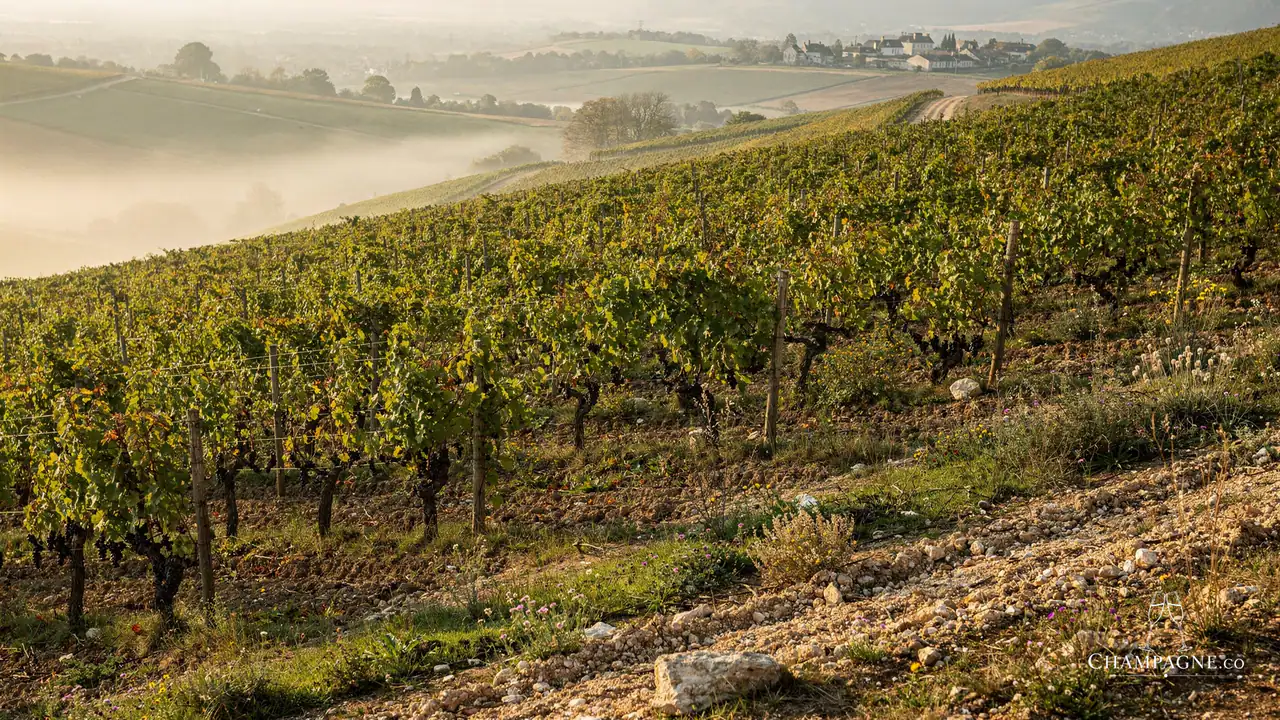
The producer's current terroir page records more than 9 hectares across 18 parcels on the western slopes of Épernay. It describes soils with loam, clay and sand, together with clay and chalk fragments in the coteaux around Épernay.
Pinot Noir occupies around 45% of the vineyard, Chardonnay 35% and Meunier 20%. The additional 40-are parcel planted with Arbanne, Petit Meslier, Pinot Gris and Pinot Blanc broadens the genetic and educational role of the estate beyond the three dominant varieties. The producer has also stated an intention to bring all seven varieties together on the Tue Bœuf parcel as a pedagogical vineyard project.
Three named sites anchor the parcel programme. Toulette, close to the family house, was the first vineyard acquired by the family and is planted with muscaté Chardonnay dating from 1947. Tue Bœuf gives a Pinot Noir cuvée, while Conges gives a Meunier cuvée.
Farming and environmental work
The estate describes its approach as viticulture raisonnée and received HVE level 3 certification in autumn 2017. Current vineyard material records ploughing carried out for nearly two decades, natural grass cover and mating-disruption techniques, with no herbicides or insecticides in the programme described by the producer.
The same page discusses a progressive move toward organic farming, but that ambition should not be converted into an organic-certification claim without a current certifier record. HVE3 is the certification that the producer currently documents directly.
Cellar and winemaking
The cellar programme is more varied than the old profile suggested. Grapes are picked by hand parcel by parcel and pressed in 4,000 kg lots on a pneumatic Bucher press. The producer says it isolates the first ten juices in small stainless-steel vats after pressing in order to assess the character of the harvest and identify potential vintage material, alongside parcels already selected for individual treatment.
The vessel palette includes the original concrete vat room, rebuilt in 2000, enamelled-steel tanks, small stainless-steel vats, a 34-hectolitre foudre, around 80 barrels of 225 litres and three 7-hectolitre natural-cement ovoïd vats. Current first-party material says roughly 30% of reserve wines are stored under wood.
Toulette, Tue Bœuf and Conges are partly vinified and raised in the ovoïd vats. The producer also states that these parcel cuvées are made without malolactic fermentation. Those details belong specifically to the parcel programme and should not be generalized across every wine.
After blending, the house states that bottles spend at least three years in its cellars. Dosage is kept below 9 g/l across the range, with around half of the wines currently falling into Brut Nature or Extra-Brut categories.
Champagne.co analysis
Janisson-Baradon's range makes most sense as a movement from blend to parcel. Brut Tradition establishes the estate-wide three-grape frame. Grande Réserve and Brut Sélection show how reserve wine and wood can change the construction of a blend. The low-dosage wines then shift attention toward dosage choice, while Toulette, Tue Bœuf and Conges isolate grape and site.
The parcel trio is especially instructive because the cellar treatment changes with it. Their partial élevage in small natural-cement ovoïds and the deliberate avoidance of malolactic fermentation are not generic house rules; they are tools used for a more specific part of the range. That distinction is precisely the kind of technical boundary that matters when comparing Champagnes from one producer.
The presence of seven permitted Champagne varieties in the vineyard adds another dimension. The current commercial range remains anchored in the principal three varieties, but the additional 40-are planting shows an estate thinking about grape diversity as part of its longer-term vineyard identity.
Buying guidance
For a first bottle, Brut Tradition is the best starting point because it includes all three principal estate varieties and gives the broadest view of the house.
Move to Grande Réserve or Brut Sélection to explore the role of Chardonnay/Pinot Noir blending and reserve wines aged in oak. The two should be compared through their exact release specifications rather than treated as interchangeable premium labels.
For readers interested in dosage, Non Dosé and Extra-Brut are the obvious routes. For site and grape specificity, Toulette is the clearest current first-party starting point, with Tue Bœuf and Conges relevant when exact current bottles are available and identifiable.
Vintage and historical releases such as Grand Cru 2005 should be bought and catalogued by exact vintage.
Editorial QA record
Outcome: REMEDIATED — PASS
Fresh research completed against current producer-controlled sources. The previous profile understated the range and cellar programme and mixed publication/compliance material into the dossier. The revised public article keeps HVE3 distinct from the estate's stated organic-conversion ambition, distinguishes top-level current navigation from parcel names still documented in the terroir/cellar material, and treats Grand Cru 2005 as an exact vintage rather than a timeless current specification. Dosage, blend, vintage and cellar facts are bounded to the relevant wine or programme.
Loading current Champagne range…
Spotted something wrong? Report a correction
Every report goes to a human review queue. Nothing on this page changes automatically.