JL Vergnon
Champagne JL Vergnon is a Chardonnay specialist based in Le Mesnil-sur-Oger, at the heart of the Côte des Blancs. The domaine’s principal vineyards lie in Le Mesnil-sur-Oger, with additional Grand Cru holdings in Oger and Avize and Premier Cru vines in…
Editorial profile
Champagne JL Vergnon is a Chardonnay specialist based in Le Mesnil-sur-Oger, at the heart of the Côte des Blancs. The domaine’s principal vineyards lie in Le Mesnil-sur-Oger, with additional Grand Cru holdings in Oger and Avize and Premier Cru vines in Vertus and Villeneuve.
The family’s modern Champagne story centres on Jean-Louis Vergnon, whose name remains on the house, followed by Didier Vergnon, who has led the domaine since 1999. A newer generation, including Clément and his partner Charlotte, is now involved in continuing the estate.
Why this producer matters
JL Vergnon provides a particularly clear way to compare Côte des Blancs Chardonnay across several levels of origin. Its range moves from blends of several villages to Premier Cru wines and then to single-village or single-parcel Grand Cru bottlings from Le Mesnil-sur-Oger.
The domaine is also unusually consistent in grape choice: it cultivates Chardonnay exclusively. Differences between the wines therefore come from origin, reserve components, vessel, vintage, ageing and dosage rather than a shift between grape varieties.
Vineyard and terroir
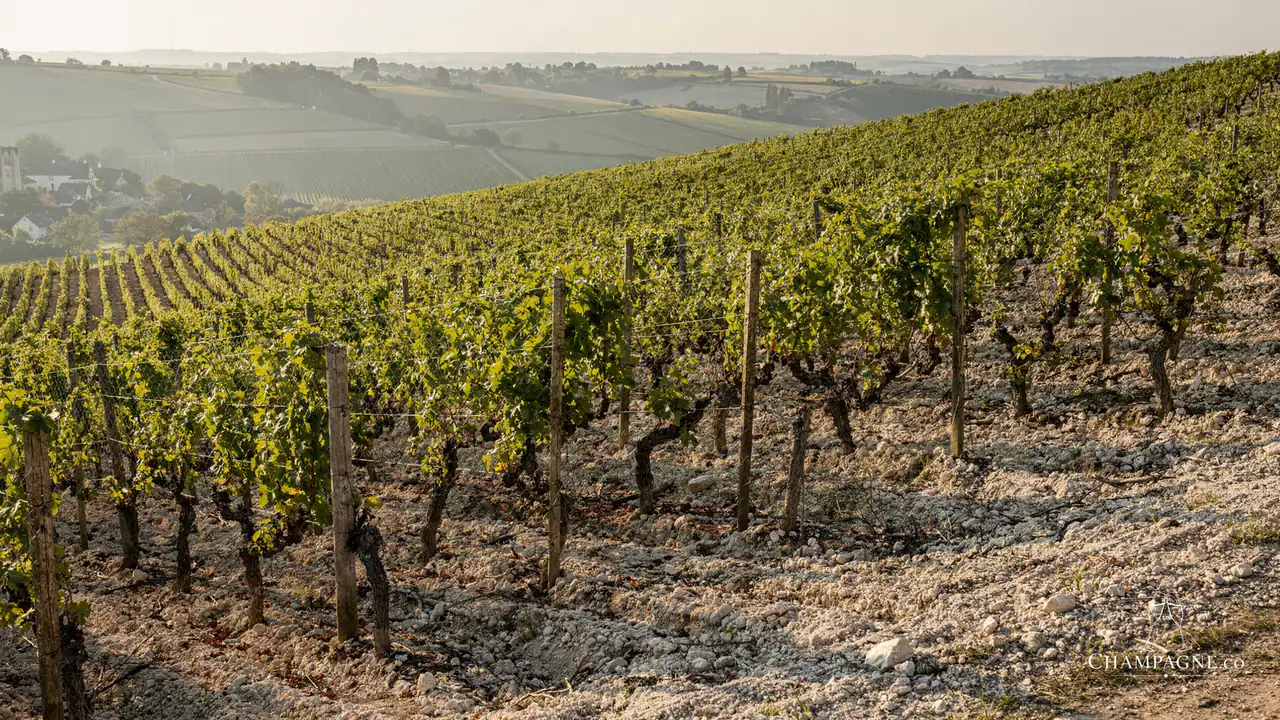
Most of the vineyard lies in Le Mesnil-sur-Oger Grand Cru, with additional parcels in Oger and Avize and Premier Cru holdings in Vertus and Villeneuve. The producer describes around twenty parcels, many planted with older vines and with varied exposures.
The vineyard is HVE level 3 certified. Herbicides have not been used for roughly fifteen years, grass is retained in the parcels and treatments are limited as part of the estate’s current environmental approach.
Cellar and winemaking
Harvesting is manual and grapes are pressed on the day of picking in a traditional vertical press. After settling, the musts are divided between stainless steel and oak depending on the cuvée.
The producer currently states that malolactic fermentation is avoided. Bottle ageing is at least three years, while dosage across the range runs from zero for Brut Nature wines to about 5 g/L for Brut bottlings. Exact vessel, reserve-wine share and ageing remain cuvée-specific.
Champagne.co analysis
JL Vergnon is best understood as a study in Chardonnay and scale. Murmure opens the picture to Premier Cru sites, Conversation and Éloquence blend several Grand Cru villages, and MSNL and Hautes Mottes narrow the focus toward specific Le Mesnil-sur-Oger parcels.
Because the grape variety remains constant, the range makes origin and cellar choices unusually easy to compare. Dosage also provides a clear axis, moving from Brut through Extra-Brut to Brut Nature.
Buying guidance
Conversation is the most straightforward starting point for the Grand Cru house style. Éloquence is the natural comparison if you want a lower-dosage version built from the same three-village framework, while Murmure shifts the origin to Premier Cru fruit and removes dosage entirely.
For the most site-specific wines, look to MSNL and Hautes Mottes and verify the exact vintage before buying. Keep Coteaux Champenois Blanc 2022 distinct as a still Chardonnay rather than a Champagne bottling.
Loading current Champagne range…
Spotted something wrong? Report a correction
Every report goes to a human review queue. Nothing on this page changes automatically.